
I am no expert on cryptocurrency, nor do I pretend to be! if you are looking for so-called Guru on Bitcoin et al, the web seems to be rolling in them and please look elsewhere. Nor, will this stroke, bitcoins and others ego telling you that will for sure go towards the $200,000+ mark and now is a good time to invest.
This will just go over the basic economic principles with my limited knowledge of bitcoin and finance giving rationale on how the retail investor might want to look at cryptocurrency as an investment or in their portfolio. This is not specific advice, please go see an advisor for advice nor is it saying that investing will make you money as this more than any other can lose value as well as gain value. This is all based on my own option please feel free to disagree.
Just looking on my Bloomberg account and an ad popped asking for me to invest in Bitcoin NOW, this is a regular occurrence. Many of the web pages and apps have similar ads. Having seen many people jump on the bandwagon of the crypto express and want to talk to me about Bitcoin et al, or tell me to invest in the last 3 years.
Looking back why wouldn’t they? The value has skyrocketed in most cryptocurrencies in 2021 and is the flavour of conversation for both financial and non-financial professionals, It’s a big business that many are talking about.
The reality is though that people are making lots of money from getting you to invest in these assets, look at some of the biggest IPOs this year, Coinbase springs to mind (2021) and today in the news Milan have dropped their 26-year history sponsorship deal with Pirelli for a Crypto sponsor is evidence of the influence of crypto.
This, however, is just a drop in the ocean as have seen Formula one, NHL, UFC all rack up big sponsorship deals, all wanting you to invest in crypto.
The point is that people will flock to what is making money, so more is advertised and therefore more people will buy. But, what exactly are you buying?
Is this just a fad like we saw in Holland in the 1600s with the Tulips and more recently with the dot com in the 2000s? As people are looking more for a get rich quick scheme or investing due to the fear of missing out. Or are they on to something that could be revolutionary in the blockchain that will change the way payments and assets are transferred?
Like, I said before I am no expert in Cryptocurrency and just look over basic fundamentals
Here is a link below, for anyone that is unsure and wants to get to grip with the basics
“A cryptocurrency is a digital or virtual currency that is secured by cryptography, which makes it nearly impossible to counterfeit or double-spend. Many cryptocurrencies are decentralized networks based on blockchain technology—a distributed ledger enforced by a disparate network of computers.”
What are my thoughts on an investment?
As for an investment, one thing that we can unite about (about the only aspect that does!) is that Cryptocurrency seems to be volatile.
As an example, Bitcoin has price movements ranging from $7,200 at the start of 2020 to $18,353 at the end of the same year while going to a high of $64,000 in April 2021.
What investor’s need to realise is that this isn’t a stock, while a stock might have reported good annual earnings reports or have a new product that is the best in the market and going to sell like hotcakes. Bitcoin, values seem to be based on pure speculation of Internet forums and Influencers tweeting rather than the real intrinsic value of the asset.
I will adhere to the point that many other assets, such as gold are all valued in the same way and so is all currencies and yes, you would be right. It is what people are willing to pay for the asset.
For, me the problem is that it’s based on being a currency and people seem to price this in. While, if you peel back the layers, the price of Bitcoin would make it very unstable as a currency only comparable to Venezuelan Bolivar and don’t see people flocking to own that!
Although, this has major floors on its own, who would want to exchange getting paid in USD for Bitcoin? Not many. It’s too volatile (as seen in figure 1). If you are hypothetically getting paid one bitcoin a year for your work you might be getting $60,000 or $10,000 for your year’s work.
Why, would anyone want to get paid like this not knowing how much purchasing power the currency is going to have. Some stability needs found before it can be used as an asset.

Figure 1 showing the volatility in bitcoin in recent years.
Meanwhile, another major problem is central banks. Now say for a second, that it does catch on as a currency and more people start using it.
Why would any major central banks, let it be used as a currency. They can’t control the money supply nor monetary policies that help to control a country by way of increasing or decreasing the interest rates.
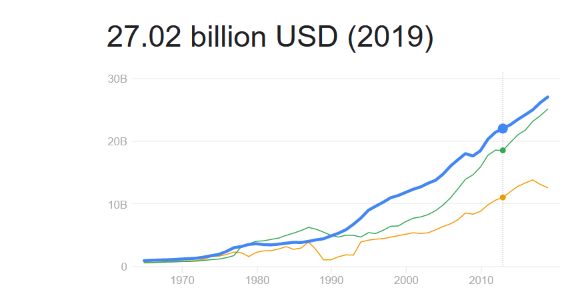
Sceptics might say that well El Salvador is accepting it as a legal currency. But, yet this is a country that has a rather small GDP and fuelled with drug smuggling problems and currency issues. A country that has a GDP less than 0.03% GDP of the world population, is it really a big leap forward?
Do you see the FED, BOE, ECB, BOJ doing the same? If going by the ex-chair of the BOE Andrew Bailey, on Bitcoin, say’s “its days are numbered”. He goes on to say that why wouldn’t central banks use their own crypto assets that the BOE is looking to do and why would it use something as speculative as Bitcoin as a currency.
Andrew Bailey in the money week report does emphasise a point that I am in favour of, he does believe that it has something in the blockchain technology. This might be in the form of ways to implement safety in central banks or private banks for payments security tracking. I agree with this as have seen many central banks such as Malta and Singapore incorporate blockchain technology into their banking systems.
Furthermore, for regulation changes in crypto, the IRS is usually late to the party in taxation due to the amount of time it takes to get regulation in place and pass through congress. If crypto is taxed, this takes one of the main advantages away from the asset in recent years, the benefits from a tax perspective and how much more can the IRS flex regulation to an asset that is used a lot by criminals.
Could we see a 2014 introduction of a system like FATCA, where it could make any U.S connected person holding bitcoin report the asset?
This sounds, obscene but a power such as the U.S has the possibility to do this and why wouldn’t it if a lot of potential Uncles Sams money is going into Bitcoin or using it for illegal activity? Why wouldn’t they want to stop this to gain more taxes and impose more control of illegal activities.
Figures 2 – Showing the size of GDP of El Salvador in 2019 and on the world stage

China unlike the U.S when it wants to impose a law doesn’t have to go through the democratic bureaucracy. China just enforces the law. And it seems to be taking swift action against crypto. China has a problem where people want to get money out of China and RMB before cryptocurrency methods included going to Macau and gambling, eventually turning eye-watering sums of money to USD through casinos (see link below). The Chinese government turned somewhat of a blind eye to this due to the trade it brought to the SAR of Macau. Although, it has not turned a blind eye to crypto, in fact, the opposite.
China, wants the RMB to be a dominant current much like USD or EUR. This can’t happen, without a lot of reserves. This is why it wants people to keep RMB in the country to impose higher reserves and can leverage it more (as well as other policies that it has imposed). With crypto it is very dependent on China’s use, this is a big threat.
As we have seen this year no company, is too big to get away from Chinese regulation, Asians richest man Jack Ma, owner of Alibaba found himself in hot water for not biding by Chinese regulation. In the past it has blocked Facebook, Google and Amazon out of China due to Chinese interest. Sure, they can do the same with Crypto if it deemed to impose such a big threat.
https://online.king.edu/news/psychology-of-fomo/
Final Thoughts
For me, alot of people, either tell you to get in crypto to line their own pockets or fear of missing out.
I get it everyone is looking for a get rich quick scheme right? But, unfortunately these people are the most vulnerable. As these are most likley to put life saving’s into a volatile asset that are most likley not appropriate for their risk profile. Plus all the ads and the crypto gurus (that get paid for you investing in the assets) don’t tell you that a lot of people have lost a lot of money in crypto and most often these are the retail investors.
They get in as they have heard about it from their barber for example or heard that it might be a great investment without too much real background check on the assets. Fear of missing out is great phycology and investing topic which have seen people flock towards new trends and ponzi schemes etc for decades.
For the average investor crypto should be thought of as no more than an asset such as gold or silver and ask yourself; what proportion of your portfolio would I allocate to this? 5-10% max, why not do the same in Crypto or at least maybe looking at split it between the two commodities.
While, I have pointed out the regulatory risks and the fact that it holds no intrinsic value, nor can really be deemed as a currency. One can’t deny its diversification from the more traditional portfolio holdings, that would be equities, property, bonds.
It could be used to split with other commodities in that proportion of your portfolio to diversify risk. In terms, of when to invest and where. I would normally opt for the safe option as a broad ETF and use simple dollar cost averaging in assets that seem to be so volatile.