This is the most common aspect of planning that I talk to my U.K. clients about. There are many questions that surround Inheritance Tax (IHT) as an expat and I will uncover them in this blog.
It doesn’t matter where you live, unlike many other developed nations that don’t have any IHT or have it a lot higher than the U.K, for example, the U.S is currently at $11.7million for the base rate the UK will tax your worldwide assets because it is based on your domicile and not residency.
This is why it is important for proper planning to ensure that wealth can be transferred efficiently for any U.K citizen that is now living abroad.
Why would you want to lower your IHT?
- The higher rate has a 40% tax
- It can get very messy when dealing with probates that have no wills or planning
- You can transfer more wealth to the ones you care about
What is Inheritance Tax (IHT)?
Inheritance tax is the tax paid when you die. It is paid on the wealth that is left behind. The total wealth is liable for U.K. IHT tax.
Inheritance Tax in Britain is the tax paid on the wealth an expat leaves behind when they die. Including, property, savings and possessions.
For example, you live in Asia and you pass away and you have offshore bank accounts, UK savings and property in the UK it is all accounted for in your estate.
The present nil rate band for the U.K rate is £325,000 and this goes up to £500,000 with a prime residence to children. This doubles up if you leave your assets to your spouse. If the spouse is deemed U.K domiciled and has not used their nil-rate band, thus allowing a maximum rate of £1 million.
Nil Rate Band is a set point where the tax begins. It’s currently set at £325,000 anything under that figure won’t be taxed and anything over will be taxed and can increase to 40%.
Example
As an example, Andrew who is 76 and a British citizen is living in Spain with his British wife Mary.
Andrew has a prime residence in the U.K worth £250,000 and assets worth £500,000 he can pass an unlimited amount to Mary tax-free. Andrew dies suddenly of a heart attack and the assets are transferred to Mary. Mary has her own assets of £250,000.
She has two children and has planned in the will that all her assets will pass to her children. When Mary dies, she can give the wealth (totalling £1 million) to her sons providing it is instructed to do so in a will under U.K law.
Tax – The Difference
Tax is important and unlike other types of tax such as CGT and income which is based on residency, IHT is based on Domicile. For example, a U.K expat working in Dubai that invests in Dubai will not pay tax on the gains. This is not the same with IHT as it is based on domicile and it doesn’t matter where you currently reside.
Effectively, if you are deemed domiciled in the UK your IHT will be taxed according to UK laws.
Changing your domicile tax status requires much more than simply showing that you now live abroad, you also have to be able to prove that you have no intention of returning to your original country of residence. You can attempt this in a number of ways, including:
- Relinquishing your UK passport
- Severing all links with social organisations and join new organisations in your country of residence
- Purchase property in your country of residence and selling all your UK based property
- Closing UK bank accounts
- Many more actions
https://www.gov.uk/government/consultations/reforms-to-the-taxation-of-non-domiciles/reforms-to-the-taxation-of-non-domiciles – Details of the changes in taxation for those deemed non-domicile
Domicile Definition – Domicile is the link an individual has with a country – and domicile extends to how that country tax treats their estate on death.
Everyone has a ‘domicile of origin’ at birth.
They can elect a ‘domicile of choice’ when they reach 16 years old, which they can change several times throughout their lifetime.
‘Deemed domicile’ can apply to UK expats who meet two tests:
- Test A is met if someone is born in the UK, has the UK as their domicile of origin and lived in the UK from 2017 to 2018 or later tax years.
- Test B applies to someone who has lived in the UK for 15 out of the previous 20 tax years
‘Domicile of dependency’ may apply to married women with a spouse with UK domicile.
However, as it is the preserve of the UK taxman when it comes to determining whether your country of domicile has changed, this is the least recommended of the two approaches. Of course, you may also then be subject to IHT in your new country of domicile. Before beginning on this path, ensure that you have spoken to an adviser to have all the facts and information.
Some points to make specifically for expats are if you have a foreign spouse unless they are deemed U.K domiciled you can’t double up your U.K IHT, although you might be able to use this to your advantage if you have a spouse with a higher tax rate (like the U.S as mentioned earlier), or not at all by structuring your wealth right.
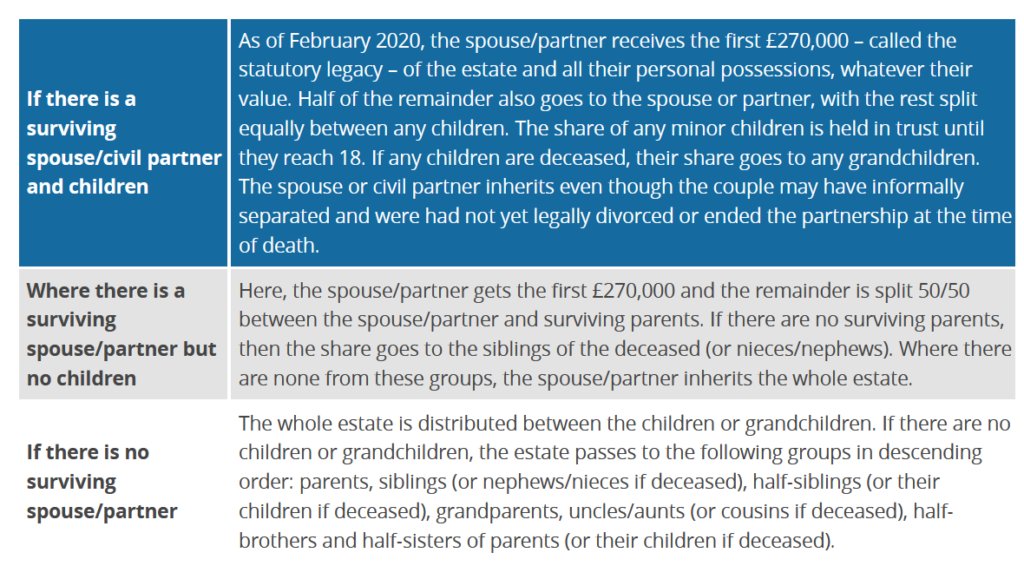
Also, the advice about having a will is correct. It is good to have a will and I have written a blog on what would happen if you haven’t written a will and U.K IHT tax.
Also, as an expat you might also need to look at the taxes on estate or IHT where you are presently residing as it might affect you.
Below is a list of countries with gift or IHT tax and seeing a tax specialist in your country of origin is worthwhile.
| Tax type | Country |
| IHT or gift tax | Belgium*, Chile, Finland, France, Germany, Greece, Hungary, Iceland, Ireland, Italy, Japan, Korea, Lithuania, Luxembourg, Netherlands, Poland, Portugal, Slovenia, Spain, Switzerland*, Turkey |
| Estate tax and gift tax | Denmark, UK, USA |
| Gifts taxed as income | Latvia, Lithuania |
| Repealed IHT or estate taxes | Australia, Austria, Canada, Czech Republic, Israel, Mexico, New Zealand, Norway, Slovakia, Sweden |
Source: OECD
Living outside the U.K with property
Most expats have a house that they own outside the U.K., for IHT if you are deemed domiciled this can still go towards your nil rate band. Meaning that you can add your house to your estate and for a single person adding on £175,000 to total £500,000. This subsequently doubles for married couples which is where the £1 million comes from.
Although, as stated before, this is only subject to a direct descendant which are children and grandchildren.
Finally, if the value of the house comes to more than £2 million, the nil rate band tapers off by £1 for every £2 the estate is above this threshold. This stops at £2.4 million.
Potentially Exempt Tax
Potentially exempt tax means if you make a gift, IHT tapers off if you die within 7 year time period.
Any gifts (not given to a spouse) worth less than £325,000 (the nil rate band) are added back to your estate to give an adjusted net worth, while a gift of more than £325,000 wipes out the nil rate band and the excess is taxed.
Where it comes to property, if you have property or wealth in the place of residency it would be worth seeing a tax advisor. You can see if any specific gains are subject to local gains tax on the gift.
Another point to remember is the seven-year taper for IHT on gifts or lifetime transfers does not apply to the residence nil-rate band.
IHT rates for gifts worth more than £325,000
| Time between the date of gift and date of donor’s death | The effective rate charged on gift |
| 0-3 years | 40% |
| 3-4 years | 32% |
| 4-5 years | 24% |
| 5-6 years | 16% |
| 6-7 years | 8% |
| More than 7 years | 0% |
Source: HMRC
Ways to Reduce Your IHT Tax
Some of the top ways to reduce IHT are:
Read my full guide on Trusts (Why You Must Have a Trust as an Expat) and the options as they will be subject to circumstances. I will say that a Trust is a strong legal contract.
Although, this gives you a strong standpoint by way of the law. They are difficult to alter once made so ensure that the right trust has been built for you.
The two main types of trust are
1. Discretionary trust
- These can be used if you want to retain control over your assets, but remove them from your estate for IHT purposes.
- They are often used by parents/grandparents.
- Beneficiaries and terms of discretionary trusts can be changed by the trustees.
- As with gifting, the “settlor” (the person placing the assets in trust) needs to survive seven years for those assets to move entirely out of their taxable estate.
2. Absolute or bare trust
- No tax is payable when assets go into such a trust.
- However, they are relatively inflexible as beneficiaries cannot be altered.
- For those looking to take a more drastic approach, you do have the option of declaring yourself non-domiciled or getting rid of your U.K passport and assets in the U.K.
These are often complex procedures and get in touch if looking at another citizenship as a state in my citizenship guide you have options available to you. Normally if you are not willing to neutralize some of the cheaper citizenships can be got for $150,000 or from $300,000 through property investment.
Read my guide to that below.
- Lower Taxes By Residence – Expat FIRE
- Inheritance Tax For UK Expats
- U.K Inheritance Tax For Overseas Expats
See an expert for specific types of trusts, as in U.K trust law you do have a number of trust options depending, on your circumstances.
QNUPs
This could be an option for expats. Setting up an effective QNUPs can help you to reduce your IHT. Read my full guide on this which I have linked below.
Investing Correctly to Reduce IHT
If have a number of assets such as farmland and forestry that are not subject to IHT, this is an option for a very few wealthy people (James Dyson, has been investing in farming for example), but other options would be investing in AIM shares.
AIM is the Alternative Investment Market.
Not all AIM shares are IHT deductible but some can reduce your IHT as you are investing in smaller companies and they want to reward this, so as a reward they remove the investment from the estate in essence. To make sure it is actually deductable, please double-check the investment as it changes each year,
My article on investing in the AIM should help you with this.
https://investmentsforexpats.com/how-to-reduce-inheritance-tax-through-the-aim/
If you have any questions relating to Inheritance Tax (IHT) as an expat and want to know what you can do please email me on info@investmentsforexpats.com.