
Chinese equities have re-entered global investors’ conversations after several years in the wilderness. Following a prolonged period of underperformance since 2020, markets linked to China, particularly Hong Kong equities, have staged a meaningful recovery. With valuations still depressed relative to global peers and macroeconomic growth holding up better than many expected, investors in 2026 are increasingly asking whether Chinese equities now represent a genuine opportunity rather than a value trap.
If you have any questions or you would like to book a discovery call, please contact me through my contact page.
Figure: Hang Seng Index over the last 5 years, Jan 26. Source: Google Finance.
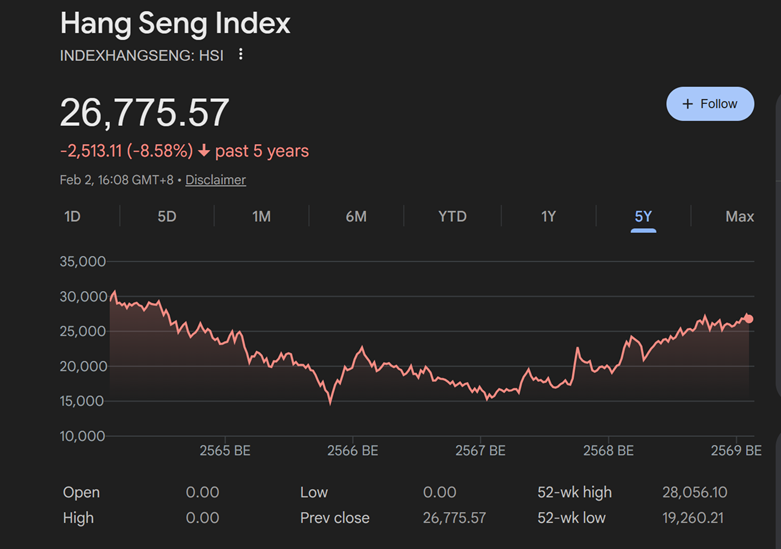
To answer that question, it is essential to look beyond short-term market rallies and examine the broader context. Market performance, valuations, sector composition, macroeconomic trends, and political and regulatory risks all play a role in determining whether Chinese equities deserve a place in portfolios this year.
| Year | Hang Seng Index Level (Year End) | Annual Return |
| 2019 | 28,190 | +9.2% |
| 2020 | 27,231 | -3.6% |
| 2021 | 23,398 | -13.6% |
| 2022 | 19,781 | -15.9% |
| 2023 | 17,047 | -12.9% |
| 2024 | 20,060 | +17.1% |
| 2025 | 25,631 | +28.6% |
| 2026 (YTD) | ~27,100 | +5.4% |
A Market That Has Finally Started to Move
Figure: Hang Seng vs S&P 500 July 2021-Jan 2026. Source Macromicro

One of the most noticeable developments over the past 18 months has been the strong recovery in the Hang Seng Index. After lagging global equity markets badly for much of the post-COVID period, Hong Kong equities delivered back-to-back strong years in 2024 and 2025. This marked a clear break from the narrative that Chinese equities were permanently uninvestable due to policy uncertainty and weak growth.
The Hang Seng’s rebound has been broad-based, driven by a combination of improving sentiment, increased liquidity, and renewed participation from both international investors and mainland Chinese capital via the Stock Connect schemes. Importantly, this rally has not simply been a speculative bounce. Earnings expectations have stabilised, balance sheets have improved in many sectors, and valuations remain far from stretched.
Alongside the index performance, Hong Kong has seen a resurgence in IPO activity. After several quiet years, 2025 saw a wave of new listings across consumer, technology, healthcare, and industrial sectors. Several large and successful IPOs helped restore Hong Kong’s position as one of the world’s leading capital markets. This matters because healthy IPO pipelines tend to reflect confidence from both corporates and investors, while also expanding the opportunity set available to global portfolios.
Figure: Hang Seng weighted constituents Jan 2026. Source: Hang Seng.
Still Paying the Price for the Post-COVID Years
Despite the recent rally, it is important to remember just how far Chinese equities fell behind other global markets after 2020. While U.S. equities, led by large technology companies, surged to repeated all-time highs, Chinese and Hong Kong markets spent years grinding lower or moving sideways. COVID-related lockdowns, weak consumer confidence, property market stress, and regulatory intervention all weighed heavily on sentiment.
As a result, many Chinese indices entered 2024 trading at levels not seen for nearly a decade in real terms. This prolonged underperformance is a key reason why valuations today remain so compelling. Unlike U.S. equities, which are priced close to perfection, Chinese markets are still priced as though investors expect disappointment.
From a cyclical perspective, this creates a different risk-reward profile. Chinese equities do not need exceptional growth to perform reasonably well. They simply need stability, modest earnings growth, and an absence of major policy shocks.
A Technology-Heavy Market Trading at a Discount
| Sector | Approximate Weight | Commentary |
| Financials | ~35–40% | Dominated by banks and insurers, providing income and stability |
| Technology & Internet | ~30–35% | Includes major Chinese tech and platform companies |
| Property & Real Estate | ~8–10% | Volatile sector affected by China’s property downturn |
| Consumer & Services | ~8–10% | Retail, travel, and consumption-related firms |
| Utilities & Energy | ~5–7% | Defensive, lower growth exposure |
China’s equity market structure is heavily tilted toward technology, internet, and consumer-focused companies, particularly in Hong Kong. Names spanning e-commerce, digital payments, social media, cloud computing, and artificial intelligence dominate index weightings.
What stands out in 2026 is that many of these companies continue to trade at materially lower price-to-earnings ratios than their U.S. counterparts. Even after the rebound in share prices, Chinese tech companies are valued at a significant discount to American mega-cap technology firms. This reflects both slower earnings growth expectations and the lingering impact of regulatory risk.
Figure: Simply Wall Street Baba (ADR) and Tencent Snow Flake Jan 26.
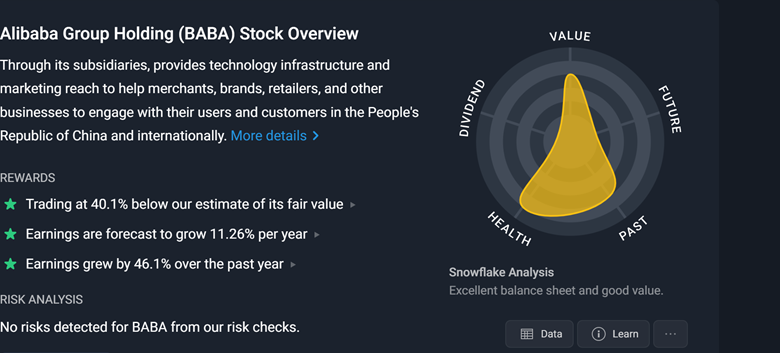

However, the valuation gap has arguably become too wide. Chinese tech firms are profitable, cash-generative, and deeply embedded in the domestic economy. While they may not enjoy the same global dominance as U.S. technology giants, they operate in one of the largest consumer markets in the world. If earnings growth continues at even a moderate pace, there is scope for valuation re-rating over time.
At the same time, investors should not expect Chinese technology stocks to trade at U.S.-style multiples in the near future. Regulatory oversight is structurally higher, and geopolitical tensions impose an additional risk premium. The opportunity lies not in chasing multiple expansions to extreme levels, but in owning solid businesses at reasonable prices.
Chinese Banks: Unloved, Cheap, and Yielding
Figure: Bank of China, Simple Wall Street snowflake.
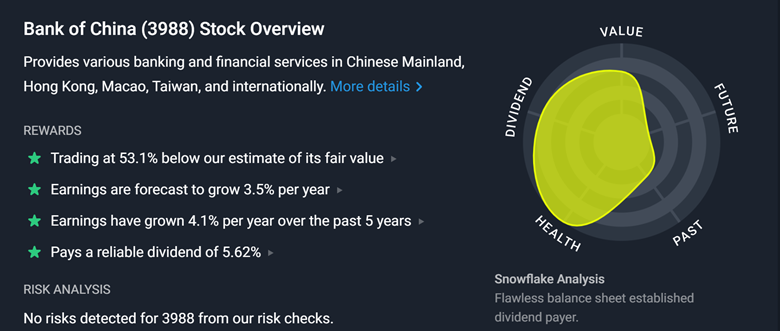
While technology often grabs the headlines, one of the most striking opportunities in Chinese equities in 2026 lies in the banking sector. Large Chinese banks continue to trade at very low price-to-book ratios, often around half of book value, while offering dividend yields that are difficult to find elsewhere in global equity markets.
This reflects investor concern around loan quality, property-related exposure, and the role of banks in supporting government policy objectives. These concerns are not unfounded. However, they are also well understood and largely priced into valuations.
For income-focused investors, Chinese banks offer a different proposition from growth-oriented tech stocks. Dividends are relatively stable, capital ratios are strong, and implicit state support reduces the likelihood of extreme downside outcomes. While capital appreciation may be limited, the income component can play a useful defensive role within a broader China allocation.
The Macro Picture: Slower Growth, But Still Growing
At a macro level, China in 2026 is no longer the hyper-growth story it once was. Annual GDP growth of close to 5 percent, while impressive compared to most developed economies, represents a structural slowdown from past decades. Demographics, debt levels, and the maturation of the economy all point toward a more moderate growth trajectory.
That said, growth near 5 percent remains significant. It supports corporate earnings, employment, and fiscal stability, particularly when compared to Europe or Japan. Export growth has moderated, and China faces increasing trade friction with the United States and its allies, but exports remain a vital component of economic activity.
Domestic consumption continues to recover gradually, though consumer confidence remains fragile. Policymakers have signalled a preference for targeted support rather than large-scale stimulus, reflecting a desire to avoid excessive leverage while maintaining economic stability.
Risks That Cannot Be Ignored
Any discussion of Chinese equities would be incomplete without addressing risk. Regulatory intervention remains the most cited concern, and the events of 2021 are still fresh in investors’ minds. Sudden policy shifts in the education and technology sectors destroyed shareholder value and fundamentally changed how investors assess political risk in China.
While the regulatory environment has been more stable recently, the risk has not disappeared. Policy objectives can still override shareholder interests, particularly in strategically sensitive sectors.
The property sector also continues to cast a long shadow over the economy. Years of excess leverage and speculative development have resulted in a prolonged adjustment that is still working its way through the system. Although systemic collapse has been avoided, property remains a drag on growth, household wealth, and local government finances.
Geopolitical risk adds another layer of complexity. U.S.–China relations continue to shape trade policy, technology access, and capital flows. Restrictions on advanced semiconductors and strategic technologies may limit growth potential in certain sectors, while also increasing volatility around news events.
Our View on Chinese Equities in 2026
China enters 2026 after what has been, by any measure, a difficult five-year period. The combined effects of COVID lockdowns, the ongoing trade war with the United States, still China’s single most important export destination, the collapse of confidence in the property sector, rising debt ratios, weak domestic consumption, and persistently high youth unemployment have created a challenging backdrop for policymakers. These are not minor obstacles, and they will require careful and disciplined management by the Chinese Communist Party over the coming years.
However, while these headwinds dominate much of the Western narrative around China, they risk obscuring what we believe is the more important long-term signal: China’s ability to innovate, move up the value chain, and export increasingly sophisticated products globally. In our view, this capability is the most telling indicator of China’s long-term economic resilience.
Nowhere is this clearer than in sectors such as electric vehicles, batteries, electronics, and advanced manufacturing. Chinese companies are no longer competing primarily on price. They are competing on scale, technology, supply chain integration, and increasingly, brand. The success of Chinese electric vehicle manufacturers offers a compelling case study.
In Thailand, for example, Chinese EV penetration has risen dramatically over the last five years. In 2019, Chinese brands accounted for virtually no EV sales. By 2021, annual EV sales in Thailand were still below 10,000 units, with Chinese manufacturers only beginning to enter the market. By 2023, total EV sales exceeded 75,000 units, with Chinese brands accounting for more than 70% of that figure. In 2024 and 2025, annual EV sales rose further toward the 90,000–100,000 range, with Chinese manufacturers such as BYD, SAIC (MG), and Great Wall Motors firmly dominating the market. This is not an isolated trend. Similar patterns are emerging across Southeast Asia, as well as in emerging markets such as Mexico and Brazil.
What makes this particularly significant is that this export success is not driven solely by external demand. It is the spillover from China’s vast domestic market and deeply integrated supply chains. Companies that can survive, compete, and scale within China’s intensely competitive domestic environment are increasingly well-positioned to expand into other emerging markets. If this spillover effect continues, and Chinese firms can balance domestic scale with international expansion, China can continue to grow even as traditional drivers such as property and low-end manufacturing fade.
Another crucial pillar of our outlook is artificial intelligence. Alongside the United States, China is widely expected to be one of the two primary beneficiaries of the AI revolution. While U.S. firms currently dominate the narrative, China’s strength lies in its combination of data scale, manufacturing integration, and applied AI across logistics, healthcare, finance, and industrial automation. If productivity gains from AI materialise anywhere close to expectations, they could meaningfully offset some of China’s longer-term demographic challenges. Higher productivity per worker would ease the pressure created by an ageing population and a shrinking labour force, while supporting corporate profitability and wage growth.
We also believe inequality and how China chooses to address it will be an increasingly important factor for markets. One of President Xi’s stated objectives has been to shift China toward a more balanced, “figure-glass” economy, rather than one that concentrates wealth solely at the top. Analysis by economists such as Keyu Jin has highlighted that relatively modest increases in disposable income for lower-income households could have an outsized impact on consumption. Estimates suggest that increasing spending power at the lower end of the income distribution by even 20% could significantly boost domestic demand.
Such a shift would have meaningful implications for financial markets. Higher consumption would support loan growth, reduce credit stress, and improve long-term prospects for banking and insurance companies. While margins may remain compressed due to policy objectives, balance sheet stability and earnings visibility could improve, particularly for large, systemically important institutions.
At the same time, it is important to recognise that China does not aspire to the same market structure as the United States. Beijing has little interest in allowing equity markets to experience extreme volatility or speculative excess. Measures to curb short selling and dampen sharp market swings reflect a preference for stability over rapid repricing. This limits the likelihood of explosive bull markets but also reduces the probability of uncontrolled crashes.
Taking all of this together, our base case is that the Hang Seng Index continues to grind higher over the next several years rather than experiencing a sharp, speculative surge. Valuations remain reasonable, corporate earnings are stabilising, and capital is increasingly searching for alternatives to U.S. assets, where valuations are stretched, and concentration risk is high. In that context, Hong Kong and China-linked equities may increasingly be viewed as a viable diversification option rather than a contrarian bet.
This does not mean the path will be smooth. Regulatory risk, geopolitical tensions, and domestic structural challenges remain very real. However, for investors with a long-term horizon, we believe that a measured allocation to Chinese equities, particularly via the Hang Seng, can play a useful role in reducing over-reliance on U.S. markets while providing exposure to innovation, emerging market growth, and attractive valuations.
In short, China in 2026 is not without its challenges, but it is far from out of the game. For diversified portfolios, selective exposure to Chinese equities may increasingly look less like a risk and more like a necessity.
Related blogs which can help are:
- Would You Invest in Thailand or Vietnam as an Emerging Market
- Where Should You Move in 2026? Top Expat Destinations for UK Entrepreneurs and Investors
- Biggest Problems and Opportunities for High Net Worth Expats in 2026
In 2026, the market has pivoted away from waiting for a “bazooka” stimulus package from Beijing. Instead, the rally is being driven by the “Anti-Involution” policy, which has forced Chinese companies to stop suicidal price wars and focus on profit margins. With consensus earnings growth for the MSCI China index projected at 15% in 2026, investors are finally seeing corporate bottom lines improve. For expats, this means the “buy and hold” case is now based on actual company fundamentals rather than speculative government intervention.
Geopolitical friction remains the primary risk. While the 2025/26 “Trade Truce” has eased delisting fears, many HNW expats are moving their exposure to Hong Kong (H-Shares) or Mainland (A-Shares) via the Stock Connect. Holding assets directly in Hong Kong mitigates the risk of US-China “financial decoupling” and provides better access to the 15th Five-Year Plan sectors—like semiconductors and biotech, which are heavily supported by domestic Chinese liquidity rather than Western institutional flows.
Investing in China is as much a bet on the CNY (Yuan) as it is on the stocks. In 2026, with the PBOC maintaining accommodative rates while the UK/US might be in a different cycle, currency volatility can easily erode a 10% equity gain. Expats should look for multi-currency investment platforms (like IBKR or Saxo) that allow for cheap hedging or the ability to hold “CNH” (offshore Yuan) cash balances. Additionally, using a “Barbell Strategy”, balancing high-growth tech with high-dividend State-Owned Enterprises (SOEs), can provide a natural buffer against local currency fluctuations.