

Following his address to the nation, Prime Minister Andy Burnham outlined an ambitious 10-year vision focused on regional empowerment, devolving greater powers to local government, tackling the cost of living crisis, expanding affordable housing and ending rough sleeping. It represents a clear shift in political priorities and a move away from the highly centralised model that has characterised Westminster for decades.
However, from an investor’s perspective, the speech was notably light on the detail that financial markets ultimately demand: how will stronger economic growth be delivered, and how will these ambitions be financed?
Burnham’s success in Greater Manchester has understandably shaped his economic philosophy. He believes that giving greater powers to local authorities, alongside increased investment in housing, transport and skills, can unlock productivity across Britain’s regions. Yet scaling a regional success story into a national economic strategy is a far greater undertaking.
Real growth added in the U.K by region 2008-2023: Source FT.
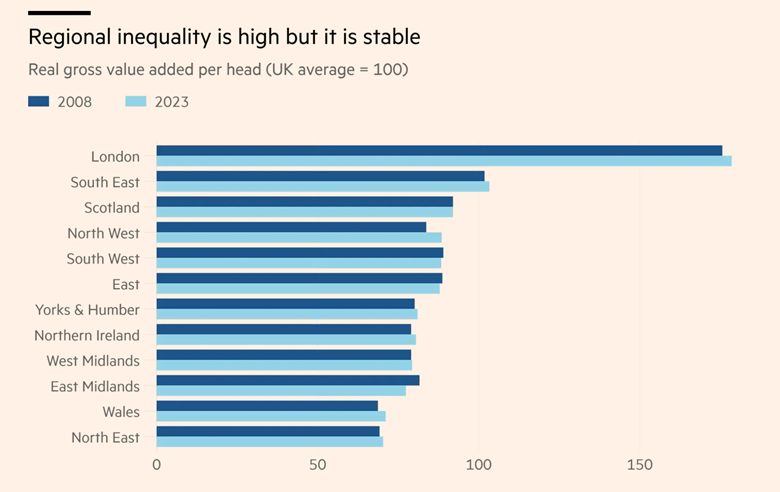
Greater Manchester represents around 3 million people. The United Kingdom is an economy of almost £3 trillion, where financial services, technology, legal services, life sciences and global capital markets remain heavily concentrated in London and the South East. Encouraging stronger regional growth is undoubtedly desirable, but it cannot come at the expense of Britain’s most productive economic engine. As Martin Wolf has argued repeatedly, successful economies benefit from powerful regional cities, but they also rely on globally competitive metropolitan centres that attract international investment, talent and innovation.
Growth Must Come First: Britain’s Investment Challenge
The defining economic challenge, in my opinion, facing the new government is not how wealth should be redistributed, but how more wealth can be created.
Economic growth underpins everything. It funds public services, raises living standards, supports higher wages and ultimately determines how much governments can spend without continually increasing taxes or borrowing. Sustained economic growth is not simply one policy objective it is the foundation upon which every other political ambition depends.
Unfortunately, this is precisely where the UK has struggled. And believe this aspect needs to be addressed.
Since the Global Financial Crisis, Britain has experienced one of the weakest periods of sustained growth in modern history. GDP growth has been modest, productivity has stagnated, real wages have struggled to keep pace with inflation, and business investment has consistently underperformed many comparable economies. While Brexit cannot explain all of these challenges, it has undoubtedly added further uncertainty and reduced private sector investment during an already difficult period.
Chart 1: UK Real GDP Growth Since 2008
- GDP Growth Since 2008
- United States: ~+38%
- Euro Area: ~+20%
- United Kingdom: ~+18%
The Productivity Problem: Why Britain Has Fallen Behind
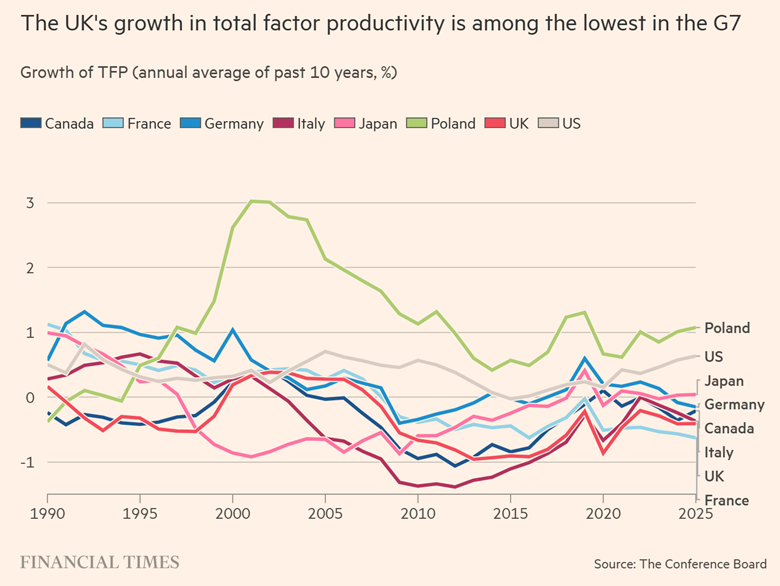
If there is one issue that explains much of the UK’s economic underperformance over the past 15 years, it is productivity.
Since the 2008 Global Financial Crisis, UK productivity growth has been among the weakest in the developed world. According to OECD data, labour productivity has increased by only around 5%, compared with 22% in the United States, 12% in Germany, and 10% in France. This prolonged period of weak productivity has become known as the “UK Productivity Puzzle.”
| Labour Productivity Growth (2008–2025) | |
| United States | 22% |
| Germany | 12% |
| France | 10% |
| United Kingdom | 5% |
Source: OECD Productivity Database
The reasons behind this are structural rather than cyclical. Britain has suffered from years of weak business investment, political uncertainty and slow infrastructure development. Businesses are often reluctant to commit long-term capital when tax policy, regulation and trade relationships continue to evolve. At the same time, planning restrictions have delayed housing, transport and energy projects, reducing the economy’s ability to grow efficiently.
Another challenge is that while the UK remains home to world-leading industries in finance, life sciences, higher education and technology, much of the wider economy has been slower to adopt new technologies, automation and more productive ways of working. The result is a growing gap between a handful of highly productive sectors and a much larger group of businesses that continue to lag behind.
Britain Doesn’t Invest Enough
Low productivity is closely linked to another long-term weakness: investment.
Investment is what drives future economic growth. It funds new factories, automation, research and development, digital infrastructure and modern transport networks. Countries that consistently invest tend to enjoy stronger productivity, higher wages and faster economic growth.
The UK has struggled in this area for many years. Gross fixed capital investment is around 17% of GDP, compared with approximately 21% across the OECD and even higher levels in France and Germany.
| Gross Fixed Capital Formation (% of GDP) | |
| France | 23% |
| Germany | 22% |
| United States | 21% |
| OECD Average | 21% |
| United Kingdom | 17% |
Source: OECD National Accounts
This may not appear to be a large difference, but over time it has a significant impact. Years of lower investment mean fewer productivity improvements, weaker wage growth and slower economic expansion. It is one of the main reasons the UK has underperformed many of its international peers.
How Can Britain Return to Growth?
Most economists agree that Britain’s growth problem is fixable, but meaningful reform will take time.
The priority I would argue is increasing private investment. Businesses need confidence that tax policy, regulation and planning rules will remain stable over many years before committing billions of pounds to new projects.
Planning reform could also have a significant impact. Faster approvals for housing, transport infrastructure, data centres and renewable energy projects would encourage investment without requiring large increases in government spending.
Another opportunity lies within Britain’s pension system. UK pension funds now invest less than 5% of their assets in domestic equities, compared with more than 40% two decades ago. Redirecting even a small proportion of this capital towards innovative British companies could provide the long-term funding many businesses need to grow rather than seeking investment overseas.
Finally, targeted tax incentives, such as permanent full expensing for business investment, would reduce the cost of investing in factories, machinery and research, making the UK a more attractive destination for global capital.
The Fiscal Reality
One of the biggest challenges facing the Burnham government is not political; it is financial.
The UK’s public finances are considerably weaker than they were before the Global Financial Crisis. Public sector net debt now stands at around 95–100% of GDP, compared with approximately 35% in 2007. While this remains below levels seen in countries such as Japan, it is one of the highest debt burdens the UK has carried outside periods of major war.
At the same time, the cost of servicing that debt has risen sharply. During much of the 2010s, the UK was able to borrow at historically low interest rates, with 10-year gilt yields often trading below 2%. Today they remain closer to 4–5%, meaning every new pound borrowed costs significantly more to finance. Debt interest payments are now among the largest items of government expenditure, exceeding annual spending on many major government departments.
The UK is also facing powerful demographic pressures. An ageing population is increasing demand for the NHS, pensions and social care, while the proportion of working-age taxpayers is growing much more slowly. The Office for Budget Responsibility (OBR) has repeatedly warned that without stronger economic growth or structural reforms, public debt is likely to continue rising over the coming decades.
UK Fiscal Position
| Fiscal Indicator | Approximate Level |
| Public Debt | 95–100% of GDP |
| Annual Budget Deficit | ~4–5% of GDP |
| 10-Year Gilt Yield | ~4.3–4.7% |
| Debt Interest Costs | Over £100bn annually |
| Government Spending | Around 45% of GDP |
Sources: OBR, HM Treasury, Office for National Statistics, Bank of England.
For investors, this matters because the government has far less room for fiscal expansion than it did fifteen years ago. Financial markets are unlikely to tolerate a significant increase in borrowing unless it is accompanied by a credible strategy to raise long-term economic growth.
The 2022 gilt market crisis following Liz Truss’s mini-budget remains a powerful reminder of this reality. Within days, gilt yields surged, sterling weakened sharply, and the Bank of England was forced to intervene to stabilise pension funds. The episode demonstrated that global bond markets can rapidly withdraw confidence if they believe fiscal policy has become unsustainable.
Burnham has repeatedly stated that he intends to maintain fiscal discipline and operate within existing fiscal rules. That commitment will almost certainly be welcomed by investors. However, markets will judge him on delivery rather than rhetoric. Any significant increase in spending without a credible plan to improve productivity, investment and tax revenues could once again place upward pressure on government borrowing costs.
Where Could Burnham Find Growth?
If Burnham is serious about improving Britain’s long-term growth rate while maintaining fiscal discipline, much of the answer lies not in increasing public spending but in implementing supply-side reforms that encourage private investment.
Planning reform is perhaps the most obvious opportunity. Britain has one of the slowest planning systems in the developed world, delaying housing, transport infrastructure, renewable energy projects and data centres. Streamlining approvals could unlock billions of pounds of private investment without placing additional pressure on the public finances.
Burnham has also proposed greater devolution of powers to regional authorities. If combined with stronger local accountability and investment incentives, this could help cities such as Manchester, Birmingham, Leeds and Bristol attract more private capital and develop into stronger regional growth hubs. However, success will depend on ensuring investment is directed towards projects that genuinely improve productivity rather than simply increasing public expenditure.
Finally, greater certainty around tax policy could encourage businesses to increase long-term investment. Permanent investment allowances, continued full expensing for capital expenditure and stable corporation tax policy would provide businesses with greater confidence to invest in new factories, automation, artificial intelligence and research and development.
What It Means for Investors
For investors, the arrival of a new government inevitably raises questions about whether Britain’s long-term economic outlook is likely to improve. While Andy Burnham’s speech outlined an ambitious vision for tackling regional inequality, expanding affordable housing and addressing social issues such as homelessness, it offered relatively little detail on what many economists would regard as the UK’s most pressing challenge: how to generate sustainably faster economic growth.
Financial markets are generally supportive of governments addressing social issues, but history shows that investors ultimately judge administrations on their ability to grow the economy. Higher productivity, stronger business investment and rising tax revenues are what create the financial capacity to fund public services and social programmes over the long term. Without stronger growth, governments eventually face increasingly difficult choices between raising taxes, increasing borrowing or reducing spending elsewhere.
That is why many economists have suggested that while Burnham’s priorities may be politically popular, markets will want to see much greater detail on the policies designed to increase investment, improve productivity and encourage entrepreneurship. Devolution, council house building and greater regional investment may all contribute positively over time, but on their own they are unlikely to transform Britain’s growth rate.
Investors will therefore be looking for further announcements on planning reform, business taxation, pension reform, infrastructure delivery, skills development and measures to encourage private capital investment. These are the reforms that many economists believe could have the greatest impact on Britain’s long-term productive capacity.
One area that received relatively little attention was Britain’s competitiveness. The UK continues to possess significant advantages: world-leading universities, one of the largest financial centres in the world, a highly respected legal system, deep capital markets and strengths in sectors such as financial services, pharmaceuticals, aerospace, artificial intelligence and higher education. Many analysts believe these advantages should form the foundation of any long-term growth strategy.
Another question investors will be asking is whether the government can attract more international capital. Global companies have choices over where they invest, build factories, establish research centres and list their shares. If the UK can provide political stability, a competitive tax system, efficient planning rules and a predictable regulatory environment, it remains well placed to attract significant inward investment. If uncertainty persists, capital is likely to continue flowing towards faster-growing economies, particularly the United States.
Perhaps the most important point is that markets are patient but demanding. Investors do not expect structural reforms to produce immediate results, but they do expect a credible roadmap. At present, Burnham has outlined the destination more clearly than the route to getting there. His speech established broad ambitions for a fairer and more balanced economy, but many of the detailed supply-side reforms needed to raise productivity and unlock private investment remain to be announced.
For long-term investors, this means maintaining perspective. There is little reason for panic, but equally there is little evidence yet that Britain’s structural growth challenges have been solved. The government’s success will ultimately be measured not by the number of initiatives announced, but by whether business investment increases, productivity accelerates, wages begin to rise sustainably and confidence returns to both domestic and international investors. Those indicators, rather than political rhetoric alone, will determine the long-term performance of UK equities, gilts, sterling and the wider economy.