
In the hunt for yield and stability in a volatile world, savvy investors are increasingly turning to the secondary market for structured notes. These products are often misunderstood and sometimes misused; they can offer double-digit returns when purchased strategically below par. In this blog, I will take you through how I use them in my portfolio.
If you have any questions or are interested in a product like this, please use my contact page to get in touch.
Blogs related to this are:
What Are Secondary Market Structured Notes?
Here is an example in my portfolio of a few of the notes; these are old notes and are no longer invested in.

Structured notes are pre-packaged investments typically issued by major banks. They combine fixed-income instruments with derivatives to deliver a tailored return based on the performance of underlying assets like equity indices or stocks.
Most structured notes are issued at par (100%), but they’re frequently traded on the secondary market at a discount, sometimes 10%, 15%, or even 20% below face value. This discount occurs due to market volatility, investor exits, or poor performance of the underlying at the time.
By buying a note at a steep discount and holding it until maturity or until it auto-calls, you can lock in much higher annualised returns than initially advertised.
Example: BBVA Phoenix Memory Autocall Note that is offered at a 12% discount even though the indexes are near par or above the strike value.
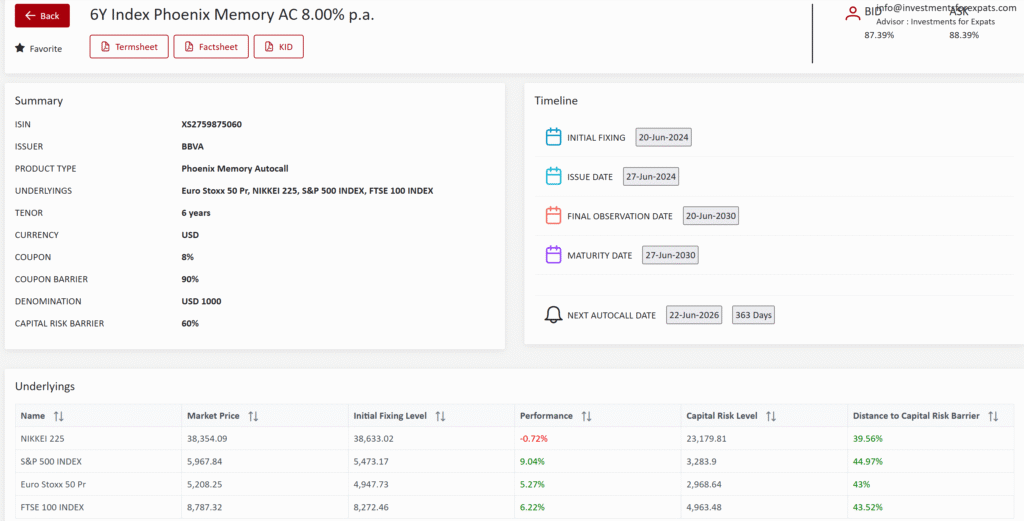
Let’s break down a real-world example based on the image above:
- Issuer: BBVA
- Coupon: 8% per annum (paid quarterly if the underlying are above the 90% barrier)
- Tenor: 6 years
- Autocall feature: Callable annually starting from year 2
- Capital Protection Barrier: 60%
- Underlying Indices: Euro Stoxx 50, Nikkei 225, S&P 500, FTSE 100
Now imagine buying this note on the secondary market at 80% of face value, meaning a 20% discount. Here’s what happens:
Scenario A: Autocall in One Year (Best Case)
Let’s assume:
- You invest $100,000 to buy the note at $800 per $1,000 denomination.
- All underlying stay above the initial fixing level at the first callable date (1 year from now).
- The note auto-calls, returning $1,000 per unit, and you receive one year’s worth of coupons at 8%.
Returns Breakdown:
- Capital gain: $1,000 – $800 = $200 per unit (25%)
- Coupon: 8% on $1,000 = $80
- Total return: $280 on $800 = 35% in one year
- Annualised return: 35% (since it matured in 1 year)
That’s $135,000 returned on your $100,000 investment after 12 months.
Scenario B: Held to Maturity (6 Years)
If the note doesn’t auto-call but continues to pay 8% annually for 6 years, and the worst-performing index finishes above 60% of the initial value, you still receive:
- Annual coupons: 8% x 6 = 48% = $48,000
- Capital return: 100% of par = $120,000 on $100,000 invested (25% gain on capital)
Total return:
- $48,000 (coupons) + $20,000 (capital gain) = $68,000
- On $100,000 investment, that’s a total return of 68% over 6 years
- Annualised return ≈ 9.06% per year
Still very attractive, especially given the capital protection down to 60%.
Key Benefits of Structured Notes
- Discount Enhances Yield
Buying at 80 or 85 results in a boosted effective return when the note is redeemed at par. - Memory Coupons
If a quarterly coupon is missed, it’s not lost—it’s remembered and paid later once conditions are met. - Autocall Acceleration
If indices perform well, you might get full capital and coupons earlier than maturity, sharply increasing annualised returns. - Defined Capital Protection
As long as the worst-performing index remains above the capital barrier (60% in this case), your principal is protected.
Risks with Structured Notes
- Market Risk: If indices crash and stay down, capital could be at risk.
- Liquidity Risk: Secondary market notes may not be easy to sell before maturity.
- Issuer Risk: Your return depends on BBVA’s solvency in this example.
- Complexity: These products are not suitable for those who don’t understand payoff structures.
The Core Idea: Buy at a Discount, Hold for Autocall or Maturity
Structured notes, particularly Phoenix Memory Autocallables, are often sold on the secondary market at discounts ranging from 10% to 20% due to not having a very active market. These discounts happen for reasons such as temporary market dips.
Buying a note at 80 to 90 cents on the dollar creates two sources of return:
- Coupon income (often 8–10% per year), paid if underlying indices stay above a certain level.
- Capital gain, since the note pays out 100% of face value at maturity or autocall, even if you bought it at 80%.
When combined, the annualised yield can exceed 12% with downside buffers built in.
Real-World Example: BBVA 6-Year Phoenix Note (as shown above)
Let’s look at the note currently available in the secondary market (see image):
- Issuer: BBVA
- Coupon: 8% per annum
- Underlying: Euro Stoxx 50, Nikkei 225, S&P 500, FTSE 100
- Coupon Barrier: 90%
- Capital Protection Barrier: 60%
- Autocall Eligible: After Year 2 (next autocall: 22 June 2026)
- Current Price: ~88 (12% discount to par)
Current Index Performance vs Fixing Level:
| Index | Performance | Distance to Capital Barrier |
|---|---|---|
| S&P 500 | +9.04% | +44.97% |
| FTSE 100 | +6.22% | +43.52% |
| Euro Stoxx 50 | +5.27% | +43% |
| Nikkei 225 | -0.72% | +39.56% |
As you can see, three of the four indices are above their initial fixing, and even the Nikkei is just marginally below. All indices are more than 39% above the capital risk barrier, providing a very comfortable buffer.
If you were to buy this note at an 88% price, hold it to maturity (2030), and all indices stay above 60%, you would receive:
- $80 per $1,000 annually in coupons (8% x 6 years = $480 total)
- $1,000 back at maturity, even though you paid just $880
That’s a $600 return on $880 investment = 68.2% total return over 6 years = 11.4% annualised.
My Strategy: Focus on Stability + Discounts
This is how I’ve built consistent returns year after year. I only buy:
Structured notes on developed market indices (S&P 500, Euro Stoxx 50, FTSE 100, Nikkei 225)
With capital protection of at least 35-40%
Coupon barriers between 80% and 90%, which are achievable even in mild market downturns
Trading at a 10–20% discount to par
With 1–2 years remaining until autocall eligibility, often with a high likelihood of being called
In the example above, the note ticks every box, it’s on developed indices, well above the capital protection barrier, and offered at a discount of 12%, setting you up for either:
- A short-term win if it auto-calls in a year (returning capital and full-year coupons = 20–30% return in 12 months), or
- A 11–12% annualised yield if held to maturity
Why It Works: Statistical Edge
Structured note design, especially Phoenix autocalls, gives the investor the advantage when bought at the right time. Based on back-testing across the past 20 years of index data:
- 90%+ of developed market index Phoenix notes avoided capital loss
- 80%+ triggered at least one coupon annually, even during volatile periods
- More than 70% auto-called in the first 2–3 years when indices were within 5–10% of the initial strike
And in this current example:
- The average distance to the capital risk barrier is 43%, meaning indices could drop over 40% from today’s levels before capital is at risk, which is extremely rare based on backtesting.
- The worst-performing index (Nikkei 225) is only 0.72% below the strike, and historically, developed indices recover from such small drawdowns within 12 months, the majority of the time.
This is why I focus only on secondary notes with solid fundamentals and near-term autocall potential, where I can pick them up at steep discounts but with a relatively low risk of drawdowns below the capital barrier.
Example Payoff Table (If Bought at 88%)
| Scenario | Outcome | Return |
|---|---|---|
| Autocall in 1 year | $1,000 + $80 coupon | $1,080 on $880 = 22.7% |
| Autocall in 2 years | $1,000 + $160 coupon | $1,160 on $880 = 31.8%, 15.4% p.a. |
| Held to maturity (6 years) | $1,000 + $480 coupons | $1,480 on $880 = 68.2%, 11.4% p.a. |
| Indices drop >40% (worst case) | Possible capital loss | Depends on final levels |
Conclusion: A Strategy That Works When You Stay Disciplined
This is not a get-rich-quick scheme. It’s a repeatable, intelligent strategy based on probability, value, and market resilience. I don’t chase exotic payoffs or take risks on emerging markets. I focus on buying quality, discounted notes linked to resilient indices when they offer the best terms.
This is one element that has worked for my portfolio over the years, and I thought I would share this as I do believe it to be a good risk-reward case. These are my views on getting hedge fund-like returns in most market cases. This is not personal financial advice. Some of my clients also use these notes; they are aware of the upsides and downsides and have been financially vetted.
Here are blogs I have written on notes before, and platforms for expats:
- Secondary Market Notes
- Structured Notes Explained For Expats
- Best Investment Platforms for Expats in 2025
Secondary market structured notes are existing notes sold by other investors, often at a discount. Unlike new issues, they can provide better entry points, shorter maturities, and potentially higher yields depending on market conditions.
Discounted notes can offer enhanced returns, diversification, and reduced downside risk. For expats, they also provide access to global equity exposure and tailored risk profiles, making them a useful complement to traditional investments
Structured notes carry risks such as issuer credit risk, market volatility, and liquidity constraints. Investors should carefully review the underlying assets, payoff structure, and terms before buying, especially when purchasing on the secondary market.