
How do Hedge Funds make money and are they a good investment?
Hedge funds are a $3.24 trillion (USD) business are known for the high returns, and risky business prospectives, but how do they actively make money, and are they better to be invested in than funds to make higher returns? Should they be used as part of your portfolio as an alternative investment rather than specialist funds?
First what is a hedge fund:
A hedge fund is stated as “alternative investments using pooled funds that employ different strategies to earn active return, or alpha, for their investors. Hedge funds may be aggressively managed or make use of derivatives and leverage in both domestic and international markets to generate high returns (either in an absolute sense or over a specified market benchmark)”. It should be noted that hedge funds face fewer regulations than the typical open-ended fund. So it can be riskier.
Why are they so risky?
Well, like I stated before that they don’t have regulation. Where a normal fund will go long (buy) shares /fixed assets and hold for a substantial period of time. Normally, on stocks in a regulated market.
A hedge fund is far more complex and uses various types of strategies (that I will explain later) on how to mitigate risk, increase earnings, and leverage returns to try and get absolute returns in all market conditions.
Normally, they come with locks. Where you’re not allowed to get your money out at any time. For those who have seen the movie ‘The Big Short’, the example is when Michael Burry emails investors in his fund to tell them that they can’t access their money because they are going to bet short on the prime mortgage loans (that pays off). Meaning if you invest in hedge funds, there are time frames you must keep it in highly reducing liquidity and can stop you from getting your money in times of volatility.
What are the requirements to invest?
Another, reason why the risk element of a hedge fund is high is it starts at least $50,000 (USD) investment. But it can be a lot more depending on the popularity of the fund. Also, the regulations do insist that you have a net worth excluding your primary residence of $1,000,000 (US). Most are only being investible by Qualified investors.
What are the fees?
Hedge funds normally have fees that are called the 2/20 rule. This is where 2% is charged as annual management fees and 20% is charged as a performance fee. This means if you invested $100,000 that $2,000 would be changed as an annual fee. Additionally, if the hedge fund went up to $10,000 it would be charged an additional $2,000 performance fee. Although, there has seen some of the more popular hedge funds go more towards 3/30 charging a 3% annual fee and 30% performance fee. This makes them substantial, higher than average passives funds, at 0.55% annual charge.
What are the advantages of investing in them?
With the high fees, lock-in and lack liquidity why invest in them. Well, this is quite a debated question when you have seen funds and even index do 36%+ year returns.
A famous case of Warren Buffet, also beating the top hedge fund managers over the 10 years by his stock picks. So are the high fees, lock-ins and high requirements all worth it. In short, and a non-conclusive answer is that they can and can’t be. Why?
Because going back to that they are less regulated. This in brief means that they can use techniques that allow them to leverage returns and invest outside a regulated spectrum that can restrict funds. Without question, this comes with more risk. But can come with higher returns than a typical fund and can add some diversification to your portfolio. Studies have shown conflicting results, but a majority do tend to be in favor of hedge funds (see table below of 10-year meta-analysis of hedge funds 2001-2011) and will discuss deeper into this question below in the next sections.
The table shows results from a range of hedge funds, mutual funds and S&P return over 10 years from 2001-2011.

How are they different from funds?
If they have shown different results to funds how do they differ?
Funds for the main part normally hold long static positions for long periods. This is they will buy stock in Apple, hold it and only change it if it is performing badly or if the share price is limited. Although, some funds such as Investment trust, do differ the majority of funds take long positions (buy) and hold for long periods until see fit to sell.
While hedge funds, take shorter dynamic term views (mostly) and use different trading strategies for they can use high-frequency trading to trade hundreds of times a day.
Hedge funds use all kinds of different techniques and strategies as well as leverage investments. Go outside the fund spectrum with investments that are not regulated by markets. Thus, not normally on the market to retail investors. They can also use services by Investment banks to help even further leverage the returns (or losses) and trade faster.
Fees difference between a fund and hedge funds
Like we stated above the 2/20 on hedge funds but how does this compare to funds.
Fees, also play a big part in performance comparison as well. Mutual fund operational fees are known to range from approximately 0.05% to as high as 5% or more. Hedge funds typically integrate what is known as a ‘two-and-twenty fee’ which includes a management fee of 2% and a performance fee of 20%.
This would mean that if a typical investor puts $100,000 into a “typical” fund with an average charge of 1%. It would cost $1,000 a year. If for example, this went up 10% it would still cost $1,000 per year. And if it lost 10% the same cost would occur.
While, if you were to invest in a hedge fund the cost will be, normally 2% and 20% of the performance so the same investor of, $100,000 would invest and get charged a $2,000 annual fee and if that same fund went up 10% it would charge an additional, $2,000 this would equate to 4 times the fund amount. Also, if the fund lost 10% it would still be 100% more than the fund.
Investments difference between the fund and hedge funds
The main difference is the way that they invest they use a range of different strategies in different asset classes see the example of a fund chart below on hedge funds and funds investments. An early study in hedge funds vs funds in the 2000s found that compared to funds they normally invest in small markets, more emerging market bonds.
Hedge fund Portfolio example

While a fund is normally structured with regulated equities, fixed assets in regulated markets and normally goes long. An example of a typical fund is shown below (S and P index below).
S&P index

Company structure
They also differ in the way that they are structured from a company investment most Funds are structured in a company while, hedge funds take a more investment trust style that is limited companies or partnerships.
Liquidity Difference in hedge funds
We have touched on this above but what is the difference from a fund. Well, a fund you can mainly withdraw at any time at the NAV (net asset value), while hedge funds have mainly locked in meaning you can only take your money out, 4, 2, or even 1 time a year (depends on the fund).
A hedge fund manager states the difference best in terms of liquidity – “A key difference between hedge funds and mutual funds is their redemption terms. Mutual fund investors can redeem their units on any given business day and receive the NAV (net asset value) of that day. Hedge funds, on the other hand, tend to be much less liquid. Some offer weekly or monthly redemptions, while others are only quarterly or annually. Many hedge funds impose a lock-up period, where you cannot withdraw your money at all. During periods of market volatility, such as the most recent financial crisis, several hedge funds suspended redemptions entirely to protect the remaining investors from a potential fire sale of the fund’s portfolio”
So are hedge funds worth investing compared to investing index or funds a deeper look?
This is a difficult question that critics would argue that they are completely different so can’t compare them. I would agree with this fact to some extent. But, it would also add from an investment standpoint what is the point in the fees, lack of liquidity, if you can’t beat the index or fund.
It is hard to tell from research as it varies so much from specific hedge funds beating the index and what time frame or market conditions. So, it will, therefore, be based on a generalization. Some famous cases wherein 2008 some hedge fund managers suggested that they could beat warren buffet on a 10-year challenge. The mangers did a not too shabby 22% (average of 5 hedge funds) while Buffet did 85.4% return over the period. I would make a note that this wasn’t in recession and was specific funds so not a lot of validity in the study with the data but does show that hedge funds could be outperformed by funds (even if it by Buffet).
But then what about an index, like the S and P that anyone can invest in. That’s has low fees passive and no lock-ins.
A graph of hedge funds returns from 1990-2017 by year as weighted by HFR.

Since hedge funds performance details are not publicly transparent it can be unfair to compare the performance of hedge fund indexes to the S&P 500.
Index performance as of March 5, 2019, shows the following gross annualized returns for the S&P 500 versus the Hedge Fund Research Index (HFRI) Fund Weighted Composite Index

HFRI need to satisfy the following:
- 1. At USD 50 million in size
- 2. Operated longer than a year
- 3. Open to new investment
- 4. Returns reported are net of fees, expenses and in USD (in line with S&P 500)
- 5. All funds are equally weighted at the start of the calendar year
| Index | 1 Years | 3 Years | 5 Years |
| HRFI Fund Weighted Composite Index | -3.62% | 5.04% | 2.94% |
| S&P 500 | 3.77% | 11.77% | 8.31% |
Again, this has limited validity as most skeptics would say that hedge funds perform better in a crisis if you look in 2008 most of the hedge funds outperformed the index and funds as they use absolute return. But according to this data on HRI in this time frame, it suggests that you would be better to invest in the S and P 500 that the “average” hedge fund.
Other studies found that it depends on what kind of hedge fund that you are looking at. A study was conducted from January 1994 to October 2018, through both bull and bear markets suggested the passive S&P 500 Index outperformed every major hedge fund strategy by about 2.25 percent in annualized return. But particular strategies performed very differently. For example, between 1994 and 2009, dedicated short strategies suffered badly, but market neutral strategies outperformed the S&P 500 Index in risk-adjusted terms.
While other studies have found that certain hedge funds to outperform the Indexes. As seen below in a Swedish study found that a certain hedge fund, (Credit Swiss) outperformed better than S and P and volatility index MSCI. Although, again it can be must be contributed to what strategy they use. In terms of absolute performance, a global macro has shown to show positive results when compared to most market conditions as being preferable.
From the studies, there is no real conclusive answer as some show significantly higher results in the S and P. Ultimately, it would come down to the market conditions and type of hedge fund. But one factor that was present and significant in the number of studies was the increased return in bear markets with hedge funds over passive income funds.
Hedge fund vs Funds on the market direction
One key reason for investing in hedge funds is that in a bear market that they outperform the market with absolute performance. This is the case 2008 where one total analysis of hedge funds, outperformance the S&P.
Several studies back this up but again, it comes down to a choice of the hedge fund finding that unsurprisingly, short bais performed higher than event-driven outperforming the MCIS index in a bear market over 3 bear periods between the 90s and 2015.
While a meta-analysis on hedge funds of 2894 found that significant performance was found in bull markets while no significant underperformance was found in bull markets. Although, one major flaw was that the volatile alpha of the hedge funds was much more. Study’s have backed up that hedge funds are better in bear markets and that rectifies the high fees charged as most passive and even active managers fail to produce absolute returns bear markets.

Is the risk worth it to invest in hedge funds?
A study comparing hedge funds concluded that two-thirds of hedge funds that were researched show positive Alpha (defined return in the excess risk of the compensation for the risk) finding 30% of the hedge funds alphas are significant, thus suggesting that the majority of hedge funds would produce significant returns compared to risk if invested. This has been backed up by previous studies in the 90s when hedge funds first came out (with little data) that many had positive Alphas, but again this depended on what type of hedge fund it was.
What strategies and types of hedge funds are there?
Hedge funds use many ways to optimize returns. Some Hedge funds may practice in one of these practices or may use a wide practice range.
What are the main hedge funds techniques?
Long & Short
This is where a fund manager will pick two contrasting stocks one going long (buying wanting to go up) and the other going short (wanting to go down) this is used to reduce market risk.
An example of this is if the manger by reviewing the metrics of the stocks thinks that, Facebook looks cheap relative to Google (both technology stocks) the manager will go long (buy) Facebook and go short (sell) on Google. In short, as long as Facebook outperforms Google it will make money. The same is said is they both fall, for example, if Facebook falls 10% and Google falls 17% it would be a 7% increase to the fund. And the opposite will happen if the gain is Google gains 10% and Facebook gains 17% the fund will pocket 7%. How ever, if Facebook falls more than Google or Google increases more than Facebook. Then the manager will be out of the money.
Market Neutral
This is similar to long-short where the manager goes long on one stock and short on another in the same sector to mitigate the risk. Although, with the mitigated risk comes, lower returns as well.
Event-Driven
Event-driven strategies are closely linked related to arbitrage, they are trying to use the specific event to capitalise on market positions and pricing, from co-operating event. An example of this would be that Amazon is going to take over Southeast Asia e-commerce Lazada, they would go long on Lazada shares. Other examples, would be going short on Thomas Cook showing bad earnings (back in 2018) for Q1 going short or even when announcing bankruptcy. Other examples are companies, reporting sales, inefficient pricing.
Specific event-driven examples
Merger Arbitrage
Arbitrage strategies, seeking to exploit pricing inflation and deflation that occurs in response to specific corporate events. Among these can include mergers and takeovers, reorganizations, restructuring, asset sales, spin-offs, bankruptcy, and other events creating inefficient stock pricing.
Arbitrage
In arbitrage, you can have Credit where it swaps and trades between mortgage back securities between junior and senior securities.
And fixed-income arbitrage where bonds are traded, where traders in the hedge funds will try and seek different price opportunities in risk-free bonds as they can be sold on different platforms.
Carry on trades
This is used by hedge funds to take advantage of low-interest rates and invest it in a fund with a higher interest rate. An example where a hedge fund manager, borrows money in Japanese Yen with low interest and then invests it AUD with a higher interest rate to maximize the returns.
Quantitative
Quantitative hedge fund strategies rely on quantitative analysis to make investment decisions. Such hedge fund strategies typically utilize technology-based algorithmic modeling to achieve desired investment objectives. Some famous examples, Two Sigma and Renaissance Technologies. These employ data scientist that use computer algorithms to identify patens to hedge on certain stocks. This has been made famous, by Jim Simons by famously employing personal with no financial background and focus on physics Ph.D. graduates and data scientists.
Global Macro
Global macro refers to the general investment strategy making investment decisions based on broad political and economic outlooks of various countries. The global macro strategy involves directional analysis, which seeks to predict the rise or decline of a country’s economy, as well as relative analysis, evaluating economic trends relative to each other. As of the unregulated environment that hedge fund environment meaning is not confined to any specific investment vehicle or asset class. They can include investment in equity, debt, commodities, futures, currencies, real estate, and other assets in various countries. Currency traders rely heavily on global macro strategies to forecast relative currency values. Likewise, interest rate portfolio managers, which trade instruments that are keyed into sovereign debt interest rates, are heavily involved with global macro fundamental analysis. An example of this, would be the Hedge fund manager, seeing a positive outlook with export growth in one quarter, in Japan, would invest in Japanese Yen.
Which strategy performs best?
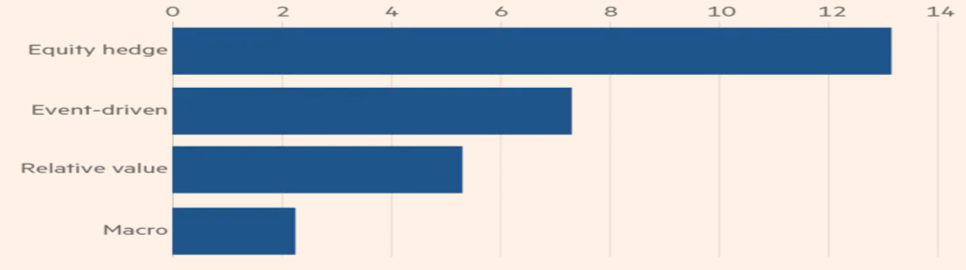
Which strategy works best, this will be subjective to how the market is bearing what strategy and a lot of other factors. But, a 2017 study on hedge funds found that Equity Hedge produced the highest results of 13.23% this being 5.56% more than the event-driven.
A 2004 study showed off a 15 year, analysis of hedge funds found that global macro showed the most prominent results in that period, while event-driven was second. Although, other studies have shown contracting results a later study in 2011 showed that long/short has a significant performance from 2004-2011. Research, on this, would say that it is variable to different factors markets, risk of the fund, and managers. Many studies have found conflicting results and in short, no real one has shown conclusive results.
How to go about Picking a hedge fund
This like most funds depends on what you are looking for in regards to an investment vehicle and factors such as investment time frame, level of risk will play a vital part.
But when looking for a good hedge fund. Look for a track record of producing results over the last five years and have these results been more than an index such as S and P to validate investing. How to go about looking into this.
How to pick a hedge fund – What method to go with and why?
From the list above of strategies, It is subjective on your time frame market and risk level to determine what kind of strategy suits your investment needs and what strategy.
I would state though on a personal basis. I find there is no point going for a hedge fund that can do what a fund could do or one that is looking to mitigate returns by contrasting results as would just invest in fixed assets or a diverse uncorrelated portfolio that would give the same results.
I would argue, the point for individual investors that if you are paying the fees for hedge funds and using them as part as an alternative in a portfolio you would want to aim for high results or at least a diversification of methods than what you would get through investing in funds (this is without doubt subjective).
So personally would prefer if possible quantitative (Two Sigma as an example) or leverage global macro funds as “pure alpha” funds that are said to have an average return of 12% a year over the last 20 years and only lost in 3 years. In a portfolio, as diversification would be added and different element that is not seen in mutual funds.
How to analyse the results?
Some funds, may have high results in the last year or even in the last 5 years, ( if related to global equities since 2015) but this doesn’t mean it is a creditable fund.
This may have been driven by global macro events. I would personally look for a hedge fund with a 2% rise over a major index (S and P 500) to justified fees over 5 years annualized return. But not, only this I would pay attention to both the sharp ratio (risk-adjusted rate of return) and the standard deviation of the fund. This will help assess if the fund is worth the risk in relation to the performance and if it has surfactant diversification (unless you are looking for a specific fund).
What metrics should I look for?
I would look at this the same way that you would picking funds. I have written an article on picking funds (below) and would use most of the technics (if you can depend on what type of hedge fund).
What site can I go to look at hedge funds?
More than 15,000 hedge funds operate worldwide with roughly $3 trillion in combined assets under management, according to ADV Ratings. A list of hedge funds can be found in the link below, with a table of the 20 biggest hedge funds tabled below by 2019 in terms of AUM.
The largest funds can earn millions of dollars per year and, in some cases, even billions. Here are the five biggest hedge funds as of mid-2019:
1. Bridgewater Associates
Bridgewater, the Connecticut-based fund of Ray Dalio, remains the largest fund in the world in terms of assets. The fund was founded in 1975 and now has $130 billion in assets under management. Dalio seems to have proven that the largest funds can still be highly profitable, and, according to Forbes, the hedge fund manager raked in over $1 billion in compensation in 2018.
2. Renaissance Technologies
James Simons, the co-founder of Renaissance Technologies, propelled his fund to the second spot on the list. Renaissance is one of the oldest and most popular quantitative firms, and its strategy has paid off significantly. The firm has roughly $68 billion under management and Simons had the most earnings of any hedge fund manager in 2018 after making $1.6 billion.
3. Man Group
Headquartered in London, Man Group is the third-largest hedge fund operator with more than $60 billion of assets under management. It provides a range of funds to institutional and private investors. James Man founded the company in 1783 as a sugar cooperative and brokerage firm. With shares listed on the London Stock Exchange, it is the largest publicly traded hedge fund in the world today.
4. AQR Capital Management
Cliff Asness, the co-founder of AQR Capital Management, has seen his firm’s assets grow to more than $60 billion since the firm was founded in 1998. AQR is the largest hedge fund representing the quant fund group and offers a number of different funds for high net worth and individual investors. However, the firm announced that it was cutting up to 10% of its workforce in early 2020 after losing substantial assets in 2019.
5. Two Sigma
Rounding out the top five is Two Sigma, another major player in the quant fund world. Thanks to its innovative technology, Two Sigma secured the fifth spot in this list of largest hedge funds by asset, with approximately $43 billion in assets under management. David Siegel, John Overdeck, and Mark Pickard established the firm in 2001.
| Rank | Firm | AUM as of second-quarter 2019 (millions of USD) |
| 1 | Bridgewater Associates | $132,050 |
| 2 | Renaissance Technologies | $68,000 |
| 3 | Man Group | $62,000 |
| 4 | AQR Capital Management | $60,840 |
| 5 | Two Sigma Investments | $42,900 |
| 6 | Millennium Management | $38,776 |
| 7 | Elliott Management | $37,769 |
| 8 | BlackRock | $32,909 |
| 9 | Citadel LLC | $32,243 |
| 10 | Davidson Kempner Capital Management | $30,880 |
| 11 | Viking Global Investors | $30,000 |
| 12 | Baupost Group | $28,900 |
| 13 | D.E Shaw & Co | $28,767 |
| 14 | Farallon Capital | $27,600 |
| 15 | Marshall Wace | $27,100 |
| 16 | The Childrens Investment Fund | $27,100 |
| 17 | Wellington Management Company | $22,000 |
| 18 | Winton Group | $22,100 |
| 19 | Capula Investment Management | $19,800 |
| 20 | York Capital Management | $18,500 |
What are the best performing hedge funds?
Hedge fund managers made $59.3bn for their investors last year in 2019, their biggest annual gains in at least a decade. Some of the best performings were LCH, although Bloomberg and other media outlets have reported a Singapore based fund Vanda is up 278% (as of mid-2019). But would recommend that this is a short term approach.
Tax on Hedge funds
This depends on where the hedge fund is based, as many will go offshore to low tax and themselves mitigate the tax though the patronship and company structure. But to the investors In the U.S and for one year more it is 15-20% on capital gains depends on your tax bracket. So will it is variable to where you form where the hedge fund is based, type of fund and where your residency is to what the tax rate is.
A conclusion should hedge funds be used in a portfolio?
I would say it is all on your risk level and liquidity requirements, investment objective and the amount you are looking to invest and return (this is subjective to a lot of factors and not on an individual basis and would seek financial assistance before investing). They do have a place in a high growth portfolio, research has shown, that they are less correlated to market and indexes and with a strong correlation between active and passive funds it gives some potential diversification, away from the correlated equities that you would have in a standards growth portfolio. With the lack of regulation (and more risk and volatility ), it can invest in different assets and strategies that are usually employed in the typical fund.
As well as this supporting research approved hedge funds have shown to performed higher in a bull market as a whole than funds. This is factored in (if applicable in regards to liquid and investment amount able).
But would state that it should be used as a balanced portfolio, as a lot of hedge funds have not shown to beat the market in bull runs and have been outperformed by index trackers. As well as the high level of risk and lock in should also be seriously considered.
In regards, to how much it stands again subjective but would use as an alternative in a portfolio. Therefor would use a guideline for the table depending on what your growth and investment time frame is (see table below).
| Conservative | Moderate | Balanced | Growth | High Growth | |
| Time Frame | 2 Years | 3 Years | 5 Years | 7 Years | 10 Years + |
| Return Objective | CPI + 1% | CPI + 2.5% | CPI + 3.5% | CPI + 5% | CPI + 6% |
| Int. Equities | 21% | 38% | 44% | 53% | 55% |
| Int. Properties | 5% | 10% | 14% | 17% | 20% |
| Fixed Interest | 50% | 38% | 26% | 13% | 0% |
| Alternatives | 0% | 0% | 10% | 15% | 25% |
| Cash | 24% | 14% | 6% | 2% | 0% |
If you want to find out more about how to use hedge funds in a portfolio please get in touch below.