
Anyone watching the U.S. stock market in 2025 has likely noticed one thing: a handful of mega-cap technology companies dominate the S&P 500 like never before. Microsoft, Apple, Nvidia, Alphabet, Amazon, and Meta alone make up close to a third of the index, and when you add Tesla and a couple of other heavyweights, the top ten names together represent more than a third of total market capitalisation. For investors who believe in diversification, this raises a natural question: Is the index too concentrated?
The truth is nuanced. Concentration is not a new phenomenon in markets, and there are historical precedents for what we see today. But there are also structural differences between now and previous episodes, particularly the dot-com bubble of the late 1990s. Moreover, the arrival of artificial intelligence (AI) as a genuine general-purpose technology adds another layer of complexity, with both bullish and bearish implications.
If you are an expat and want a second opinion or a portfolio review, please book a discovery call. A lot of the time, expats will ask me to review their portfolio as they have something in their portfolio they are unsure about (usually offshore bonds) or want to check the management fees or products.
Useful blogs which I have written for expats:
- Best Investment Platforms for Expats in 2025: Fees, Funds & Features Compared
- Best Offshore Banks for British Expats in 2025
Concentration Then and Now
Table: Dot-com Bubble vs Today compares concentration, valuations, and earnings quality.
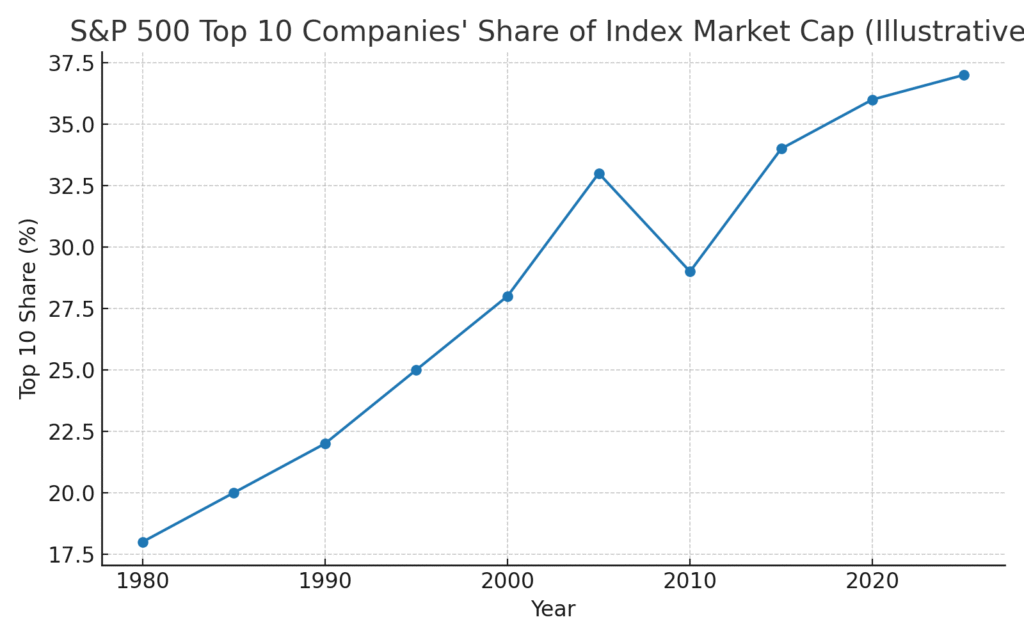
The S&P 500 has always had leaders. In the 1960s and 1970s, investors piled into the so-called “Nifty Fifty”, a group of blue-chip growth companies like IBM, Xerox, and Coca-Cola. Their dominance of the index was striking at the time. In the 2000s, the commodity super-cycle made energy companies disproportionately important. And in the late 1990s, the technology and telecom boom created narrow leadership in exactly the way critics are pointing to today.
The data make clear, however, that the current level of concentration is exceptional. The top ten companies now represent a larger share of the S&P 500 than at any other time in history. That means index investors are far more dependent on the fortunes of a handful of names than in the past, even compared to the dot-com era.
But concentration by itself is not necessarily a sign of impending trouble. Sometimes, leadership is deserved because the largest companies are genuinely the most profitable and productive. Other times, it is the product of speculative excess. The art of market analysis lies in distinguishing between the two.
Comparing Today With the Dot-Com Bubble
But concentration by itself is not necessarily a sign of impending trouble. Sometimes, leadership is deserved because the largest companies are genuinely the most profitable and productive. Other times, it is the product of speculative excess. The art of market analysis lies in distinguishing between the two.
Chart: Dot-com vs Today (concentration & valuations)
Table: (Bottom) The differences between the 2000s tech bubble and today.

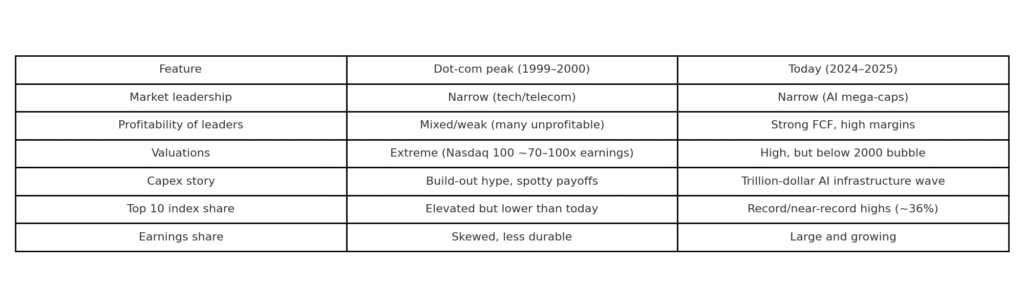
Superficially, the parallels with the late 1990s are obvious: a technology revolution, investors crowding into a handful of leaders, and valuation multiples climbing to elevated levels. In both cases, investors were buying into a narrative of transformative innovation that would reshape the economy.
The differences, however, are crucial. During the dot-com boom, many of the companies driving the frenzy had little or no profits. Business models were untested, and capital was being raised on promises rather than results. Valuations reflected speculation rather than fundamentals. When the bubble burst, most of those companies collapsed, and the leadership of the S&P 500 shifted dramatically.
Today’s mega-cap leaders are very different. Microsoft, Apple, Alphabet, and Amazon are some of the most profitable companies in history, generating hundreds of billions of dollars in free cash flow collectively. Nvidia has become the backbone of AI infrastructure, with data centre revenue growing at unprecedented rates. Even Meta, once left for dead after its pivot to the metaverse, has returned to growth thanks to disciplined spending and advertising strength.
Valuations are high, but they are not remotely at the levels seen in 2000. The Nasdaq 100 traded at 70–100 times earnings back then; today, the largest tech companies trade closer to 25–40 times, elevated but not absurd when set against their growth rates and margins.
Perhaps most importantly, the technology story this time is not based on ephemeral website traffic but on tangible infrastructure spending. The largest companies are pouring hundreds of billions of dollars into AI data centres, chips, and software ecosystems. This spending is not speculative in the sense of “if we build it, users might come.” Usage is already surging, and the revenue streams, whether cloud workloads, advertising, or enterprise subscriptions, are real.
A Global Perspective on Concentration
It is also worth remembering that concentrated indices are not uniquely American. Taiwan’s stock market has been dominated for decades by TSMC, which at times makes up more than 40 percent of its index. Korea’s market is similarly shaped by Samsung Electronics, often representing a quarter of the KOSPI. These countries have not been paralysed by concentration; instead, they reflect the dominance of national champions in sectors of global importance.
From this perspective, the U.S. looks less like an outlier and more like a market where the biggest companies happen to be global leaders in technology. Investors abroad have long accepted that a single firm can dominate a benchmark without rendering the index uninvestable.
Why Concentration Might Be Justified
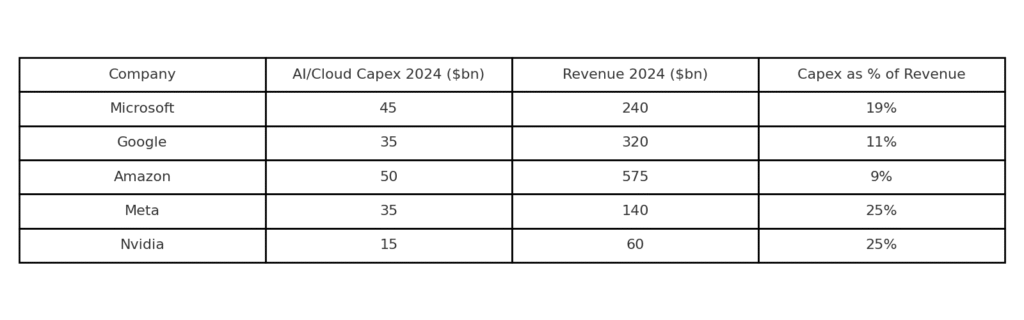
Table: AI CAPEX vs Revenge 2024
There is a strong case that today’s S&P 500 concentration is warranted. First, the earnings leadership of the mega-cap tech companies is real. Collectively, the top handful of companies generate a disproportionate share of index profits. They are not just large by market value but also by economic output.
Second, their return on capital is extraordinary. Cloud platforms, app ecosystems, and advertising networks have operating leverage that most traditional businesses cannot match. Margins are not only high but durable, thanks to network effects, scale advantages, and massive cash reserves.
Third, AI could prove to be one of the rare “general-purpose technologies” that reshape the economy in ways comparable to electricity or the internet itself. If that is the case, then being overweight, the companies that build and control the AI infrastructure are not irrational; it is rational. The largest tech firms have the distribution, developer ecosystems, and proprietary data to monetise AI at scale. In such a scenario, concentration simply reflects where the economic value is accruing.
Finally, the scale of investment is extraordinary. Microsoft, Amazon, Alphabet, and Meta are committing tens of billions of dollars annually to AI infrastructure. This is not vaporware but concrete spending on chips, power, and data centres. The sheer magnitude of capital deployment suggests a long-duration commitment that will have real economic consequences.
Table: Market cap weight vs Earnings weight of the top companies
Why It Might Not Be Sustainable
That said, there are equally compelling reasons to be cautious.
The first is valuation risk. Even if multiples are not at 2000 levels, they are still elevated compared with historical norms. High valuations leave little room for disappointment. If AI revenue takes longer to materialise than expected, or if margins are pressured by competition and costs, investors could see sharp drawdowns.
Second is market breadth. The S&P 500 has been rising largely on the strength of its top names. History suggests that when leadership is this narrow, forward returns can become more volatile. If the largest stocks stumble, the index could decline even if the broader economy remains stable.
Third is uncertainty over the return on AI capital expenditure. Companies are spending at an unprecedented pace, but whether every dollar will generate proportional revenue is unclear. There is a risk that competition commoditises AI services faster than expected, driving down margins and delaying payoffs. For every success like Nvidia, there may be multiple companies struggling to monetise AI products profitably.
Finally, there are macro and policy risks. AI data centres require enormous amounts of power, creating strain on energy grids and raising environmental concerns. Governments may intervene with regulations or restrictions. At the same time, the U.S. economy has become unusually reliant on tech-led investment. If growth slows or interest rates remain higher for longer, valuations could compress.
Can AI Spending Truly Pay Off?
The ultimate question is whether the massive spending on AI will translate into sustainable profits. On the bullish side, the revenue streams are already visible. AI workloads are driving cloud demand. Productivity suites are being priced with AI premiums. Advertising platforms are seeing improved targeting and engagement. Even hardware sales are benefiting from AI applications in both consumer and enterprise markets.
But the bear case emphasises unit economics. AI models are expensive to train and run. If customers baulk at high inference costs, providers may struggle to maintain margins. Open-source alternatives could erode pricing power. And while AI assistants and copilots are exciting, they may not justify the same level of willingness to pay that early adopters expect.
The truth probably lies in between. AI is real, but monetisation may take longer and follow a less linear path than the bulls anticipate. Investors should expect volatility as business models evolve.
A Balanced View
So is the S&P 500 too concentrated? The answer depends on how one interprets the sustainability of mega-tech earnings and the monetisation of AI.
On one hand, history teaches us that periods of narrow leadership can last longer than sceptics expect. The Nifty Fifty stayed dominant for years before fading. Oil companies held sway for decades during commodity booms. It is possible that the current concentration simply reflects the reality that U.S. tech firms have a structural advantage in a transformative technology.
On the other hand, no era of extreme concentration lasts forever. Eventually, leadership broadens or reverts, whether through valuation corrections, regulatory changes, or the emergence of new industries. Investors should not assume that today’s giants will remain permanently dominant.
Conclusion
The current concentration of the S&P 500 is unusual but not unprecedented. Unlike 2000, the largest companies today are profitable, entrenched, and benefiting from a tangible wave of AI investment. That makes this episode different in important ways. Yet the risks are also real: valuations are stretched, breadth is narrow, and the payoffs from AI spending are not guaranteed.
For investors, the lesson is not to panic about concentration but to understand what it means. If you own an S&P 500 tracker, you are effectively making a bet on the fortunes of a small group of AI-driven mega-cap companies. That can work spectacularly well if AI lives up to its promise, but it can also hurt if reality falls short of the hype.
A balanced portfolio, with exposure beyond the current leaders, remains the most prudent approach. After all, history shows that concentration cycles always feel permanent in the moment, but eventually, they give way to new leadership.
Useful blogs for expats which I have written:
While the S&P 500 remains the benchmark for US equities, its diversification is at a 50-year low due to “mega-tech” dominance. In 2026, the top 10 companies account for a record percentage of the index’s total value, meaning a downturn in the AI sector can disproportionately impact the entire index. For many expats, “index heavy” now means being “theme heavy,” prompting a shift toward equal-weighted ETFs or active management to find value outside of the “Magnificent Seven.”
AI Circularity Risk refers to the concern that a significant portion of AI revenue is currently generated by tech giants selling services to AI startups that they themselves have funded. In 2026, analysts are watching for “Phase 2” of AI—the transition from infrastructure spending to actual enterprise monetisation. If companies cannot prove a return on their massive AI capital expenditures, the S&P 500 could face a structural repricing. Investors are increasingly hedging this risk by diversifying into “Anti-Momentum” sectors like utilities and logistics.
Expats can reduce concentration risk by rebalancing into ex-US international funds or multi-asset offshore platforms. With US valuations at historic highs relative to earnings, many high-net-worth investors are looking toward emerging markets (like India or Southeast Asia) and “real assets” such as commodities and infrastructure. Using a Personal Portfolio Bond (PPB) or a SIPP to hold a blend of global ETFs can help ensure your wealth isn’t solely dependent on the performance of a few US tech stocks.