When selecting funds, for either myself or clients. I use quite strict measures, with independent rating agencies, fund size, performance over the last 5 years, the fund managers, if it has produced Alpha, and outperformance of the relative benchmark with an investment aim that makes it unique. As I argue why else should I invest in it over investing in a lower-cost index fund?
As I am under the illusion that if you are going to invest in a global equity fund that is actively managed it should look to outperform a low-cost index fund and not many do outperform these index funds.
To be honest, the market has a lot of average performers, but Morgan Stanley both global brands and Opportunity fund, are both in the top quartile of my personal equity funds selection (I am not paid to use them and actually have a small $100 a month plan in opportunities on its own as I thought it was a good fund) and will go through the reasoning why.
Global Brands uses an old fashioned way that Warren Buffets uses as one of his ways to seek good stocks. This being that the funds will still be around in 10 years’ time and will still grow. Names that you will have directly or indirectly come in contact with several times a day and continue to use.
MS Opportunity seeks large companies that are going to grow and outperform the market.
Global Brands review
The size of the fund is big. Of course it has its name, Morgan Stanley behind it and that helps. However, normally a fund doesn’t get that big if it constantly underperforms and doesn’t return to investors. I would say the modern-day investor is quite savvy to a good fund and quickly picks up on good or bad ones.
Why Do I Like It?
The Stocks

The funds top holdings are names that you would have heard, and most likely to use every day.
When we look further at the fund’s holdings, such as Microsoft, how many use Microsoft. I don’t just mean office, but Lindklin, Skype, Xbox. It has many more uses that nearly everyone comes into contact with most days and will continue to do so over the coming years.
The same goes for Reckitt Benkiser, its second-largest holding, Vanish, Colgan, Finish names that you might be familiar with but not where they come from. Yet most people will use one of their products every day.
With Coca Cola, it’s not just the fizzy black drink it owns a lot more than that, it’s brand Coca-Cola that you see in the supermarket. It owns water, other fizzy drinks (Fanta, Sprite) in fact it’s quite amazing what it does own and the other drink companies it holds which you may think are competitors.
The companies are not just one source but many different branches within themselves thus meaning the companies are not relying on one product, one revenue stream and one profit.
These and the other companies are names that are not likely to go away in the short term. Despite the macroeconomic situation. People will still need and use these products. So, therefore will continue to grow. Personally, I believe with all the mathematical metrics that are used to measure stock prices. People forgot to ask themselves the simple questions that will aim if a stock will do well in the long term.
- Will the company most likely be around in the next 10 years?
- Is it innovative and a leader in its sector?
- Do people use it or need it for everyday life?
Examples that answer this would be Amazon and Microsoft are two great example of this for a long term investor.

The funds aim

The funds aim is to look for brands that are developed on intangible assets, name or contracts, something not physical.
For example, look at the top two holdings Microsoft and Reckitt Benckiser.
Both have a solid distribution of named products that people trust and will continue to buy or use. Lets, take a look at the Reckitt Benckiser- You may not know the name but, you will have come across its products and highly likely that you use it on a daily basis.

The long term, growth of the fund, looks pretty stable with this aim.
What I don’t like is that the fund for a global equity fund still buys debt security, warrants, and preference shares. I get the attraction as it can be separate to equity, and preference shares have a higher rating but I am a believer in keeping it simple.
The performance

Although, this in itself, is not a reason to select a fund as past performance is never any indication to the present or future however when you use this in conjunction with its aim and see that it has stuck to the aim. By, outperforming the benchmark in both a bull and bear markets. It is a positive sign.
One criticism that I do have is that I do see it very correlated to the Indexes in global market cap market.
What the ratings say
The rating agencies are highly rated although, like most wouldn’t use this in content and not as a sole judgment. As it is of course not an absolute guarantee. The 10-year outlook is positive. Although, nothing is certain, personally I would be happy with most agencies giving it a positive outlook and to be rating constantly higher 5 stars, is a rare occurrence.


Split
It is heavily in equities that are in North America an Europe that are know to be heavily correlated from an equity standpoint.

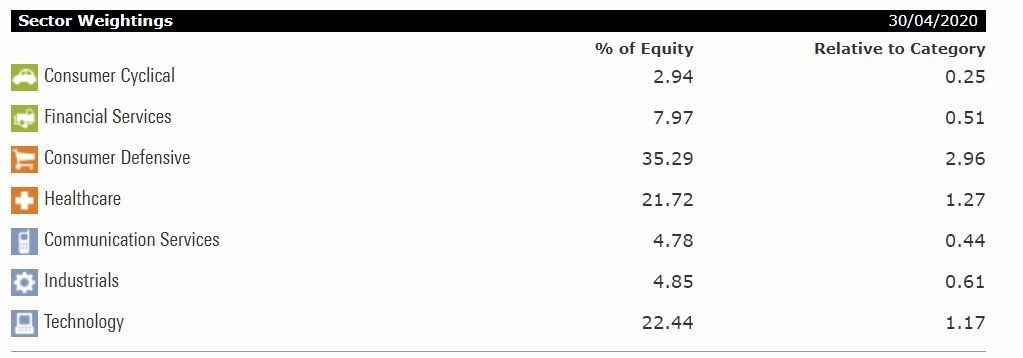
However, when we go further into the breakdown, we see that it is well diversified in sectors, and if go further the companies in these sectors see that they are uncorrelated and the companies themselves are quite diversified in what they do.
Look more in to the geographical split large-cap companies, is that they don’t just operate in one country in fact look at where the top companies get their revenue.
Where are they looking to get it in the future? They see emerging markets as promising as any other companies and are fighting to be part in that for their growth. So I would argue that large companies are already diversified geographically and in a better financial position to act on getting into emerging markets.
The Fees
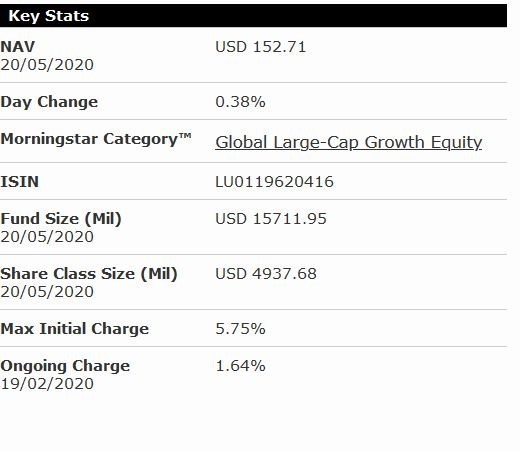
The fund charges high direct costs. So would be more advisable to go through a platform than paying the 5.75% entrance fee. Additional to the ongoing, at 1.64% a year. As don’t see this as feasible due to how correlated it is with large-cap indexes and would personally if this high go though, an S&P ETF for value.
Conclusion
The fund itself fits in well with an International equity portion of your portfolio and I would be happy to have for someone looking to achieve long term growth (10+ years) of 5+%.
The fund looks like it is mainly based in the U.S however, with the companies they have chosen, they are well diversified and in many other countries and are always looking to expand and can get in to the emerging markets. This is backed by ratings from independent agencies who rate a lot of funds and not many funds achieve a 5* rating.
What I would say is that, make sure that when looking at global stocks, make sure that the fund and the manager are beating the market, or else it would be wise to take a lower cost market ETF.