What to look out for if you are considering moving your pension or have moved your pension. Are you contemplating or have you already initiated the transfer of your U.K. pension abroad?
This article is a crucial read for expats, designed to empower you with insights on how to discern between commission-driven sales tactics and sound advice. Regularly inundated with emails about poorly invested pensions or excessive fees, I aim to shed light on potential pitfalls.
In this piece, we will delve into identifiable red flags for those amid pension transfers or those who have already completed them, particularly if you find yourself burdened by exorbitant fees. We’ll explore suspect platforms and highlight how advisors may increase their earnings through funds or structured notes tied to your policy.
Book a discovery call or contact me using the contact page on my website.
Expats Venturing Offshore Options
For expats residing abroad, the option to transfer pensions to Self-Invested Personal Pensions (SIPPs) or, in certain locations, Qualifying Recognised Overseas Pension Schemes (QROPs) is available.
Before deciding, it’s essential to weigh various factors. Many individuals have unknowingly transferred pensions for potential tax benefits, often resulting in commissions for advisors. Explore the link below for a comprehensive breakdown of the costs associated with QROPs and SIPPs:
While both options offer advantages, often hyped for commission-driven sales, the provided link explains the fees and provides insight into whether QROPs and/or SIPPs are the right fit for you.
A cautionary note: as of 2023, transferring amounts under 250,000 GBP to QROPs may not be advisable for most individuals. However, for larger sums, it could potentially mitigate tax liabilities and grant access to substantial lump sums if you meet the requirements.
It’s crucial to emphasise that this article does not constitute personal financial advice. For tailored guidance, please reach out to a qualified and competent financial advisor. If you wish to contact me, please use the button at the bottom of the page.
I have been presented with the option of an offshore bond or incorporating it into my pension. Is this acceptable?
The short answer is no, at least not in most pension cases. Of course, the suitability will hinge on the bond’s setup terms and charges. To be fair, if used at the base cost for larger amounts, it can cost about the same as a platform, hovering around 0.2%. However, among the hundreds of emails received monthly regarding pension transfers, hardly any are used at the base cost. Therefore, I will attempt to elucidate the base costs of offshore bonds and explain why you should exclusively consider utilising an FCA-regulated platform.
Platforms such as Novia and Premium (Morningstar) typically incur lower costs, as offshore bonds can be employed to conceal commission. The FCA has become stringent on the use of offshore bonds in pensions, deeming them of little use.
In the following, I will discuss an article I have written about platforms and offshore bond costs. This will entail an exploration of the expenses associated with platforms and offshore bonds applicable to international pension transfers, shedding light on offshore bond charges.
The charges of offshore bonds
This is one aspect that can be a bit subjective.
Before I go too much further, I want to explain that this is a commission lead platform, so you can have commission built into this product. This dramatically affects the cost of the platform.
Also, unlike FCA platforms, it allows funds to be charged upfront and trail for advisors, thus giving them another kickback. For this reason, be very wary of this fact and watch out if you are being recommended this platform.
Although having analysed it on my blogs, it does come out as an average cost with other bond options such as Quilter and Utmost, with full commission 7% upfront to the IFA.
Costing 1% a year for 10 years with an admin charge of 400 GBP. The 7% taken upfront is taken from the policy over the 10 years of the plan.
The study found that the RL360 PIMMs were best used for 20 years or more for the 10-year establishment charge option. This is because, after the first 10 years, the charges drop to just the admin charge (400 GBP or currency equivalent).
However, the problem with this is the lack of flexibility. The most common option being advised/sold is the 10-year establishment period, and many investors who have this product might want some flexibility within a 10-year time frame.
An example of how the charges work is: if you were to put $100,000 you would pay $1000 for 10 years (at the full commission of 7% to IFA), and the admin charges 400 GBP a year for the 10 years. Thus if you were to take out $50,000 at year 2 of the plan, you will still be paying $1000 (2%) for the next 8 years, plus the admin charges. This can eat up any gains.
This lack of flexibility and the fact I have noticed that for people who have had these policies, this information has been omitted in the past. Before investing, I would make sure you are fully aware of how the product works and the charges. You can ask for a full breakdown.
The commission vs full charges
The base charge for the 10 years is 0.067% (seen below) and has a surrender charge of 0.670% compared to the full commission. This makes it at least from a financial perspective much more competitive than the full 1% a year cost with less flexibility if the full commission. The illustration displayed is based on an investment of £1,000,000.00 to give the charge per year of 0.067%.
Base cost at 0.067% on a term of 10 years

Full commission (you can see if your advisors has or had charge 7% upfront)

PIMs have an upfront model where no exit charges exist, which provides some flexibility
As you can see from the images above the 7% upfront to the advisor is a much more costly route.
Add to this, the dealing charges are 40 GBP (the first 10 deals are free) which adds up to the cost of the portfolio.
How does the cost of offshore bonds compare to platforms?
In regard to platforms in the offshore or local market space, it doesn’t compare in terms of cost and flexibility. The flexibility is much less, and the costs are much higher.
Take for example, you were to put 100,000.00 GBP in a platform or offshore bond at the base and full commission cost.
One point to note is that the advisor can charge up to the full amount or take less commission upfront I.E 2%
| Platform | Admin cost (GBP) | Platform annual cost (GBP) | dealing cost (GBP) | Total cost (GBP) | Notes |
| RL360 10 Year surrender no commission | 400 | 67 | 20 | 467 (plus dealing and custody) | Lacks flexibility for 10 years and charges on the original premium |
| RL360 full commission | 400 | 1000 | 20 | 1400 (plus dealing and custody) | Lacks flexibility |
| Ardan | N/A | 400 | 5 GBP (40 GBP for notes) | 400 (GBP plus dealing charges) | Full flexibility |
| Novia | N/A | 350 | 5 GBP | 350 (plus dealing charges) | Full flexibility |
As can be seen from the table above, if completed on the base cost and compared over a 10-year time frame, it is pretty reasonable if you don’t move your investments over 10 times in that period.
If the base cost is compared to other bond platforms it does get a bit more complicated to analyse the charges as platforms have different establishment periods (please see my blog on offshore bond costs for a full review). However, some of the more flexible bond options, such as ITA, Movmentum, and Hansard, have been compared below.
| Platform | Admin cost | Annual cost | Dealing cost | Full cost | Notes |
| ITA Access portfolio plus | 450 | 1000 | 45 | 1450 | This includes 0.5% to the IFA but has full access for a short period of time |
| Hansard Z1 | 412 | N/A | 40 | 412 | 1% is charged upfront initially |
| Momentum | N/A | 650 | 40 | 650 | Fully flexible |
| ITA access 8000 | 450 | 250 (first 8 years) | 40 | 700 | The annual cost is only for the first 8 years |
Adviser Costs on Pension Transfers
The fees on pension transfers differ depending on what option you have chosen.
Fee-based advice – This can be a flat fee, an hourly rate, or a percentage. Fee-based advisors act as fiduciaries for their clients. They must work in the client’s best interests. This restrains them from a conflict of interest in selling products that are not deemed fit for the client.
The client must be given a variety of options regarding the portfolios deemed feasible for their level of risk and the advisor must assess all levels of risk before any recommendation.
Commission-Based – Advisors earn money solely on the products they sell to clients (mainly offshore bonds and funds). This is done from remuneration from the companies, funds, and platforms. In the offshore world, these are normally in a bond-like structure from the companies described above.
The regulation of the products is getting significantly better and the commission on pensions has been capped as of 2020. The regulation is still subjective.
For more information on offshore bonds, please feel free to read the article on offshore bonds.
I have transferred my pension into offshore bonds and am currently paying the full fees. What can I do?
This situation can be challenging, as offshore bonds often come with surrender periods of 5-10 years, depending on the establishment period when initially set up.
Consequently, transferring out prematurely incurs penalties, a result of the upfront commission paid to the advisor. To address this, I recommend consulting first with a fee-based advisor. Discuss your platform options and perform calculations to determine whether it makes sense to transfer to an alternative platform.
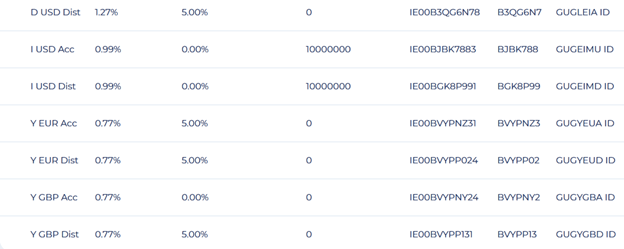
The second aspect to consider is the funds. In offshore bonds, funds may be invested in non-clean class shares, leading to significantly higher costs compared to clean class shares. For instance, a popular fund like Guinness Global Equity (as displayed on its website) has multiple prices, and advisors might place you in a higher-priced class to receive kickbacks from the fees—entry fees as high as 5% and an annual fee of 0.5%.
A helpful strategy is to check the ISIN on websites like Morningstar or the FT that document charges. The figure below, taken from the Guinness Global Equity Income fund, illustrates varying charges depending on the share class. It’s crucial to ensure you opt for the lowest cost. If you are considering moving your pension offshore, choosing FCA-regulated platforms such as Novia Global or Morningstar is a reliable way to access only clean-class shares.

What would I do if I was looking to transfer my pension overseas or already transferred?
Disclaimer: This is subjective, and I recommend consulting with a fee-based Independent Financial Advisor (IFA) about your specific options. However, I’ll provide a straightforward summary to enhance clarity for readers.
- If I haven’t transferred my pension, I would exclusively consider transferring to Novia and/or Morningstar platforms (as of 2023) if you are looking to transfer out of the U.K. These options offer competitive pricing costs, are FCA-regulated, and operate on a fee-based model only. Any alternatives outside the U.K. would not be my preference. Novia and Morningstar are among the most competitively priced platforms at 0.35% and 0.34%, respectively. Novia also offers a trust cost of £180, while Morningstar provides a Trust for a similar price. This simplifies the decision-making process and ensures transparent fees. For further details, refer to this article: Comparing Platforms: Novia vs. Morningstar for Expats
- If you have already transferred into an offshore bond, I would first assess cost-effective alternatives. Check the funds and portfolio to ensure alignment with your risk profile, focusing on clean-class funds, particularly ETFs.
- Seek fee advice and consider changing your advisor if they placed you in the offshore bond. They prioritise commissions over your best interests, irrespective of their demeanour.
Summary
Pension transfers are a huge subject because you may have pensions from previous employment and you may have varying types of pensions. Defined Benefit pensions are much harder to transfer, and a lot of the time they won’t be able to be transferred due to the surrounding legislation, reporting and concerns as to what has happened before. If you have a Defined Contribution pension, these are far more transferrable but it’s understanding what is going to be best for you and your long-term plans.
If you have any questions, please contact me using the button at the bottom of the page or by filling out the form on my contact page.
Further reading:
Following the abolition of the Lifetime Allowance, two new limits now apply: the Lump Sum Allowance (LSA) of £268,275 and the Overseas Transfer Allowance (OTA) of £1,073,100. If your total pension value exceeds the OTA, any transfer to a QROPS may trigger a 25% tax charge on the excess. For most expats in 2026, an International SIPP remains the more flexible, tax-efficient route as it avoids these specific overseas transfer penalties while allowing full global investment access.
Many UK providers (such as Nutmeg or standard workplace schemes) are increasingly restricting access for non-residents due to post-Brexit compliance. This does not prevent a transfer, but it does make it more urgent. You can still move your ‘frozen’ funds into an International SIPP hosted on an expat-friendly platform like Invinitive or Novia Global. This restores your ability to manage your investments and choose your own currency, regardless of where you live.
In 2026, the choice depends on your ‘Lifetime Allowance’ position and your long-term residency. QROPS are generally reserved for those with very large pots (£1M+) or those who are certain they will never return to the UK. For the majority of expats, an International SIPP is superior because it offers lower fees, no ‘lock-in’ periods, and the ability to move back to the UK without complicated tax reporting or penalties.
Free tools for this topic
All free tools →Free, no sign-up, nothing stored.

Henry Temple-Baxter
Henry Temple-Baxter is the founder of Investments for Expats and is CISI Level 4 qualified. A long-term expat himself, he has lived and worked in Kuala Lumpur, Beijing, Bangkok, Hong Kong and Ho Chi Minh City. He set up the firm in 2018 to give UK expats fee-only, transparent advice on pensions, tax and investing abroad.
This guide is general information, not personal advice. Tax rules can change and their effect depends on your circumstances. Capital at risk.