
On Thursday, 5 November, the market sold AI and chip stocks hard after Democrats won Congress. My view is that investors confused two different things: a slowdown in where and when data centres get built, and the end of the AI investment cycle. The first is likely. The second is not. But I also think AI was already priced for a great deal of good news, which is part of why the fall was so violent. AI can be one of the defining technologies of the century while some AI stocks are still too expensive.
What happened
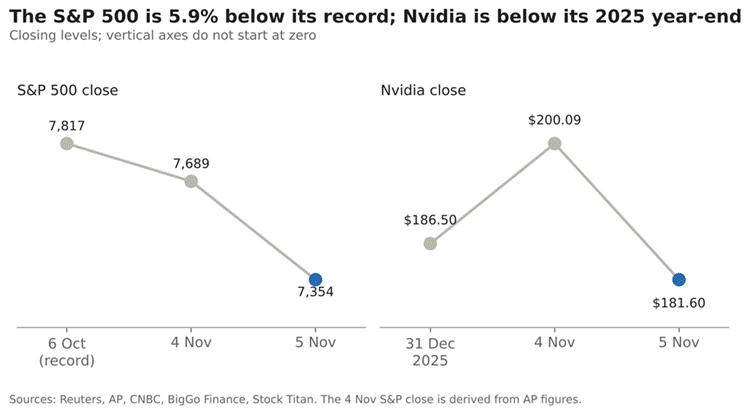
The S&P 500 fell 4.4% to 7,353.73, its worst day since April 2025. The Nasdaq fell 5.5% to 24,315, about 12% below its 6 October record, which put it in a correction. Chipmakers took the worst of it: the iShares Semiconductor ETF fell about 10.4%, its worst day since March 2020, and Nvidia lost 9.3% to $181.60.
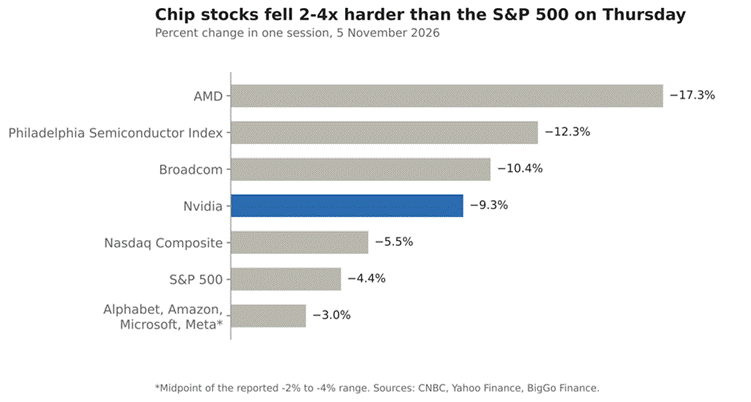
The election was the headline trigger, since Democrats won governorships in Texas and Georgia after campaigning partly on data-centre moratoriums. But it was not the only one. Qualcomm fell on weak guidance, Amazon and Alphabet had disappointing earnings, and Nomura’s cross-asset strategist described the unwinding of 2026’s most popular trades as “wildly acute” for over a month. A nervous market found a reason to sell.
Money talks, but it changes the conditions, not the outcome
This is more than a lobbying argument. Microsoft, Amazon, Alphabet, Meta, Oracle and Nvidia have the financial resources, the commercial incentive and the strategic reason to keep building. Alphabet alone has guided to roughly $175-205B of capital spending in 2026. These companies will not abandon an infrastructure race because some state governments add restrictions.
I would be careful, though. Money does not automatically defeat political opposition. What it does is change the economics of the debate. Developers can pay for new power generation and local grid upgrades, adopt water recycling and alternative cooling, sign long-term electricity agreements that protect residential customers, and bring jobs, tax revenue and infrastructure to the area. Political resistance is therefore more likely to change the conditions under which data centres are built than to remove the investment.
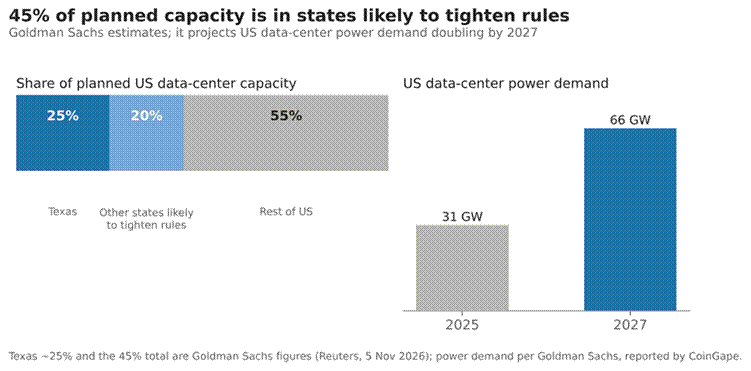
That does not mean every project goes ahead. Some will be delayed, cancelled, or moved, and not every state will welcome them: at least 14 have considered moratoriums, including Republican-led ones. Goldman Sachs estimates that states likely to tighten rules hold about 45% of planned US capacity, with Texas alone around 25%, and it expects temporary pauses there. The point is that capital looks for another location. Goldman also forecasts US data-centre power demand rising from 31 GW in 2025 to 66 GW in 2027, while expecting only 50-60% of planned capacity to come online on schedule. That is delay, not demand destruction.
A bipartisan strategic priority
I think this is the strongest argument. The US is competing with China for leadership in AI, and that is about far more than chatbots. It touches military capability, cybersecurity, scientific research, industrial productivity, semiconductors and economic influence. There is a real difference between opposing a badly planned data centre in your district and opposing America’s AI ambitions. Democrats can do the first without doing the second.
The record shows cross-party support for strategic technology investment. The 2022 CHIPS and Science Act passed the Senate 64-33. On 26 February this year, Democratic and Republican senators (Cantwell, Young, Hickenlooper and Blackburn) reintroduced the Future of AI Innovation Act to keep US leadership in the global AI race. And on 25 September, Republican senators Cornyn and McCormick and Democratic senators Fetterman and Gallego introduced a bill to keep Chinese optical transceivers out of sensitive government systems. To be fair, these are about standards and supply-chain security rather than data-centre permits, and the first has yet to pass. They show that AI leadership is a shared goal, not that Democrats will wave projects through.
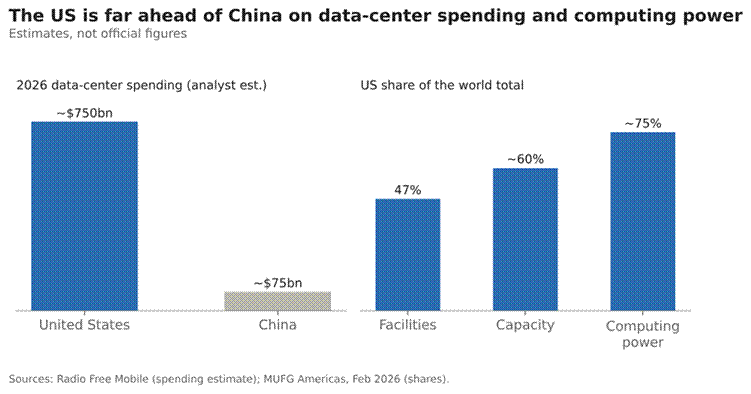
The competitive gap is real. One analyst estimates US data-centre spending at about $750B this year against roughly $75B in China, and the US has about three-quarters of global computing power. China, however, has roughly three times US electricity generation and is adding more. Power is where America is most exposed, which is why the argument over power and ratepayer terms matters more than a simple yes or no.
Falling behind in AI would have consequences extending well beyond the technology sector. AI could become a major driver of productivity, industrial competitiveness and military capability. Allowing China to establish a dominant position in these technologies would carry considerable long-term economic and strategic costs for Washington. This makes continued investment in American computing infrastructure a national priority, regardless of which party controls Congress.
The market was already expensive
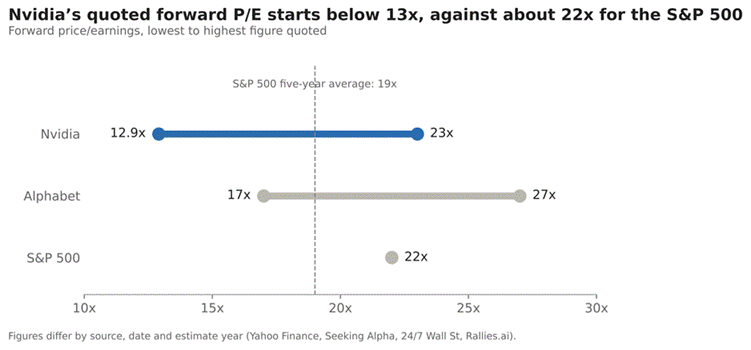
The AI boom has been running since ChatGPT launched in late 2022. On 6 October, the S&P 500 and Nasdaq closed at records, and Nvidia was approaching a $6 trillion market value. The S&P 500 was trading at about 22 times forward earnings against a five-year average near 19, and the Nasdaq’s fall on 5 November was its third correction of 2026. Investors had come to treat AI-driven growth as almost inevitable.
The economist Hyman Minsky explained why that matters. His Financial Instability Hypothesis says that long periods of stability push investors to take more risk, so that calm itself makes the system more fragile. Applied to AI, the pattern is easy to see. AI delivered real technological progress and large commercial investment. Strong share prices encouraged investors to raise their exposure, and valuations came to reflect optimistic assumptions about future earnings. Companies committed enormous amounts of capital to infrastructure, while rising expenditure has put pressure on free cash flow and increased financing requirements. Investors, meanwhile, became highly sensitive to any sign that growth might disappoint.
I would not overstate that financing point. The hyperscalers have substantial cash flows and strong balance sheets, so it would be misleading to call the buildout debt-fuelled. Alphabet, Amazon and Meta have each reported negative free cash flow recently, and Alphabet’s long-term debt reportedly rose from about $46.5B to $98.2B in a year. But negative free cash flow can be temporary when capital expenditure is unusually high: it is what you see when a company front-loads spending on assets that are meant to earn returns for years. It becomes a worry only if the revenue never arrives. The point is not that these companies are in trouble. It is that a market priced for perfection has less room for error, and a modest negative development can trigger an outsized reaction, which is what I think we saw.
Even Bank of America warned just before the election that the AI boom was a major risk to the global economy. None of this means the cycle is over. A market can be right about a long-term theme and wrong about the price, and a pullback is not proof that the thesis has broken. It can be a necessary repricing of expectations.
On valuation, I would be careful. Nvidia was quoted at about 12.9x forward earnings before the fall, but other sources had it near 23x in July. The figure depends heavily on which earnings year you use, so I would not treat it as proof of a bargain. Alphabet’s quoted multiple ranges from about 17x to 27x. What I would say is that Nvidia looks reasonable against its expected growth, and that its results on 17 November are the next real test.
A word on the election
This is opinion. I think this was largely a cost-of-living election. In an AP-NORC poll, 85% of voters cited the economy, and 84% the cost of living as major factors, and the Iran war’s effect on fuel prices was part of that. To hold ground in Republican strongholds, I expect Democrats to focus on affordability, including electricity bills. That favours negotiation over how data centres are powered and who pays, rather than outright bans.
The case against me
There is a serious bear case. Art Hogan of B. Riley argues that hyperscalers already have their data centres, so slower building makes those assets more valuable, which would hurt chipmakers like Nvidia while helping Alphabet or Microsoft. Even temporary moratoriums could delay orders, and Goldman itself expects only 50-60% of planned capacity on schedule. If investors lose patience with heavy spending, chip demand could weaken whatever politicians do. And a forward P/E is only as good as the earnings estimate behind it, while Minsky’s point cuts both ways: fragile markets can fall further before they steady.
Conclusion
Ultimately, I think investors need to separate the long-term AI investment opportunity from the short-term behaviour of financial markets. The technology is likely to remain one of the biggest drivers of economic change over the coming decade, but that does not mean the journey will be smooth or that every company involved will be successful. After several years of exceptional returns, some repricing was probably inevitable. Personally, I see this as a potential reset in expectations rather than evidence that the AI investment cycle has reached its conclusion.
Free tools for this topic
All free tools →Free, no sign-up, nothing stored.
This guide is general information, not personal advice. Tax rules can change and their effect depends on your circumstances. Capital at risk.