
This article will compare all of these options, and answer some frequently asked questions, including what smart beta funds are in human terms.
I have done a video going through Smart Beta.
Firstly, who are Dimensional Fund Advisors and Vanguard?
Many people know who Vanguard is. They are one of the biggest financial services groups in the world, with $5.6trillion USD assets under management as of 2019.
Founded by the late Jack Bogle in 1975, they are most famous for their index funds, which track a specific index, such as the S&P500 or MSCI World.
They do also offer actively-managed funds as well, although those funds have typically lagged their main index funds.
Fewer people have heard of Dimensional Fund Advisors (DFA). Headquartered in Texas, and founded in 1981, they have over $600billion USD assets under management.
With offices in over 13 different locations, they are fast growing. However, in terms of size, Vanguard is still much bigger:

Both firms focus on passive investments. The main difference is that DFA focuses more on value and small caps, and claim to use superior technology.
This is sometimes known as a “smart beta ETF” or index funds. It follows an index, so is passive, but also considers many factors in picking stocks within the index.
What is Smart Beta then in human terms?
This article doesn’t have enough time to discuss the difference between active, passive, and smart beta in all of its complexity, but I will summarise the basics here.
Traditional fund managers (“active managers”) try to beat the stock market by picking specific stocks or sectors that will outperform – they are seeking alpha.
In other words, they charge you more than index funds, to try to beat the index.
Most active funds have historically failed in this mission, at least in the long-term. Many active managers can, and do, beat the S&P500 over a 2 or even 5-year period, but struggle over 20 years or more.
The few areas of outperform remain in areas like small caps, as the chart below shows.

In comparison, index funds, or passive investment funds, are merely trying to get the market average – a small cost for getting access to that fund.
So for example, last year the S&P500 went up by about 28%. So passive funds would give you 28% – costs (about 0.1% for holding the funds).
Smart Beta, in comparison, is somewhere in the middle. It is also relatively cheap like the passive funds but isn’t quite as passive as pure index investments.
However, they are different in that it uses computer algorithms to try to take advantage of market inefficiencies. So beating the market, not from the human touch, but with technology.
Advocates of smart beta claim it is the best of both worlds; the low costs of passive funds but the “brains” of an active fund.
So unlike iShares, BlackRock, and other index funds which often are almost identical to Vanguard in terms of fees and performance, there is a reasonable difference between Vanguard and DFAs.
DFA tends to charge about 0.15% more per year for the funds, as compared to Vanguard or iShares.
Do these differences affect performance?
DFAs haven’t been around for a long enough time to make any concrete conclusions. In another 30 years, we will have a better idea about the reality of their claims to offer over -performance.
However, in the last 10-12 years, Vanguard has often beaten DFAs marginally. Even where DFA has come out on top, the difference is marginal, and only for a few years.
Take the DFA U.S. Large Company Portfolio, which is similar to the S&P500 Vanguard Index. As per the stats below, DFA has beaten Vanguard some years, and trailed during other periods:
| Year | Index -benchmark | DFA Large Cap | Vanguard S&P |
| 2019 | 27.6% | 27.59% | 27.56% |
| 2018 | -4.38% | -4.43% | -4.42% |
| 2017 | 21.83% | 21.73% | 21.78% |
| 2016 | 11.96% | 11.90% | 11.93% |
| 2015 | 1.38% | 1.38% | 1.35% |
| 2014 | 13.69% | 13.53% | 13.63% |
| 2013 | 32.39% | 32.33% | 32.33% |
| 2012 | 16.00% | 15.82% | 15.98% |
| 2011 | 2.11% | 2.10% | 2.09% |
| 2010 | 15.06% | 15.00% | 14.91% |
| 2009 | 26.46% | 26.62% | 26.49% |
In some ways as well, the above figures are not a completely fair example, because the DFA fund tilts their focus to small caps, which have done better in recent years, compared to larger cap indexes.
So DFA large-cap vs Vanguard S&P500 isn’t an exact apple vs apple comparison. It is more like apples vs apples and with some oranges in the same basket!
If we extend the category search to small caps, international large caps, and other categories of funds, we find that Vanguard slightly beats DFA with lower expense ratios, and also lower volatility.
From 2009 until today, I found Vanguard has a slight 0.13% per year advantage across a wide range of the most popular funds.
Hardly a huge advantage, but it does show that beating Vanilla index funds isn’t easy on a consistent basis.
Frequently asked questions
This section will answer some frequently asked questions (FAQs) that haven’t been covered already in the article.
What are some of the arguments in favour of smart beta that hasn’t been covered already?
In addition to the arguments mentioned above, supporters of these funds claim that smart beta gives investors a better risk-adjusted performance.
In effect that they won’t always beat the market, but they will give you a better performance relative to the volatility of the fund. In other words, they might fall less, when the general market is down.
Another argument is that the US market is very weighted in favour of the biggest firms by capitalisation such as Apple, Amazon and Netflix, that have super high valuations.
So according to proponents of smart beta, they can add value by strategically picking, weighting and rebalancing the stock picks that are built into the index.
So it isn’t a purely weighted index fund, and this can reduce risks.
Can you buy dimensional fund advisors online?
You can’t currently DIY invest DFM investments. You need to go through an advisory firm. The reason is to stop “hot money” coming in and out, like what happened to Vanguard in 2009, and during previous stock market crashes.
DFM want people to buy and hold, which they assume is more likely to happen through advisory firms.
There is certainly some degree of truth to this statement. Various studies have shown that investors that are in index funds, still try to time the markets.
This contributes to results like the ones below:
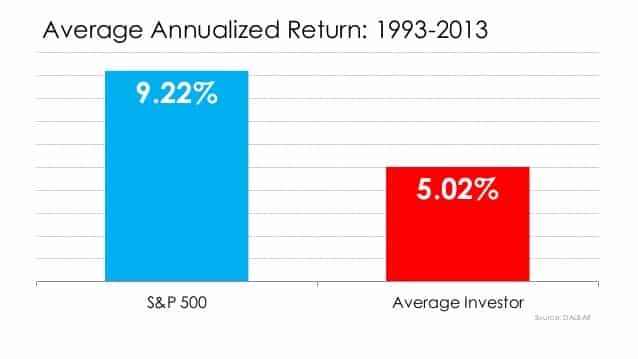
I have personally lost count of the number of people I have met, that have stopped investing due to Trump, Brexit and various other political events.
How about Vanguard in comparison to iShares and other index funds?
What is most interesting is, if we compare Vanguard with iShares ETFs, the performance is also very similar. The same is true with BlackRock or HSBC (UK) index funds.
Ultimately most index funds these days, are relatively similar, with the exception of these “smart beta” ones like from DFA.
So investindo with Vanguard over iShares won’t give you a huge advantage.
What does Jack Bogle think about smart beta?
The father of low-cost investing Jack Bogle, was unimpressed before his death with the idea that Vanguard, Dimensional Fund Advisors or any other firm, could beat the traditional index fund with smart beta tactics.
He commented that value and small caps will outperform during certain periods of time, but that doesn’t make over-performance over the long-term likely.
If smart-beta is winning, dumb-beta is losing, by the exact same amount. Meaning strategy A might work for investor A, but strategy B might not work for investor B.
What is most interesting about Bogle’s analysis, is that he contends that these funds don’t help improve risk-adjusted performance in the long-term – one of the key arguments proponents of smart beta use.
Vincent Deluard, also has some strong arguments, as per the video here. As he mentions, specific smart-beta funds can outperform for a short period, but that isn’t a good reason in isolation to invest.
What is particularly interesting about his analysis is what will happen if interest rate rise in the future.
What does Beta measure?
Beta measures the volatility of an asset. For example, if the S&P500 is used as proxy, the beta is one.
A stock that has a beta of 3 has a return which changes by three times as much as the general market – whether positive or negative.
Don’t small caps usually beat large caps?
Small caps have beaten large caps over the last 100 years, however, it depends on which time horizon you pick.
For example, small caps drastically beat large caps in the Great Depression, but have also trailed large caps during other periods.
Why is it easier to beat a small-cap index than the S&P500?
The S&P500 is mainly institutional money. That wasn’t the case in the 1950s or 1960s when the average investors were teachers, doctors and other individuals that often traded on emotions.
Now most owners are institutional – including banks and hedge funds. Small caps, especially in emerging markets, have less institutional investors.
That doesn’t mean in the US and UK, the small cap indexes are vastly different to the larger markets like the S&P500.
As per the graph below, many small cap indexes are also being driven by institutional money these days:

So beating a small cap index might be slightly easier than a large cap one, but has also gotten more difficult.
This trend has also lead to a situation where even great investors, like Warren Buffett, are struggling to beat the market.
Are most smart-beta funds alike?
Not all smart beta funds are the same. Dimensional Fund Advisors is just one option.
Each smart beta fund has its own methodology, bias and smart beta index to track.