
An offshore bond is an investment structure that offers investors the flexibility to manage when and how much tax they pay, as well as determine the tax jurisdiction involved. These bonds, also known as portfolio bonds or tax wrappers, are created by life insurance companies and set up in locations with favourable tax conditions, such as the Isle of Man, Luxembourg, Guernsey, or even Dublin, known for its regulatory standards and tax efficiency.
Global life insurance firms like Quilter International and Generali Worldwide commonly provide these investment vehicles. Within an offshore bond, investments can grow in a tax-efficient manner, benefiting from what’s termed “gross roll-up,” where tax on the investment growth is minimised, potentially enhancing returns.
Taxation becomes relevant only when funds, either as income or capital, from these bonds are repatriated into the UK, making it crucial for investors to understand the tax laws of their residency when they decide to cash in the bond. Therefore, choosing the right provider and locale is essential as it impacts taxation and access rules.
Though offshore bonds are often touted as low-cost and tax-efficient structures, careful consideration is necessary due to past associations with high fees and opaque sales practices targeting expats with risky investment options.
If you have any questions on whether an offshore bond is suitable for you, or if it’s in your portfolio and you want to make sure that it is optimal for your portfolio, please contact me using the button below or via my contact page.
I have linked videos and blogs which are relevant to offshore bonds at the bottom of this article.
Why Issue Bonds Offshore?
Offshore bonds serve as tax-efficient vehicles that can hold various assets, including stocks, shares, or mutual funds. The offshore setup adds a legal and tax-efficient layer often associated with life insurance policies. Structured to combine life insurance with investment portfolios, these bonds allow investors to manage assets efficiently.
They offer potential tax advantages and enhanced investor protection. While similar to onshore Open-Ended Investment Companies (OEICs), offshore investment bonds defer taxation on the gains and income from their underlying investments, distinguishing them from traditional fixed-income bonds, where investors lend money to entities at interest. This deferred tax feature is a notable difference between onshore and offshore bonds.
Offshore bonds offer a tax-efficient structure capable of holding a wide range of assets, such as stocks, shares, or mutual funds. One key reason for issuing bonds offshore is the ability to provide a combined legal and tax shield, akin to a life insurance policy, for an investment portfolio. These bonds are designed to integrate life insurance with investment management, allowing investors to purchase, manage, and trade their assets within this framework.
Issuing bonds offshore can provide significant tax benefits and enhanced investor protection. However, these offshore investment bonds, also referred to as portfolio bonds or wrappers, differ fundamentally from traditional bonds. Traditional bonds are fixed-income investments where investors lend money to an entity, like a corporation or government, which agrees to repay the funds at a fixed or variable interest rate over a specified period.
A major distinction between onshore and offshore bonds is the deferral of taxation. With offshore bonds, gains and income from the underlying investments are often subject to little or no tax during the investment term, offering a strategic tax advantage over onshore options, such as Open-Ended Investment Companies (OEICs).
Do Offshore Bonds Work?
We often evaluate offshore bonds and their providers, leading to a frequent question: “Do these offshore bonds work, especially for international executives?” Offshore bonds can indeed be effective investment vehicles for individuals with substantial sums to invest. However, their success largely depends on the transparency of their fee structures. If burdened with hidden commissions and high ongoing costs, even a promising investment solution can become less beneficial.
Therefore, the effectiveness of offshore bonds lies in their suitability for the investor and the absence of excessive fees and charges. When these conditions are met, offshore bonds can serve as a valuable financial tool.
Are Offshore Investment Bonds Taxable?
The taxability of offshore investment bonds depends on your personal tax status and the applicable rates. Generally, these bonds offer tax-efficient benefits, such as the ability to withdraw up to five percent of the investment amount each year as tax-deferred income. This feature allows for regular or accumulated withdrawals over a period of up to 20 years without triggering a taxable event.
A taxable event may occur if you exceed the five percent annual limit, fully cash in the bond, or if the last life assured on the bond passes away, leading to an income tax charge.
While tax deferral is often promoted as a significant benefit, especially to expats, it is essential to confirm whether this advantage is applicable and beneficial for your specific situation before relying on it.
Offshore Bonds Taxation
The tax deferral features of an offshore investment bond allow you to decide when to pay tax, typically when you decide to cash in part or all of your bond. The amount of tax due during such a chargeable event will depend on your highest marginal income tax rate at that time.
For many expats, it is advised to delay such events until they have moved to a low-tax jurisdiction, such as the UAE, or until their tax status changes, for example, from a higher to a lower or basic rate taxpayer, possibly upon retirement.
It’s important to note that if you move to or already live in a low or no-tax country, the benefits of tax deferral may not apply to you.
By placing your offshore bond within a trust, you or your beneficiaries may be able to reduce or eliminate the taxes incurred when transferring wealth. Assets exceeding the inheritance tax nil rate band not held in trust could be subject to a 40 percent inheritance tax.
Furthermore, an offshore bond or trust can be organised to allow you access to the funds during your lifetime.
It’s crucial to discuss these aspects thoroughly with a financial adviser to fully understand the features, benefits, risks, and tax implications specific to your situation.
Investing in Offshore Bonds: Key Facts
If you’re considering an offshore investment bond, here are some important points to understand:
Structure of an Investment Bond
Offshore bonds act as tax-efficient wrappers that allow you to invest in a variety of funds, which can include equities, fixed-interest securities, property, and cash deposits. These bonds combine the legal and tax benefits of a life assurance policy with an investment portfolio, offering potential tax advantages.
Taxation of an Offshore Bond
Offshore bonds are subject to chargeable event legislation, meaning that any gains are assessed for income tax rather than capital gains tax (CGT). Since the bond is held with an offshore insurer, it doesn’t incur income tax or CGT within the fund, except for any non-reclaimable withholding tax. Gains, dividends, rent, or interest generated within the fund are taxed at 0%.
UK Taxation for Bondholders
For individuals, chargeable event gains are subjected to income tax at rates of 20%, 40%, or 45%. Trustees are taxed at 45%. Taxpayers can apply their personal allowances and the standard income tax bands to determine their total tax liability. Trustees can enjoy a lower tax rate of 20% on the first £1,000 of chargeable event gains if no other income is present.
What is an Offshore Portfolio Bond?
An offshore portfolio bond is another term for an offshore investment bond, serving as a potentially tax-efficient investment wrapper that accommodates various assets like stocks, shares, and mutual funds. However, the tax efficiency of an offshore portfolio bond is not universally beneficial and depends significantly on your tax residency and personal tax status.
10 Reasons to Use an Offshore Bond
One of the most frequently asked questions our financial planners encounter is: “Why use an offshore bond?” Here are 10 key features of offshore investment bonds:
- Tax-Efficient Management: Offshore bonds serve as tax-efficient platforms that allow you to manage your investments effectively.
- Comprehensive Banking Facilities: They may include an offshore bank account along with a personal chequebook, credit card, and internet banking services.
- Simplified Tax Reporting: These bonds can simplify tax reporting, as they are not considered ‘income-producing assets,’ eliminating the need for self-assessment tax returns for individuals or trustees under certain conditions.
- Gross Roll-Up Advantage: Investments within the bond can be switched without triggering tax reporting or capital gains tax (CGT).
- Gross Income Receipt: Income generated by investments within the bond is received gross and subject to income tax only when the bond is fully encashed in the future.
- Time Apportionment Relief: Your income tax liability is reduced in proportion to the time spent as a non-UK resident. For instance, if you were a non-UK resident for half the time the bond was held, the taxable gain would be halved.
- Tax-Free Gift Assignments: The bond can be assigned as a gift without incurring an income tax charge, although inheritance tax (IHT) considerations may apply.
- Capital Withdrawals: You can withdraw up to 5% of the original premium each year for 20 years, treated as a return of capital, thus not subject to immediate taxation.
- Flexible Assignments: Offshore bonds can be partially or fully assigned to another family member or individual, unlike ISAs or pensions.
- Trust Flexibility: Bonds can be placed in or taken out of a trust without triggering income tax charges or CGT.
Gross Roll-Up Explained
The presence or absence of gross roll-up can drastically affect your investment returns. For example:
Imagine you invest $2, and that amount doubles every year over a twenty-year period. After twenty years, your $2 investment could grow to a staggering $2,097,152.
However, if that same investment were subjected to a 20% annual tax, similar to a standard basic rate tax, it would only grow to $254,964.
If a 40% tax rate were applied annually, the investment would shrink to just $24,178.
This example illustrates the substantial impact of taxation on investment growth, highlighting the importance of effective tax planning. Offshore bonds, when suitable, can be strategic vehicles to help preserve investment returns.
How Top Slicing Works
Top slicing is a tax calculation method that can impact UK residents with offshore investment bonds. Here’s an example to illustrate the process:
Suppose you have a taxable income of $40,000 above your personal allowance for the current tax year, and you realise a gain of $18,000 from your offshore bond, which you’ve held for four complete policy years.
The top-sliced gain is $18,000 divided by the 4 years, resulting in a $4,500 slice per year.
Your total taxable income is $40,000, and if the higher rate tax threshold is $45,000, parts of the slice will fall into both the basic and higher rate tax brackets.
Top slicing allows the tax rate to be applied proportionately to each slice.
In this scenario, $5,000 of your income, including part of the slice, is within the basic rate tax bracket, and the remaining $500 of the slice falls into the higher rate bracket.
- $5,000 x 20% = $1,000
- $500 x 40% = $200
The total tax on the slice amounts to $1,200, yielding an effective tax rate of 26.67% (($1,200 / $4,500) x 100).
Since your bond has been active for four policy years, you multiply $1,200 by 4 to calculate the total tax payable on the gain, which is $4,800.
While onshore bonds can use top slicing, it’s only applicable from the date of the last chargeable event, unlike offshore bonds that may offer additional benefits like time apportionment relief.
What is Time Apportionment Relief?
Time apportionment relief is applicable when an offshore bond is held by an individual who is a UK resident for only a portion of the time between the bond’s start date and a chargeable event.
In such cases, the chargeable gain is proportionately reduced based on the ratio of days the individual was not a UK resident to the total number of days since the policy began.
What is a Personal Portfolio Bond?
Personal Portfolio Bonds (PPBs) are life insurance or capital redemption policies that permit the policyholder to select a wider range of assets than those typically allowed under PPB legislation. Generally, if you hold assets such as structured products, individual stocks, or unauthorised investment trusts within your offshore bond, it may be classified as a PPB.
For UK residents, if your bond is designated as a PPB, you are subject to taxation on a 15% annual deemed gain, calculated based on your original premium and cumulative deemed gains, regardless of whether the bond actually appreciates in value. This deemed gain is taxed at your highest marginal income tax rate each year. While time apportionment relief may be available, top-slicing relief is not.
For example:
Imagine Sarah, a UK resident, invests a single premium of $700,000 in a policy. In the sixth year, she decides to cash in the policy for $750,000.
If Sarah’s policy didn’t contain any problematic assets and wasn’t classified as highly personalised, the taxable gain would be $50,000 ($750,000 – $700,000).
However, if her policy included non-compliant assets and was thus deemed highly personalised, she would face UK income tax each year on the deemed gain basis. Consequently, the tax liability could total approximately $183,000 by the end of the fifth year.
It’s important to note that no deemed gain is applied in the year the policy is fully surrendered.
If Sarah had initially lived overseas when she started the plan and moved to the UK in the fourth year without disposing of the problematic assets by the end of that year, her plan would be classified as a PPB at the end of that plan year. Consequently, she would receive a Chargeable Event Certificate for a deemed gain of $160,000. If she had sold the problematic assets prior to the plan’s anniversary, there would be no deemed gains, as the plan would not be counted as highly personalised.
When is My Bond Not Deemed a Personal Portfolio Bond?
According to PPB legislation, your bond will not be considered a Personal Portfolio Bond if it includes only the following types of assets:
- Property allocated by the insurer to an internally linked fund.
- Units in an authorised unit trust.
- Shares in an approved investment trust, or an overseas equivalent.
- Shares in an open-ended investment company (OEIC).
- Cash provided it is not held for speculative purposes.
- Interests in collective investment schemes, such as units in non-UK unit trusts or arrangements that confer rights similar to co-ownership under the laws of a country outside the UK.
- Shares in a UK Real Estate Investment Trust (REIT) or an overseas equivalent.
- An interest in an authorised contractual scheme.
Who Issues Offshore Investment Bonds?
Offshore investment bonds are typically issued by international insurance or life assurance companies located in low or zero-tax jurisdictions such as the Isle of Man and Dublin. These regions often have investor protection schemes, making the bonds attractive to both onshore and offshore investors.
Types of Offshore Investment Bonds
- Life Assurance Basis: These bonds terminate upon the death of the sole or last surviving life assured. They can be surrendered at any time, but may incur early surrender fees during a specified period.
- Capital Redemption Basis: These policies have a fixed term and provide a guaranteed value at maturity, such as after 99 years, ensuring at least double the initial investment, less any withdrawals. Like life assurance policies, they can be surrendered at any time, but may also be subject to early surrender fees.
Who Are Offshore Bonds Typically Sold To?
Offshore bonds are primarily marketed to:
- Non-UK Taxpayers: Investors who are currently, and will definitely remain, non-UK taxpayers at the time of a chargeable event.
- Individuals Planning to Live Abroad: Investors looking to take advantage of the ‘gross roll-up’ effect, such as those planning to live or retire in jurisdictions with lower income tax rates than the UK, where they would be subject to local tax on chargeable gains.
- Trust Fund Placement: Investors interested in placing their investment within a trust for inheritance tax (IHT) mitigation purposes.
Features and Benefits of Offshore Bonds
- Tax Deferred Withdrawals: Withdraw up to 5% per annum over a 20-year period without immediate tax implications.
- Withholding Tax: Dividends and other income may incur non-recoverable withholding tax.
- Low Local Tax Rates: Income and realised gains within the funds are either not taxed locally or may be subject to a low tax rate.
- Tax on Surrender: Higher or additional rate taxpayers pay tax at their respective rates on any chargeable gain upon surrender. Basic rate taxpayers incur a 20% tax, while starter rate taxpayers are taxed at 10%.
- Top-Slicing Relief: Available for basic rate taxpayers who become higher rate taxpayers upon receipt of bond proceeds, or higher rate taxpayers pushed into the additional rate band.
- Calculation of Chargeable Excesses: For chargeable excesses from part surrenders or assignments, the top slice is calculated by dividing the gain by the number of complete years since the policy began, regardless of any prior chargeable part surrenders or assignments.
- Compounding Effect: The benefits of income and gains accumulating gross can significantly enhance overall returns, particularly over the long term.
- Issuance from Tax-Friendly Jurisdictions: These bonds are often issued from low or no-tax jurisdictions, some of which provide investor protection policies; however, the level of protection varies depending on the jurisdiction of the issuing life company.
Consumer Protection Across Different Jurisdictions
Offshore bonds, by their nature, fall outside UK tax regulations, meaning they do not adhere to UK consumer protection laws. It is crucial to understand the consumer protection mechanisms provided by the jurisdiction of the offshore bond, such as the Isle of Man, Dublin, or Guernsey. Only after fully understanding and feeling comfortable with that protection should you consider using a provider that favours a particular jurisdiction.
Comparison of Tax Treatment: Onshore vs. Offshore Bonds
Main Issues with Offshore Investment Bonds
While offshore investment bonds can be valuable solutions for many onshore and offshore investors, challenges often arise from how they are marketed and sold.
- High, Hidden Fees: A significant issue that investors face is the prevalence of high, hidden, and confusing fees and charges. Excessively high charges will hinder even the most successful investments.
- Impact of Costs on Returns: In investment terms, higher costs equate to lower returns. Therefore, we strongly recommend a Second Opinion Investment Review for anyone with an offshore investment bond to ensure that their returns are not being eroded by unnecessary fees.
- Variable Fee Structures: Different wrappers, like Quilter International’s Executive Investment and Executive Redemption bonds, have distinctive fee structures based on the wealth management company selling them. Investors working with a fee-only financial planner may pay a one-off fee for bond establishment with minimal ongoing charges, while those relying on advisers seeking larger commissions may lose up to 9.5% of their investment over ten years due to regular management fees, or even more in the first quarter after inception if they need immediate access to their capital.
Typical Fees and Charges Associated with Offshore Bonds
Fees and charges vary widely among providers and bonds, often making them difficult to understand. Common costs may include:
- Establishment Charges
- Regular Management Charges
- Administration Fees (potentially charged quarterly)
- Dealing Charges (applied with changes to the underlying portfolio)
- Currency Dealing Charges
- Early Withdrawal Charges (can be as high as 9.5% in the first quarter for some bonds)
- Ongoing Service Charges (also known as trail commission)
- Annual Management and Other Fees from underlying fund managers
Cost Considerations
Offshore bonds typically carry different cost structures compared to investment platforms, often with higher expenses and less flexibility. For example, investing £500,000 through an RL360 bond could involve substantial base and full commission costs. Advisors might charge a commission that could be up to the full amount or opt for a reduced upfront fee, such as 2%.
| RL360 10-Year Surrender no commission | Admin Cost (GBP) | Platform Annual Cost (GBP) | Dealing Cost (GBP for ETFs/Funds) | Total Cost (GBP) | Notes |
| RL360 10-Year Surrender no commission | 400 | 67 | 20 | 467 (plus dealing and custody) | Lacks flexibility for 10 years and charges on original premium |
| RL360 Full Commission | 400 | 1000 | 20 | 1400 (plus dealing and custody) | Lacks flexibility |
| Ardan (Platform) | N/A | 400 | 5 | 400 (plus dealing charges) | Full flexibility |
| Novia (Platform FCA Regulated) | N/A | 350 | 5 | 350 (plus dealing charges) | Full flexibility |
| Platform | Admin cost | Annual cost | Dealing cost | Full cost | Notes |
| ITA Access portfolio plus | 450 | 1000 | 45 | 1450 | This includes 0.5% to the IFA but has full access for a short period of time |
| Hansard Z1 | 412 | N/A | 40 | 412 | 1% is charged upfront initially |
| Momentum | N/A | 650 | 40 | 650 | Fully flexible |
| ITA access 8000 | 450 | 250 (first 8 years) | 40 | 700 | The annual cost is only for the first 8 years |

The commission vs full charges
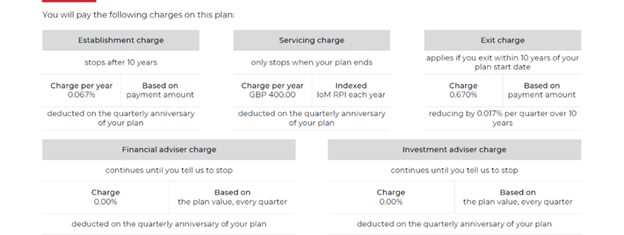
The base charge for the 10-year period is 0.067% (seen below) and has a surrender charge of 0.670% compared to the full commission. This makes it, at least from a financial perspective, much more competitive than the full 1% a year cost with less flexibility if the full commission, where the advisor will get up to 7% upfront.
If you have a question, please use the button below to contact me.
Conclusion
Offshore bonds can work for expats in their portfolio; however, it has to be under the right circumstances.
Many offshore bonds are sold under the guise of a tax reduction, which is correct if you live in areas like the UK or you plan to return to the UK. However, if you live in low or zero-tax areas, they are likely inappropriate for you.
The fees and costs can be reasonable on larger sums of money, but if you are working with smaller amounts, there are likely to be alternatives which would be better.
The tax efficiency comes through the roll-up or withdrawals, and these can be planned to be the most efficient for you.
To understand more, please watch my videos and read my blogs, which are specific to expats in Southeast Asia.
Any questions, please contact me using the button at the bottom of the page or my contact page.
Further reading:
- https://investmentsforexpats.com/rl360-pimms-review/
- https://investmentsforexpats.com/red-flags-for-uk-pension-transfers/
- Best Investment Platforms for Expats – 2023
One of the most powerful features of an offshore bond is the ability to withdraw up to 5% of the initial investment per year (cumulatively) without any immediate UK tax liability. For an expat returning to the UK, this allows for a tax-deferred “income” stream. If you don’t use your 5% allowance in one year, it rolls over to the next (e.g., after 10 years, you could technically withdraw 50% of the initial capital tax-free). However, it is important to remember that this is a deferral, not a total exemption; tax will eventually be due when the bond is fully surrendered or “encashed.”
The primary difference is the “Tax Wrapper.” An international platform is a General Investment Account (GIA) where you are liable for tax on dividends and capital gains as they occur. An offshore bond is a life insurance contract that provides “Gross Roll-up,” meaning no tax is paid within the bond on capital gains or income. In 2026, we generally advise that for portfolios under £500,000, the high administrative fees of a bond often outweigh the tax benefits. However, for HNW individuals moving to high-tax jurisdictions, the bond’s ability to “hide” taxable events from local authorities can be a major advantage.
With the UK government announcing that pensions will be brought into the Inheritance Tax (IHT) net from April 2027, many expats are looking for alternatives. An offshore bond can be placed into a Discretionary Trust, which effectively removes the value of the bond from your estate for IHT purposes after seven years. Unlike a pension, which will soon be hit with a 40% IHT charge upon death, a bond held in trust can provide a way to pass wealth to beneficiaries much more tax-efficiently, provided the structure is set up before repatriating to the UK.
Videos which further explain offshore bonds: