How do you navigate bonds and fixed interest within a portfolio as an expat? Well, I have written this guide for expats to help them understand how they can use these types of investments to their advantage inside and as part of their portfolio.
With the Fed funds rate just over 5%, finally after over a decade of interest rates being just positive, you are getting paid to have money in near risk-free assets, short-term T-bills, Gilts, and money markets.
History of the Fed funds rate: 2021 source CNBC

However, J Powell indicated in his last speech for June that the Fed is pausing interest rates and is likely to hike twice more in the future.
It’s highly likely, depending on economic indicators data, to come down sooner rather than later (Fed before the ECB) aiming to get inflation near the 2% level, where every developed market central bank’s target is for 2024/2025 or as soon as possible. This will mean that money markets and short-term T-Bills may not yield as high as what are presently doing. Therefore, you may want to look further ahead for your portfolio and for other assets/strategies to make the most of your portfolio.
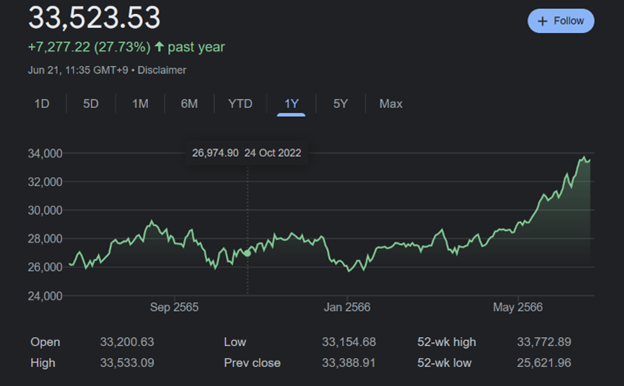
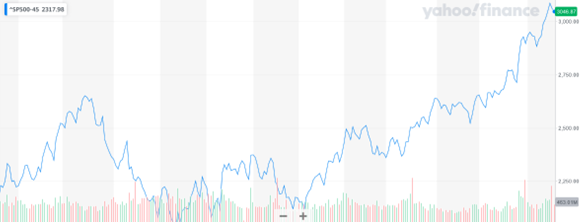
Many analysts and CIOs at large banks and asset managers are underweight to neutral equities in the short term. The reason being is due to the surge of certain tech stocks recently and the disparity between certain developed market indexes and the underlying economies.
Nikkei 225: 1 year 21/6/2023 source: Google finance
Euro Stoxx 50- 1 year return. Source: Google financa.

S&P 500 Information Tech index YTD (21/6/2023): Source Yahoo Finance.
https://www.wealthbriefing.com/html/article.php?id=195732
It seems the logical asset for less volatility (historically speaking) bonds should be an option.
With Investment grade short-duration bonds yielding 5% plus on average. If you are willing to get technical and to invest in individual bonds on the secondary market some are at a 15% discount to par.
Bonds Logistics
This is to cover a quick overview of bonds and how the asset class works by explaining the yield curve bond strategies in brief and credit ratings on bonds. If you are familiar with bonds you can skip to part 2 of the section on recommendations. This is just to aid you to get an understanding of bonds that in turn will help understand the rationale for why the funds below have been selected.
Bonds can be quite complex to understand so will aim to do my best to explain the logistics, bond strategies, and yield curve so that you can comprehend the bond recommendation after. For more information here is another link for you to read as well:
https://www.investopedia.com/financial-edge/0312/the-basics-of-bonds.aspx
What are Bonds:
Bonds are fixed-income securities issued by governments, municipalities, and corporations to raise capital. When you invest in a bond, you are essentially lending money to the bond issuer in exchange for regular interest payments (coupons) and the return of the principal amount (par value) at maturity. Let’s break down the logistics of bond returns, investing at a discount, collecting coupons, total returns, and different bond strategies.
- Return on Bonds if Held to Maturity: When you hold a bond until its maturity, you will receive periodic interest payments (coupons) and the return of the principal amount (par value). The coupon rate is expressed as a percentage of the bond’s par value and represents the fixed interest payment you’ll receive annually or semi-annually. At maturity, you will receive the par value of the bond, which is the face value stated on the bond certificate.
For example, if you purchase a bond with a par value of $1,000 and a coupon rate of 5%, you will receive $50 in interest payments each year until maturity. At the bond’s maturity, you will also receive the $1,000 principal amount.
- Investing in Bonds at a Discount to Par and Collecting Coupons: Sometimes, bonds can be purchased on the secondary market at a price below their par value, creating a discount. The discount is determined by market forces such as changes in interest rates or the creditworthiness of the issuer. If you buy a bond at a discount, your return will consist of the following components:
- Periodic coupon payments: You will receive regular interest payments based on the bond’s coupon rate and the discounted price you paid.
- Capital gain at maturity: As you purchased the bond at a discount, you will benefit from a capital gain at maturity when you receive the full par value.
For instance, if you buy a $1,000 bond at a discount price of $900 with a 5% coupon rate, you will receive annual interest payments of $45 ($900 x 0.05). At maturity, you will receive the par value of $1,000, resulting in a capital gain of $100 ($1,000 – $900).
- Total Return of Bonds and the Inverse Relationship with Interest Rates: The total return on a bond includes both the interest payments and any capital gain or loss. Bond prices and interest rates have an inverse relationship. When interest rates rise, the price of existing bonds tends to fall, and vice versa. This relationship occurs because as interest rates increase, newer bonds with higher coupon rates become available, making existing bonds with lower coupon rates less attractive. Consequently, the price of existing bonds must decrease to increase their yield and match the prevailing market rates.
The total return of a bond can be higher or lower than the yield to maturity depending on market conditions, holding period, and the presence of any capital gains or losses due to interest rate fluctuations.
Bond Strategies Used
A few Bond Strategies are commonly used: Laddering and Barbell:
Laddering is a bond investment strategy that involves diversifying your bond portfolio by purchasing bonds with different maturities. Instead of investing all your funds in a single bond, you spread your investment across multiple bonds with staggered maturity dates. This strategy helps mitigate the impact of interest rate changes, provides a regular income stream, and allows for reinvestment opportunities as bonds mature.
For example, if you have $10,000 to invest, you could divide it into five equal parts and purchase five different bonds with varying maturities, such as one bond maturing in one year, another in two years, and so on. As each bond matures, you have the option to reinvest the proceeds at prevailing interest rates.
Barbell: The barbell strategy involves concentrating your bond investments at the two extremes of the maturity spectrum—investing in both short-term and long-term bonds while avoiding intermediate-term bonds. This strategy aims to balance income generation and liquidity with potentially higher returns.
By investing in short-term bonds, you gain liquidity and flexibility as these bonds mature quickly, allowing you to reinvest at higher interest rates. Simultaneously, investing in long-term bonds provides the potential for higher yields and acts as a hedge against declining interest rates.
Investment grade to Junk bonds explained
Investment-grade bonds are issued by entities, such as governments, corporations, or municipalities, which have a relatively low risk of defaulting on their debt payments. These bonds are considered safer investments because they are backed by entities with strong creditworthiness. They typically have higher credit ratings, which are assigned by major rating agencies, and offer lower yields (coupons) compared to riskier bonds.
Credit Investopedia: Image of credit rating in bonds and risk of default-
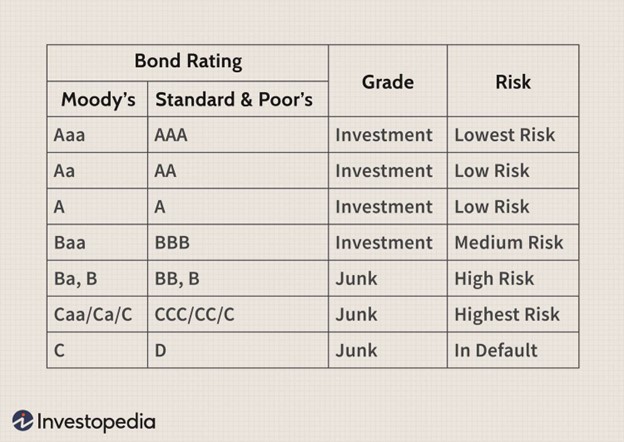
Junk bonds, also known as high-yield bonds, are issued by entities with a higher risk of defaulting on their debt payments. These bonds are backed by entities that have lower credit ratings and are considered more speculative investments. Due to the increased risk, investors demand higher yields (coupons) to compensate for the potential default risk associated with these bonds.
Credit Rating System: Credit rating agencies, such as Moody’s, Standard & Poor’s (S&P), and Fitch Ratings, assign credit ratings to bonds based on the creditworthiness and financial health of the issuing entity. The ratings assess the likelihood of the issuer defaulting on its debt obligations.
The credit rating system typically consists of letter-based ratings, with AAA (or Aaa) representing the highest quality and lowest risk, and D (or C) representing default or near-default status. Each rating agency has its own specific rating scale, but they generally share similar principles. For example, S&P’s credit ratings range from AAA to D, with AAA being the highest rating and D representing default.
The difference in Coupons: The coupon on a bond refers to the fixed interest rate paid to bondholders as a percentage of the bond’s face value (usually paid semi-annually). The coupon rate is determined by various factors, including the credit rating of the issuer and prevailing market conditions.
Investment-grade bonds, with their higher credit ratings and lower default risk, typically offer lower coupon rates. This is because investors perceive these bonds as safer investments, and therefore, they accept lower yields in exchange for the reduced risk.
On the other hand, junk bonds, with lower credit ratings and higher default risk, have higher coupon rates. Investors require a higher yield to compensate for the additional risk associated with these bonds.
It’s important to note that the credit rating agencies’ assessments of creditworthiness and the resulting ratings can influence the market perception of risk and impact the prices and yields of bonds.
Yield Curve Explained
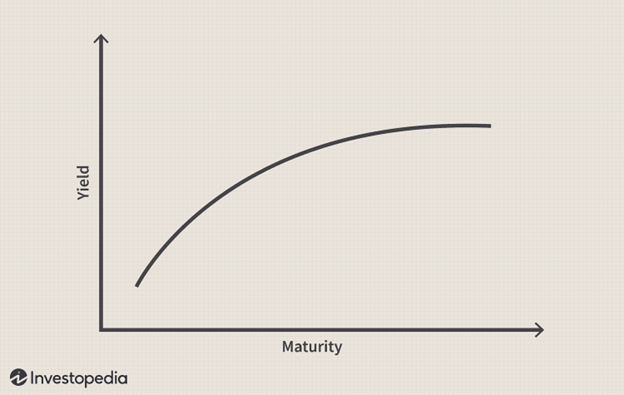
Yield Curve- Graph from Investopedia showing the relationship in the normal yield curve that investors should normally be compensated more for holding long-term bonds than short-term (of the same bond).
Inverted Yield curve: This happens in a period of economic uncertainty where short-term bonds yield higher than long-term bonds as investors rush toward short term less risky bonds. As you can see from the image, presently we are in inverted yield territory.
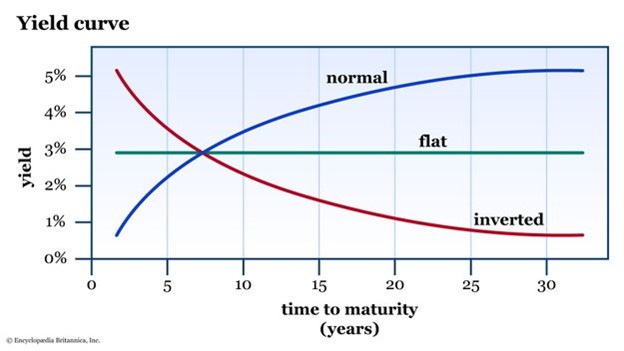
The yield curve is a graphical representation of interest rates (yields) for bonds of different maturities. It shows the relationship between the interest rate (vertical axis) and the time to maturity (horizontal axis). The yield curve can take different shapes, and its shape provides insights into market expectations and economic conditions.
- Inverse Yield Curve (Bleak Economic Outlook): An inverted yield curve occurs when short-term interest rates are higher than long-term interest rates. This situation is considered unusual and often indicates a bleak economic outlook. Investors typically demand higher compensation for the risk associated with short-term investments during uncertain times, leading to higher short-term rates. Meanwhile, long-term rates may be lower due to expectations of economic slowdown or recession.
An inverted yield curve is seen as a potential predictor of an economic downturn. It suggests that investors anticipate central banks to cut interest rates in the future to stimulate economic activity and combat recessionary pressures.
- Normal Yield Curve (Positive Slope): A normal yield curve occurs when long-term interest rates are higher than short-term interest rates. This positive slope is the most common shape of the yield curve, reflecting a healthy economic outlook. In normal market conditions, investors expect higher compensation for the added risk of lending money over a longer period. Hence, long-term rates are higher than short-term rates.
A positively sloped yield curve indicates expectations of economic expansion, higher inflation, and potential rate hikes by central banks in response to economic growth.
Strategies for your portfolio and funds?
Strategies for when interest rates are high and expected to be cut (like now):
- a) Extending Duration: Investors may consider moving from short-duration bonds to long-duration bonds. Longer-term bonds are more sensitive to changes in interest rates, so when rates fall, the value of these bonds tends to rise more significantly, potentially generating capital gains.
- b) Bond Swaps: Bond swaps involve selling existing bonds with lower coupon rates and buying bonds with higher coupon rates. This strategy allows investors to increase their current income by taking advantage of higher coupon payments in the market.
- c) Floating-Rate Bonds: Floating-rate bonds have interest rates that adjust periodically based on a benchmark rate (e.g., LIBOR). These bonds provide protection against rising interest rates as their coupon payments increase with rate hikes.
d) Treasury Inflation-Protected Securities (TIPS): TIPS are bonds designed to protect against inflation. Their principal value adjusts based on changes in the Consumer Price Index (CPI). Investing in TIPS can be beneficial during periods of high inflation expectations.
Personally, in the next few months, I would go for right in the belly of the curve investing in mid-term duration bond funds of investment-grade bonds during periods when the yield curve is transitioning from inverted to normal and it can be a strategic decision based on a few factors. Here are a few reasons why an investor might consider this approach right now:
- Yield Curve Expectations: When the yield curve is moving from an inverted shape to a normal shape, it indicates that longer-term interest rates are expected to rise. By investing in a mid-term duration bond fund, investors can position themselves to capture higher yields before they potentially decline as rates rise.
- Yield Pickup: Mid-term duration bonds generally offer higher yields compared to short-term bonds. During a transition from an inverted to a normal yield curve, short-term bond yields might be relatively low due to central bank policies aimed at stimulating economic growth. Investing in mid-term bonds could allow investors to earn higher yields than what short-term bonds offer.
- Potential Capital Appreciation: If an investor purchases mid-term duration bonds when the yield curve is transitioning, they may benefit from capital appreciation as interest rates decline. As the yield curve normalizes, the prices of existing bonds could rise due to the inverse relationship between bond prices and yields. This capital appreciation can enhance total returns for investors.
Three passive bond funds that emulate this to make use of this scenario are
- Vanguard Intermediate-Term Corporate Bond ETF (VCIT): This fund seeks to track the performance of the Bloomberg Barclays U.S. 5-10 Year Corporate Bond Index. It invests primarily in investment-grade corporate bonds with maturities between 5 and 10 years. VCIT has a low expense ratio and provides exposure to a diversified portfolio of high-quality corporate bonds.
- iShares Intermediate Credit Bond ETF (CIU): CIU aims to track the performance of the Bloomberg Barclays U.S. Intermediate Credit Bond Index. The fund invests in investment-grade corporate bonds, as well as government and agency securities with maturities between 1 and 10 years. CIU offers broad exposure to the intermediate credit bond market.
- Schwab U.S. Aggregate Bond ETF (SCHZ): SCHZ seeks to track the performance of the Bloomberg Barclays U.S. Aggregate Bond Index, which includes investment-grade U.S. government, corporate, and mortgage-backed securities with maturities between 1 and 10 years. The fund provides broad exposure to the U.S. bond market and has a low expense ratio.
However, the retail investor would also look at finding a good active bond fund as can employ (at least in theory) active strategies explained above potentially taking advantage of these strategies to yield higher performance (in theory) so would urge to look at these bond funds that are well established and large and have a good track record (however no guarantee that will continue) for an active strategy for the present economic climate:
- PIMCO Investment Grade Credit Bond Fund (PIGIX):
- Overview: PIGIX is an actively managed fund by PIMCO that aims to provide a high level of income while maintaining investment-grade credit quality. The fund primarily invests in investment-grade corporate bonds, but it also has the flexibility to invest in other fixed-income sectors. PIMCO’s experienced portfolio managers employ bottom-up credit research and macroeconomic analysis to identify attractive investment opportunities.
- T. Rowe Price Investment Grade Bond Fund (PRIGX):
- Overview: PRIGX is an actively managed fund offered by T. Rowe Price that seeks to generate income and preserve capital by investing in a diversified portfolio of investment-grade fixed-income securities. The fund focuses on corporate bonds but also includes exposure to U.S. government and agency securities, mortgage-backed securities, and other fixed-income instruments. T. Rowe Price’s investment team utilizes fundamental analysis and risk management strategies to make investment decisions.
- Fidelity Investment Grade Bond Fund (FBNDX):
- Overview: FBNDX is an actively managed fund offered by Fidelity Investments that aims to achieve a high level of current income by investing primarily in investment-grade fixed-income securities. The fund invests across various sectors, including corporate bonds, government and agency securities, mortgage-backed securities, and asset-backed securities. Fidelity’s experienced team of portfolio managers employs fundamental research and credit analysis to select securities with attractive risk-adjusted return potential.
3 Investments for Expats Fixed Interest Options.
As I believe fixed interest yields are back! We have looked at both the emerging market, global market, and investment grade for opportunities:
Creating CLN (credit-linked notes) on Investment grade bonds that have a higher yield than the bond of the respected entity.
For example, we have created a Ford-based CLN (in USD) where unless default were to occur within the time frame (5 years) the investor would receive an 8% a year coupon for 5 years unless default in the underlying entity or issuer occurs within that time frame. As this is 0.9% a year higher than the bond coupon for the time frame in Ford (see link below) it makes use of a pickup on the coupon.
https://markets.businessinsider.com/bonds/6_625-ford-motor-bond-2028-us345370by59
We can do this for most listed major indexed companies (on S&P 500, Euro Stoxx 50, FTSE 100, ASX 200, Nikkei 225) so will send over some of the options we are presently looking at if you are interested, please email me.
We also think that selective EM government bonds have a positive outlook for investors due to the respective risk/return.
Two that we particularly like are Indian and Indonesian due to the respected outlook and return.
However investing in these directly for a retail investor that is not a local in the respected country can be difficult as normally need to open up a brokerage in the country of the issuer, which normally means going to the country and navigating document in a foreign language, this comes with exchange rate risk (as dominated in the issuer’s currency) however, we are looking to create midterm (5 years) CLN in USD on both these government bonds with a coupon of around 6-7% for investors.
From a regulatory perspective this will only be open to 1) Sophisticated investors that do not require the liquidity with the term 2) Is in line with your investment and risk tolerance 3) Done as part of an overall balanced portfolio 4) If spoke to first and understand the associated risks verbally and been sent and read over the respected prospectus and KIID.
- Note rates may change depending on market conditions.
If you do have any questions about how to use bonds or the bespoke options in your specific portfolio and want to rebalance or diversify your portfolio please feel free to email me using the button below or through the contact page with your questions.
For more information, here are some articles I have written on bonds and notes:
- Offshore Bonds vs Global Platforms
- Offshore Bond Case Study
- Lloyds Bank Fixed Term Deposit Accounts with Ardan – How to guide