Table of contents
Why you should reconsider an offshore bond if you are using it for tax purposes.
Normally, estate planning and investing have not been associated with investment platforms due to not being protected from CGT and the inability to have a beneficiary, for expats offshore returning to places such as the U.K., who have opted for offshore bonds for a more tax-efficient option.
I have written about taxes in my previous articles on offshore bonds. Touching on aspects such as returning to the U.K.
To recap in brief:
If you go back to the U.K. with an offshore bond, you can withdraw up to 5% a year or all on one go if you decide to hold for 20 years. Allowing for a gross roll-up of gains. This made bonds very popular for estate planning (or at least sold on this factor).
Although these have been sold (or mis-sold) on the tax efficiency.
I have written in previous articles about how these are not as tax efficient as you might think or what has been led to believe. They can still be subject to taxes if you get a chargeable event, for example, withdraw 5% or more in the U.K., and it can get quite complex from a tax perspective if you take partial withdrawals, and you will have to rely on time appointment relief and/or top-slicing for mitigation of tax.
Furthermore, offshore bonds have been associated with high fees and long lock-in periods, making them very inflexible. This was due to the commission paid on bonds sold. In most cases, offshore bonds are not in your best interest as they have high fees and usually tie you in for a long period of time.
I have pointed out in a number of articles that bonds do have uses and have some fee-based offshore bonds at a base cost that are flexible and liquid. These are the options expats should consider if offshore bonds are for them.
- Offshore Bonds vs Global Platforms
- Offshore Bonds Explained
- Saving Plans and Offshore Bond Reviews for expats
- Popular Offshore Bonds for Expats Explained
Ardans Solution
However, the Ardan platform has put in (since last year) an option that helps mitigate taxes if moving back to the U.K., and the estate planning process is easier for expats.
Ardan’s platform cost is 0.4% making it lower than all of the bond options with no exit costs. Making it (for me at least) a more feasible option than most in the market. Speak to a fee-based IFA to see if it is feasible for you, as some might not be in your best interest, e.g you have larger amounts to invest.
Just a bit of quick background information on what is normal practice to mitigate CGT if returning to the U.K.
If you were in a platform, normally the practice of mitigating U.K. tax would be to sell your gains before you go back to the U.K., and if you were in a place such as the UAE (with no CGT tax) it would potentially mitigate the tax liability on the U.K.
Although this can be costly and not always work out best for you. For example, you might be in a fund that is presently down and may rise in that time period that you sold and bought back. Not to mention the extra transaction costs.
Ardan has introduced an option that allows for automatic reinvestment that doesn’t incur dealing costs or buying and selling back the funds. However, it will allow you to reduce your CGT if you are to return to the U.K.
The below is taken from the Ardan website, which describes the product they are offering:
How is it taxed?
The sale of any investments within the portfolio account or a switch between investments is a disposal for capital gains tax (CGT) purposes and may give rise to a capital gains liability. Investments held within the portfolio account may also receive taxable income in the form of interest or dividend payments. This income is generally paid to the cash account within the portfolio. The make-up of the underlying investment will determine if the income received is to be taxed as either interest or dividend income. The income generated is subject to tax regardless of whether this is accumulated, re-invested into the fund or paid directly to the client.
What is Capital Gains Tax
CGT is the tax when disposing of a chargeable asset. Only the gain (increase in value), after the deduction of any costs, allowable losses, and the annual exemption, is taxable and not the actual amount received. The assets held within the portfolio account are treated independently when calculating whether there has been a gain or loss for CGT. This makes it possible to dispose of one asset and retain another, therefore, allowing any CGT liability to be spread over different tax years.
Capital Gains Tax Annual Exemption
The annual exemption (per UK tax year) is available to each UK tax resident. The allowance is currently £12,300 and has been frozen until April 2026. If the gain falls within the annual exemption, there will be no CGT liability.
Example
Mr Smith has a share portfolio he bought in 2010for £10,000. He sells the whole portfolio in 2021 for £21,000, realising a gain of £11,000 (£21,000 -£10,000). The gain falls within the available CGT annual exemption of £12,300. Therefore, there is no tax liability. The annual exemption is deducted after any ‘allowable losses’ from the same tax year have been deducted. It cannot be carried forward to another tax year.
Dividend / Interest
An individual is able to receive £2,000 in dividend income each tax year before this is taxable. An individual also has a personal savings allowance that could allow either £1,000 or £500 (depending on other income) to be used against any interest income they receive. In some cases, individuals may be able to make use of the ‘starting rate of savings’, which allows an additional £5,000 to be used against any interest income received.
Allowable Losses
When a loss is realised from the disposal of a ‘chargeable asset’, this is called an ‘allowable loss’; these can be offset against any gains. To claim, any allowable losses must be reported to HMRC within 4 years after the end of the tax year that the assets were disposed of. It is only possible to claim an ‘allowable loss’ where the disposal of the asset would have resulted in a CGT liability had there been a gain.
Reliefs
There is no apportionment relief available on chargeable assets held by individuals whilst non-UK residents. Nor is there any form of automatic rebasing of the portfolio account when an individual returns to the UK. However, by using a process known as ‘bed and breakfasting’ it is possible to rebase the value of the portfolio account prior to becoming a UK resident.
Bed and Breakfasting
This process works by disposing of any assets held within the portfolio account while non-UK residents and repurchasing the same or different assets the following day. The future gain upon disposal will be calculated based upon the upshift in value after the assets were repurchased and not the original purchase.
Important Notes
Every care has been taken to ensure that the information provided is current and in accordance with our understanding of current law and Her Majesty’s Revenue and Customs’ (HMRC) practice as at January 2022. You should note, however, that we cannot take on the
role of an individual taxation adviser and independent confirmation should be obtained before acting or refraining from acting upon the information given. The law and HMRC practice are subject to change. You should bear in mind that tax rules can change in future and their effects on you will depend on your individual circumstances.
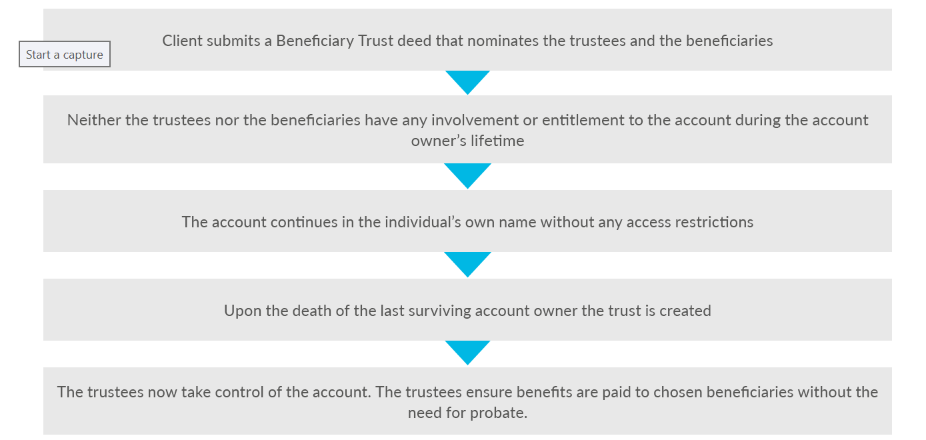
Although Ardan has developed a beneficial option to cope with probate. One aspect where this works better than an offshore bond is that the beneficiary can keep the account if they want to.
Figure 1: Taken from Ardans’ beneficiary PDF explaining how it works.
My thoughts & Summary
I do see how this is opted towards one platform, and I will aim to add any other platforms that have this option. However, I thought I would mention this topic as bonds have been mis-sold due to the tax efficiency and the ability to have a beneficiary, with many still getting sold. I wanted to debunk this myth, which I have done in other articles on taxation of offshore bonds, among others, that the need to go into an expensive, illiquid offshore bond should not be a prime driver.
I want most potential investors to be armed with this knowledge prior to making any investment decisions.
If you have any questions, please contact me through my contact page
Further reading that you might be interested in:
Unlike offshore bonds, which often come with high fees, long lock-in periods, and complex tax implications, the Ardan Platform offers greater flexibility, lower costs (around 0.4%), and no exit charges. It also allows beneficiaries to retain the account, making estate planning smoother for expats
The platform includes an automatic reinvestment option that helps reduce Capital Gains Tax (CGT) exposure when moving back to the UK. This avoids costly buy/sell transactions and can mitigate tax liability compared to traditional offshore bond strategies
“Bed and breakfasting” is a process where assets are sold while non-UK resident and repurchased the next day. This resets the base value of investments, potentially reducing future CGT liability upon returning to the UK. The Ardan Platform supports this strategy, making it easier for expats to manage tax planning effectively