I get asked what options are open to me in the expat market for saving and investing. I have done a number of reviews on options and reviews on specific platforms and funds in my blogs. However, I want to go over the main savings plans and bond options in the expat market.
These include saving plans, offshore bonds and investment accounts.
- Offshore Bonds Explained
- Popular Offshore Bonds for Expats Explained
- Offshore Investment Bonds For UK Expats
What is my review of popular bond options such as RL360 PIMS, OMI collective bond?
I have written, a number of articles, on bonds and yes they do have the benefits of gross roll-up structuring which is useful for Australian citizens returning to Australia. It can make a big difference to your tax liability, but the problem is that these are often missold and often not used correctly.
That is why you see so many bad reviews on the products, the products besides being high fees due to commission are mainly not to blame and are the advisors advising them as many expats in savings plans or offshore bonds are not happy, because they want to take capital and find they have heavy fees or even worse lose all your money.
I will put some, links to the articles that I have written about the reviews below, or feel free to ask me any question on the chat
- Savings Plan Reviews For Expats 2021
- RL360 Expat Review
- Old Mutual Executive Bond Review
- Old Mutual Bond Review: For Expats
Expat Savings Plans
I have written a review in 2021, about the saving plans.
I believe they can be better than keeping money in the bank if used right. However, again, most of these are not used right and so many times you see (well I do) 25 year plans with a high percentage of a personal income being paid in. It is just not feasible and most people end up not completing the plans and losing money instead of gaining money.
Most of the plans (Dominion/Platform One excluded that I know of) are set up as life insurance where the plans have 101% of the death benefit.
These plans have 5 to 30 years options. With 5-year plans normally cost a lot more and they are normally based in an offshore location such as IOM, Cayman Islands, or Guernsey.
The main problem, like have eluded above is that these plans have lock-in periods where you must contribute at least 12-18 months before you can take any money out. Even then it is based on the time left on the plan and the amount paid in. For example, if you have a 25-year plan and have paid the first 30 months and want to take all your money out you will get little to nothing back.
So, be sure that you can afford what you putting in. A tip here is if you are really looking to use these plans go for a shorter period of 10 years with around 10% of your salary (if can afford it) or with an amount that you will not notice. As the plans only really work if you use them to maturity, invest right and don’t take money out. Other than this. They are pretty useless.
If you have a plan you should have been told about the lock-in period if it has one. I often get questions (at least once a week) about expats that have these plans but they have stopped contributing and lost all their money. If you do have one of these I hope this article helps and if not feel free to get in touch to see if I can help you. However, to be honest you don’t have much wiggle room with these types of plans.
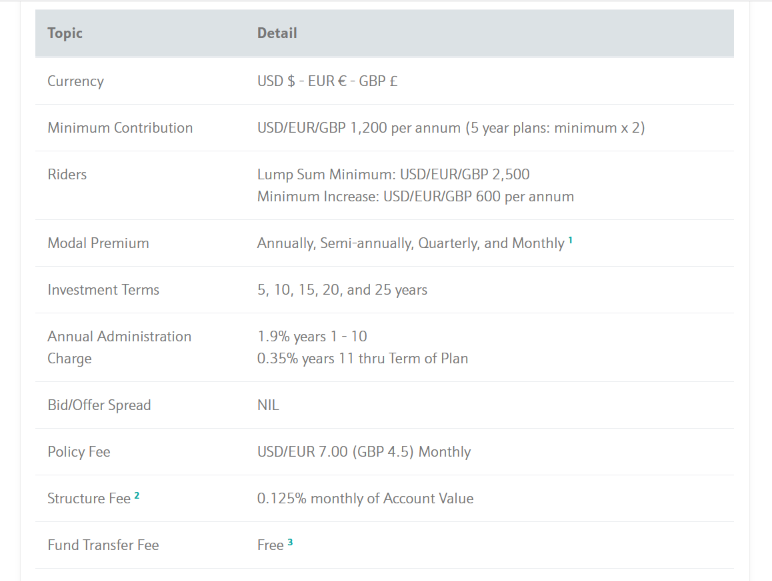
The way they work is the fees are taken up front and the client is then refunded in bonuses at the end of the plan.
Here is an example, of the charging structure of the Investors Trust Evolution plan taken from the website,
Are These Plans Worth it?
Well, they can be but, you will
- Have to make sure you complete the plan
- Not take any breaks
- Get high returns each year.
If you are paying fees of 2-3% (what the average fees equate to) a year you will have to get 5% just to keep up with inflation. Cheaper options are available for larger amounts into a platform and are normally advised to do so on a quarterly basis with clients, it has a lot more flexibility and it can cost less.
However, if you are looking just to replicate a pension-like plan you would be putting into back home (4-5% of your salary) these can work.
Again, the best tips I can give are to use a shorter period of time, it has a much higher percentage of working over a shorter time period. Plus make sure you have the funds to fund the plan. The average quoted is 7 years for the entirety of the plan.
If you do have one of these plans which many expats do. You can ask for the maximum surrender value and this will be based on how many years you have in the plan left and how much you have paid in.
It will then give you a figure of how much you can withdraw. Note, this can be significantly less than what you have contributed, especially, if you have a long way until maturity.
Please speak to a good quality financial advisor, as it can be more beneficial to stop contributing and bite the bullet and invest somewhere else with more flexibility. That is not a specific recommendation and not personal financial advice. However, if you stop contributing you are normally, hit with higher fees and will have to make 5%+ sometime just to break even.
How do The Plans Work and Are They Any Different?
Some of the new plans are better, such as Dominion, which I personally like compared to others due to it’s flexibility and cost. But, some of the older plans like Generali, FPI, and RL360, are extremely high fees and will not let you miss contribution dates by implying more high fees if used or taking away the bonus.
In short, make sure you can fully commit to these plans, and if you have one and you are not happy please seek advice.
Offshore Bonds
Offshore portfolio bonds are also widely sold in the expat market. These are lump-sum products that are typically shorter in length – for example 5 or 10-year charging structures. Such bonds are also used for British, Irish, Dutch and Belgium expats who want to transfer their pensions overseas.
They are typically more flexible as 70% or more of the money can be withdrawn without penalty on day 1.
Provider and Product Names
Some of the most popular and widely sold names are:
- Friends Provident International Reserve Investment Bond
- Friends Provident Summit Bond
- Friends Provident International Zenith
- Generali Worldwide Choice Account
- Generali Worldwide Professional Portfolio Bond
- Hansard International Capital Investment Bond
- Quilter International (used to be called Royal Skandia) Collective Investment Bond
- Quilter International Collective Redemption Bond
- Quilter International Executive Redemption Bond
- RL360 Pims
- RL360 Oracle
- Investors Trust Access Portfolio
- Investors Trust Fixed Income Portfolio
- AXA Evolution Bond
- Providence Life Horizon Portfolio Bond
- Providence Life Orbit Portfolio Bond
- Providence Life Polaris Portfolio Bond
- Premier Trust Global Premier
- Canada Life Wealth Preservation Account
- Prudential International Portfolio Bond
Fees and Charges Within Offshore Bonds
Do you have a bond with policies, RL360, FPI, Generali, OMI, or Zurich (some have undergone name changes or mergers in recent years) these are commonly sold to expats in UAE, Asia Pacific and many other areas mainly for the ‘tax benefits’.
Here is where I want to explain offshore bonds for expats so they can understand whether they would be a good investment for them as they benefit from tax-free growth, often referred to as gross roll-up.
Also, in countries like Australia, the benefits, if they are structured right can be tax-efficient on income. This can for a lot of High Net Worths (HNWs) have a significant impact on the portfolio.
Other than that, for most countries unless it is brought into the country neither the capital or income is subject to the local taxes.
This is why many U.K expats take these bonds, based on the tax benefits you get. Thus, opting for a good location is important for an offshore bond.
- Zurich Offshore Bonds
- Utmost International Offshore Bonds
- RL360 Offshore Bonds
Although, some bonds do offer low-cost options many that I have listed above have high-end charges with little flexibility. I will go over the benefits of offshore bonds and explain to you the options if you have or are considering these bonds.
What is an Offshore Bond?
It is essentially a tax wrapper that can hold within its structure a number of assets. The “offshore” is based on the tax in many jurisdictions having little to no tax.
Mainly, the Isle of Man is used as a common location. While, the structure, of these, have a life insurance element with a portfolio that investors can use to buy/sell assets through.
It is very much the same as OEIC (open-ended investment company) from a tax perspective if you were to hold in the U.K. or elsewhere.
The structure of the bonds is that investors lend money to an entity that borrows the funds for a period of time at a variable or set rate.
Do They Work?
Yes, they can but only if structured right. Also, which I have gone over a number of times in the videos and blogs, they are mostly sold with non-transparent fees and structures that are not made clear to the investor. This means they have high fees, long lock-in periods and are sold on tax efficiency when you might not need it.
Offshore bonds usually have a number of fees associated with them. Establishment fee upfront, establishment fee annual, annual management fee, policy fee, custody fee. Policy fees and admin fees are usually set amounts, while the establishment fee and annual management fee will vary based on the amount of commission the IFA charges and the term of the plan.
For example, if you see an establishment period of 10 years charging 1% on the initial investments with an annual management fee of 1% over the original investment. The commission will be based on the term duration and the amount over the base cost. So, for example, if you are getting charged 1.5% over 10 years AMC and establishment 1.5%, the IFA would be getting 5% commission (saying the base cost is 1%).
You need to know the base cost of all the platforms but as they are structured different it is difficult. I have done, a number of articles, on the costs. But, some of the lowest I know are 400 GBP a year base cost with 1% upfront or 0.36% of original policy value, plus a $500 admin charges and $45 dealing charges. So would be wary of anything 1.2% and question it even more if the advisor is putting on a fee of 0.5%-1.5% as well.
In short, these bonds can work for the right person if they are looking for investments medium to long term but costs need to be transparent and most of the costs need to be shown upfront.
Are These Tax Efficient?
The gains, interest and rent are taxed at 0% although, the income tax is dependent on your location. So, for example in the U.K, it would be on your income band, of 20%, 40%, 45%. Trustees are taxed 45% with the first 1000 GBP being taxed at 20% if no other income is taken.
It also allows a gross roll-up. This is what I have to illustrate for U.S clients, not using offshore bonds but as they are taxed based on their citizenship, but the advantages of this are as follows.
Say you put $100,000 into your account and after year one your investments grow 10% and your tax rate is 20% instead of the $110,000 at the end of the year due to your tax situation it would be $108,000 as you can see if you compound this over 10-20 years it can really start to eat up on your investments.
$100,000 compounded, over 15 years at 10% equates to $417,724.82
while $100,000 at 8% of 15 years, $317,216.91
Also, for U.K citizens it can be used by top-slicing, with 2021, figures top-slicing can be used, an example of your taxable income is 49,000 GBP (20% U.K rate) and you gain 15,000 GBP from the bond in 3 years.
This would be the amount divided by the number of years, 15,000 GBP divided by 3 is 5,000 GBP

Top slicing allows the tax to be applied at different rates, in this case.
For the case above, with an income of 49,000 GBP, 1,270 GBP can be taxed at 20% and 3730 GBP will be taxed at the 40% rate.
The total tax is (254 GBP on the basic rate 1,270 GBP and 1492 GBP at the higher rate 3730 GBP) 1746 GBP which equate to 34.92%.
On onshore bonds, these are taxed to the last chargeable event, not to the inception of the bond.
Tax deferral is one of the main options these are sold on. Ironically, these are sold to a lot of people in locations like the UAE, where tax is low to zero already, so don’t be sold on this basis alone if this is you and are looking to stay in a low to zero tax area.
How Does Tax Deferral Work?
This works, in general terms, allowing for 5% to be withdrawn each year as tax-deferred income of the bond. This can be taken every year or built up over a 20-year time frame.
The tax deferral is part of the structure and how it should be set up. As ideally, you would want to take the majority of the income if possible in a low-income tax location or when you are in a lower income tax bracket (when you retire for most). For example, if you plan on being in low tax jurisdiction for the foreseeable future the benefit of these bonds can be lost
This is why it is important to talk to an IFA about this and it can then be structured properly for your needs. If you would like to talk to an IFA, please email me at info@investmentsforexpats.com
What are the Main Reasons to Look at a Bond?
Like I have mentioned above, it’s the tax savings if used in the right way. Also known as gross tax roll up and the 5% withdrawal.
The other main one that I can think of is trust and beneficiary options where you can have a full beneficiary option unlike a lot of platforms that is not possible. This might be useful if you have accumulated a significant amount of wealth that you would like to pass on.
What are the Best Bonds to use at the Best Prices?
To find the best bonds there are a number of factors you need to consider such as location, security, fees, IFA charges and this information will be individual to you and your situation. To what your presences are, I have in a number of blogs rates the bonds on my personal preferences and review most individually.
Personally, for high net worths on a cost basis, I think the best one in the market is Hansard, I have written reviews on Hansard charging structure. The primary Z1 is 1% upfront and 400 GBP base cost and it is flexible to take in and out.
While those looking for more adventurous or crypto and trading is Custodian, I have written a number of reviews on Custodian. I like the features such as Exante trading with no trading fees and a crypto wallet with a free range of funds. The base cost with no coms is 0.36% for 10 years based on the original policy value and accrued amount with a $500 admin fee and $45 dollars a trade. This like most bonds should be used for those with a longer investments time frame base on the charging structure.
* Note I have no special connection nor do I get paid by them for saying this and seek an IFA to see full specification and get personalised information.
https://investmentsforexpats.com/hansard-international-review/
What Should I do if I Already Have a Bond?
I have had a lot of people contact me saying that they already hold a bond and want to change it, this is common as they are mainly sold to expats. What can be missed out on is the high charging structure and lock-in periods. This means many expats come looking for other options.
I would always say it’s worth seeking a second option if you are holding the bonds, from both an investment and cost basis as I have seen 100s of expats that have been overcharged and poorly invested.
Here are some options of platforms, if you are looking to look at lower-cost options
Interactive Brokers and Internaxx are two of the most popular ones. Others that are commonly used include:
- DBS Vickers Securities
- E*trade Financial
- iFast International
- Novia Global
- Platform One International
- Praemium James
- Raymond James
- Saxo Capital Markets/Saxo Bank
- Ardan International
- Capital Platforms Isle of Man/Capital International Group
- Capital Platforms Singapore
- Momentum Wealth Personal Portfolio
- Moventum Platform/Moventum Capital Platform in Luxembourg.
- Nucleus platform
- Aria platform
Finally, it might be worth looking at platform options, as these can be a lot lower cost as some start at 0.25% depending on the amount with good offshore options as IBKR or Novia for an advisor one, but, the benefits of these need to be discussed with an IFA.
If you have any questions, or want to speak to me about bonds that you may have or thinking about, please email me at info@investmentsforexpats.com