What Frontier markets would I look to invest in for uncorrelated returns in 2022? This takes into account the current market situation factors such as interest rates, inflation and where you can find returns that are uncorrelated.
With global markets in turmoil, many are looking for some uncorrelated investments to the global large-cap equities most usually invest in. One problem most equity analysts say is that the developed world markets are too correlated to the U.S. with the old saying goes “The U.S sneezes and Europe catches a cold”.
This article aims to cover some of the more frontier markets that will have the potential to skip the next recession. This comes with increased risks and should only be considered for sophisticated investors. Please also note that this is not financial advice and I am not saying you should invest in frontier markets, this is just something I have been researching and considering. If you need personal financial advice, please seek a qualified and competent professional.
For any questions please email me: info@investmentsforexpats.com
Vietnam
One country that has been on a lot of people’s radar for a while, Vietnam has managed to stay out of rescission for the last 30 years. Despite of COVID 19 is looking to rebound strongly with growth estimated at 6.5%.
Figure 1: Shows growth of the U.S vs Vietnam over the last 30 years.

From an economic standpoint as to why Vietnam has managed to avoid a rescission over the last 30 years is due to population growth and foreign investments flocking into the country and I still see this as relevant today.
Why in 2022 would you still want to consider Vietnam?
Vietnam has strong trade agreements being part of the Trans-Pacific Partnership alongside Asian partnerships.
An important aspect going forward is that some of the highest-performing computer software projects in the world are coming from Vietnam and this is supported by the demographics. This may explain why companies such as Samsung have opted to set up a regional basis in Vietnam over Thailand.
If this isn’t enough the GDP of the country is still very low and with the trade war with China and many companies worried about being dependent on China are looking for diversification with countries. Japan is offering incentives for its companies to move out of China. This has also escalated with many companies being affected by supply chain problems with China’s tough stance on Covid 19. The logical option seems Vietnam due to a lower wage and reasonably educated population that shares a border to the south of China.
It was not as good as what was expected!
In 2005, Goldman Sachs predicted that Vietnam would have a GDP per capita of $4,337 in 2020. Vietnam failed to live up to this expectation. With GDP still under $3000 per capita.
Figure 2: Focus economics table of Vietnam
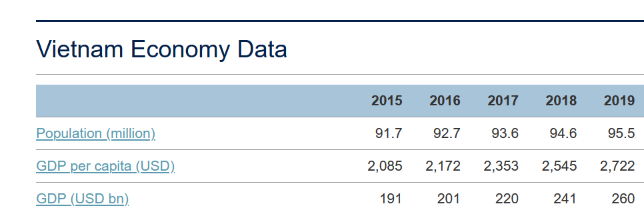
Vietnam has doubled it’s GDP since 2012.
On the stock market, it has two exchanges, and 700 listed companies and there have been talks to merge the two exchanges. A growing amount of companies and capital are coming to the exchanges every year.
What problems does Vietnam have?
Like any Emerging Market (EM) country it has problems with corruption. This is evident in the Saigon MRT which was meant to be finished in 2019 but is still yet to be finished.
What are my views and opinions?
Having lived in Vietnam I have picked a few aspects from my time in the country. Please note that this is my own view and have not completed any research.
Vietnam has a growth mindset. I saw entrepreneurs everywhere. Having had Vietnamese friends that just started a makeup business making a good living (from a western standpoint) and just set it up in their house. Vietnamese, unlike south-east Asian countries, seem to have (very general terms) a better work ethic from what I saw and have seen in other countries.
From an education basis, parents take a similar stance to China putting a large amount of emphasis on education, this can be explained by its scores in Science and Maths to overcome the middle-income trap. When I lived in Vietnam, I had a feeling of a happening country probably what many would have said it was like living in China in the early 2000s. For me, this is what Vietnam is. A smaller carbon copy of China. At the time of writing Vietnam has a quarter of the GDP per capita with growth potential.
How to Invest?
Vietnam Enterprise Investments Limited (VEIL) in the UK and VanEck Vietnam ETF (VNM) in the US are the easier options.
There is the ability to purchase stocks using platforms, however, this relies on people understanding the company, its financials and being confident about it’s future. This for me is a higher risk and potentially higher reward if it works but I don’t see the percentages in favour of a stock picker unless you have information that allows you to make that decision.
There are alternative ways to invest outside of equities such as property, however, this can be difficult depending on the laws that surround the property in Vietnam. In Thailand, an expat isn’t able to own a property (in short) and that makes it difficult to invest and buy property.
Uzbekistan
One region that never gets mentioned is central Asia and I refer to it as the only market yet to be discovered.
At the heart is Uzbekistan. I’ll be honest and say that I know little about the country and have never visited. However, I am fascinated by the metrics and how it seems to go under the radar for many investors in the west.
It has the largest population in central Asia with 35 million. It has a large manufacturing base as well as being the bread winner of the region. Since 2018 with the country’s reforms to policies, investors have been flocking to invest in the country and countries such as India, and China, as well as private investors.
From a Macro standpoint
Presently it has a GDP of roughly $55 billion which $35 billion is foreign reserves and $22 billion in gold. This means it has low debt. In this present environment, it is not a bad place to be with higher interest rates and a strong dollar.
Uzbekistan also has a strong agricultural basis that has lifted the economy in 2022 with high commodity prices in gas, gold, and cotton that Uzbekistan exports to other countries.
Having a low GDP per capita of $1800 it has the potential for growth and it is expected to grow at 5.2% a year.
Uzbekistan has close trade links with China and is part of the belt and road project. In 2022 China recently pledged $37 million of financial assistance to Uzbekistan in a sign of warming ties between the countries.
From a demographic point, it has a growing population that is unheard of in the west.
Of course, it has problems such as the Russian sanctions and the slowing Chinese economy as well as the usual political and regulatory problems with any frontier markets. However, many indicators are pointing green for the country in the future.
Conclusion
There are likely to be places where you can find uncorrelated returns to other events. When I say uncorrelated, I don’t think there will ever be an investment that is 100% completely uncorrelated, however, what I am aiming for is something where there is a chance of growth where the turmoil of events in the West may not have such a big impact.
For me this is Vietnam currently, it’s economy is doing well and I think some of the events may be affect performance, however, it has a lot of other factors going for it and this is why I have written about it.
Another one of these is Uzbekistan, this is a place I haven’t been to and don’t completely understand, however, looking at the figures and data it shows promise in my opinion.
Please note, this is not financial advice and I am not suggesting you invest in these areas to get uncorrelated returns, you must complete your own research and due diligence if you want to invest.
If you have any questions about the areas, investment products or anything else discussed, please email me at info@investmentsforexpats.com.
Articles related to this one are: