
The Broader Equity Markets
Before I start, please note this is NOT independent financial advice and if you are looking for financial advice, please speak to a competent and qualified advisor who will be able to help you. This is my review and my opinions using the data which I have seen and found.
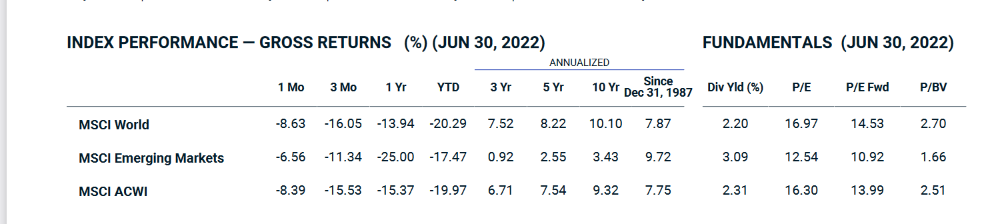
From January to July I have seen equity markets fall with the MSCI down 20.29 % year to date. This can be due to a magnitude of macro events in 2022, such as the war on Ukraine as well as the boom-bust cycles and after-effects of COVID 19 lockdowns.
Ultimately, a hit in the mid-term in large-cap equities was well overdue. Interest rates had remained low since 2008 and stock prices had been rising due to investors primarily investing in equities rather than other assets (see figure 1) this is seen in the S&P500.
The current stocks in the S&P500 had been uplifted on expectations rather than earnings and were being amplified in 2020 by stay-at-home retail investors who look more towards growth tech stocks. Stocks such as Apple saw a 45% growth in their gross profit from 2020-2021 yet their share price increased over 120%.
https://finance.yahoo.com/quote/AAPL/financials?p=AAPL
Figure 1: The S&P index since 2008 the U.S largest index
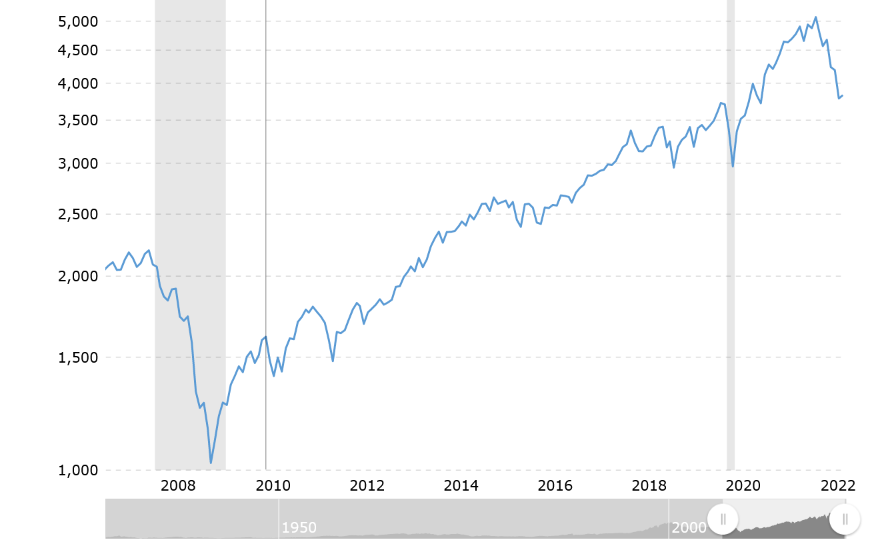
Figure 2: Msci world index, EM markets and ACWI
https://www.msci.com/documents/10199/178e6643-6ae6-47b9-82be-e1fc565ededb
Due to low-interest rates, investors have not had the allocation of their portfolios in bonds and have looked for stocks and/ or property for alternative investments that have pushed up the prices in equity and property alike.
Economic cycles have shown that this run would need to come to a halt at some point. Current stimulus packages that had been given by western governments were going to lead to harsh fiscal policies as low-interest rates were already at near all-time lows.
In an economic environment figures below show what usually happens to asset classes as well as the boom and bust cycle
| Business Cycles and Investment Performance | |
| Contraction | Expansion |
| Risks higher in equities | Profit potential higher in equities |
| Stock prices fall due to lower demand | Stock prices rise due to higher demand |
| Bond yields are typically higher at the beginning and middle and fall at the end | Bond yields are typically lower at the beginning and rise at the end |
This has made it harder for consumers to deal with the high level of inflation that has been brought on by external factors such as war and its impact on oil prices.
Equity Outlook
The U.S
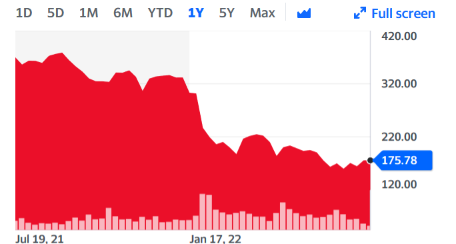
The U.S which is weighted towards the large-cap tech companies (Apple alone is bigger than the FTSE 100) has taken a hit, however, fund managers and investors alike have seen this as a reversion to the mean (maybe not over yet) and seen as a better chance to buy certain funds or stocks, for example, Meta (Facebook) is trading at near 50% of its stock peak yet its profits has grown YTD making it more of a value stock than a growth stock.
Figure 3: Meta stock price and earnings

U.K
Although, the U.K benchmark index, the FTSE100 is up 6.03% (July 2022) this year and only down 1.23% YTD. This is mainly due to factors such as being weighted toward large oil companies and the rising oil prices, mining companies and bank stocks with the rising interest rates having a positive effect. As well as a strong dollar being converted into GBP (its base currency) giving higher earnings.
Personally, I don’t see this trend continuing in U.K markets as the dollar will have to weaken for emerging markets debt in USD will find it significantly harder to pay the money back and potentially have default risk. As well as oil prices are unstable and sustainable for many at present prices and countries looking for alternatives to Russia for oil and cleaner energy to bring the supply up again and lower prices.
Emerging markets
Emerging markets such as China have been hit hard due to lockdown in the country as well as regulation risks for business. Personally, I am still positive about China in the long term for the following reasons (in brief).
- The CCP has been successful due to its economic prosperity which has been unprecedented in such a short time. This has led to citizens overlooking its “challenging” stance on people. Its easy to look over the flaws if you are getting exponentially richer.
- The CCP understands the importance of long-term growth and what is required to achieve long-term growth. It won’t let long-term growth be halted and I see this zero COVID stance as the CCP aiming to look strong and not take back its position. I don’t think it will have a long-term effect on GDP.
Your Portfolio
U.S Equity
I would be happy to keep in for most long-term portfolios and although I do not expect the same growth if any growth at all over the short to medium term in funds (for the reasons explained above). Your weighting in the U.S region on these specific U.S funds is still relatively low compared to normal mutual funds proportion that holds 60% in U.S based equities.
If you are looking for alternatives to these funds looking at a smart Beta ETF might be a consideration, an example could be Vanguard low volatility S&P500 which would have a lower Beta and less volatility. Alternatively, a Dimensional fund that is weighted less towards the large-cap tech stocks that make up the majority of weighting in any U.S. S&P500 trackers and the Fidelity fund.
U.K Equity
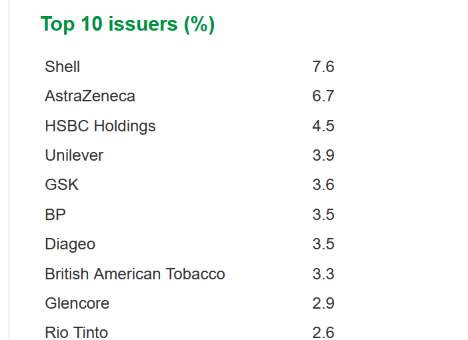
This could be a feasible option long term as U.K equities seem undervalued when you compare to U.S equities and the fact that at least in the FTSE100 and most of the U.K equities are for the least part defensive and would be able to tolerate a rescission and inflammatory environment that is highly likely for the next few years. This is shown by the companies below which are mainly oil, pharmaceutical, banks, and consumer supply. The image shows the top 10 issuers of shares.
I do not favour U.K equity long-term. This could be looked at rebalancing in other asset locations.
EM equity
It has negatively impacted China’s holdings but again looking long-term for the reasons stated above I am still optimistic about the region and funds. I look to go in with a 5-10 year time frame and aim to ride out the short-term volatility.
Although, I would keep an eye out for more serious effects on the economy and business.
These could be, but not at all isolated to, China’s debt problem could be significant. Even more so as the state owns the land and properties if people start defaulting due to less property demand as well as individual businesses and sector risks that were more than evident last year in the education sector and companies such as Alibaba. It could throw a big spanner in the works as China will be left with a debt which will be very hard to service.
There is also ADRs risk for not meeting SEC regulations. These are some of the major risks I can see for China.
Where to Look to Find Value
It should be okay to hold a portfolio for now.
If you did want to rebalance any of the gains it is a hard place and time to do so. I would look in equities, funds and stocks that have little to no debt which have good profit margins and are defensive with a good intellectual brand.
Due to the fact that little debt would be easier to deal with in an inflationary environment as well as the defensive nature being used by consumers and profit margins being able to be absorbed and able to come out stable through a recession for a medium-term outlook.
From a long-term perspective, it may be worth looking at growth stocks/funds that are currently undervalued with good profits as another option for equities.
Fixed assets and bonds could be coming back with inflation-protected government bonds such as GILTs (U.K Government Inflation Protected Bonds) and TIPs (U.S Treasury Inflation Protected Bonds) might be a feasible option for a conservative investor. I personally, do not think these are feasible for growth as they are still yielding too low for a long-term outlook. Raising interest rates will make bond prices less attractive in other regions.
Looking at alternative assets, such as property if you don’t have already in the forms or REITs. These allow you to invest in property without holding the physical asset. They can still come with lock-in periods.
Commodities could have rationale if used currently and have a future use such as Lutetium. However, I still think personally it’s too volatile. Gold and other assets are less correlated to your overall portfolio and could be something to look at if you want something else to hedge inflation.
Other assets can come in multi assets funds that short equities (make money when they go down instead of up) and aim to strip out volatility such as Winthorpe Woodrow Absolute return (0.75% charge)
https://www.winthropwoodrow.com/_files/ugd/9e4b65_1acb1074676a4cf7bab386fc177812d0.pdf?index=true
Alternatively, a low volatility ETF as mentioned above is currently the most common way to gain exposure.
What’s in my Portfolio
Personally, in my own portfolio, I have invested in Structured notes to give protection on equity falls and the way the banks issue them (going into Zero coupon bonds) have been able to offer higher fixed returns with some FCA ones offering capital protection. Some offer 9.7% in USD fixed returns presently for 7-year maximum time frame lock-in.
These are only relevant if you understand the investment and the risks such as default (default of the issuer normally a large bank) and illiquidity as they are normally illiquid for 4 years or more. The SEC state these as complex investments that shouldn’t be invested in by retail investors, although they have become very popular for retail investors due to the protection element in recent years. It shows a shift to protection in my eyes.
Overall I am happy to wait until the end of the year and watch how things prevail before rebalancing or changing any funds.
If you have any questions about your portfolio or would like a portfolio review, please feel free to email me at info@investmentsforexpats.com. Portfolio reviews by myself are free and I open up a certain amount each month.