
With over 4 million Indian expats living in the U.S, it is a popular place for Indians to live and work. This is clear when looking at the top CEOs of some of the world’s biggest companies who are Indians. But, with this in mind, I often get asked what are my options to invest as an Indian expat?
This does depend on what your intentions are. If you are looking to stay in the U.S you have some of the best platform options for you with the likes of IBKR and would be wise to top up your 401k and IRA if possible.
These would allow for tax-free growth and a 401k can be used to reduce your tax rate. To put it simply if you are looking to stay in the U.S your circumstances don’t change much from your typical American citizen (only at amounts above $500,000). Personally, I would aim to use all the schemes you have open for tax-free growth that the U.S offers such as 529 plans and Roth IRA.
A tip for those that are maximising all these accounts is to set up an annuity option (if feasible for your circumstances) as this can allow for tax-free growth and with interest rates getting higher (as of writing on Oct 22) you have some fixed rates nearing 5%. As well as this if you do have a long time frame for investing and don’t need to take the cash you can opt for some bonus features offering up 10%-20% over a 10-year time frame as well.
High Net Worth Expats
The difference comes for Indian expats in the high net worth range who have over $500,000 liquid cash, you have some options to allow for tax-free growth. Unlike, some of the options in the U.S where you can set up an Irrevocable Trust where the assets are not on in your name. Some offshore trust options exist and if structured correctly it can allow for easy tax filing and tax-free growth. This is due to the way the trusts are set up as international pensions with DTA (double taxation agreement) for the U.S.
However, note it’s not all as simple as you do have some restrictions. One is the cost as these cost $1000 minimum per year. So, $500,000 only should be used. The second issue is the age most of these trusts (without making a bespoke option) act as a pension with DTA and have age limits on withdrawals until 55.
Here is an example of how it can work:
$ 2 million initial lump sum aiming for growth of 6% a year in the state of California and the tax if you held for more than a year (long-term gains rate) and outside any retirement plans the tax due would be $30,193 on the federal/state/local level. If this is due every year for 10 years it adds up to over $300,000, therefore, the price paid for the trust becomes beneficial for the tax gains.
This also has not taken into consideration the compound effect. I.E if you were to pay $30,193 (around 1.5% of the gains) and compound it at 6% over 10 years.
Be aware this is a simple example and has not gone into detail on funds/dividends or anything like that nor is it allowing for other factors like partners etc.
The end results compounded is $3,581,695.39 (not taking into consideration trust costs) as you can see in the figure below:
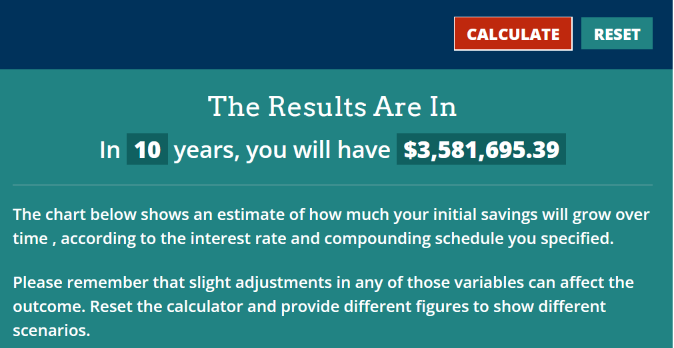
While, if you deduct 1.5% (roughly the percentage each year taken in long gains tax) it would be a difference of 475,756.55 over a 10-year period. This is not an exact figure but is just given as an example of the effects of tax-deferred growth over a period of time.

Therefore, it can be useful to use trusts and other options for high net worths. Also, note that these can be used to invest in different asset classes without the need PFICs taxation. From a tax filing standpoint as well it’s simple as it only gets taxed on the gains on withdrawal so forms 1040 and FBAR 8938.
Another aspect to consider as an Indian expat in the U.S and one I come across is that many may have stocks in India, I am a fan of this. From a growth basis due to the long-term outlook of the Indian economy still being at low GDP per capita. However, the U.S does not take kindly to any investments that are based outside the U.S (outside a retirement plan without DTA with the U.S) and are subject to PFIC taxation which can wipe off the gains via taxation. This is another reason why you might want to look at moving your Indian assets to the U.S. or in a trust.
For property from the U.S, you can get up to $250,000 for a prime residence per single filer in capital gains. This gets more complicated if you are not using it as a prime residence.
So, what if I don’t want to live in the U.S permanently?
Again, it does depend on where you want to finally reside. But, for most, it will not make as much sense to contribute to any long-term scheme in the U.S outside your 401k. I get asked frequently by Indian expats in the U.S “should I wait to invest in Indian bank accounts when I am back in India as it can get 7%+” and yes this might be an option for a part of your portfolio. However, the problem with these bank accounts is they may look attractive on the outside but when you have inflation on IDR at 5%-6% the real rate of return could only be 1%-2%.
Personally, I would not look to invest all your portfolio in these savings accounts. The same is true with Indian stocks when you go back. As said above I like the opportunity to invest in Indian stocks/funds and being on the ground gives you a great advantage in one of the best growth potential markets in the world over the next 10 years.
However, you do have global markets and find that too many Indians are solely invested in the Indian market making thus being subject to great risk due to being an emerging market and subject to the political and regulatory risks that might not be so prevalent in developed markets. I would urge you to diversify your portfolio.
401ks, if you are looking to relocate. A rollover of your 401K into an IRA might give you more control of tax basis. As to roll it over into an IRA the taxation differs on withdrawal. A 401k withdraws from all the funds equally. While with an IRA you have more flexibility over the funds you withdraw from thus you can take from the ones that are at a loss lessening your tax burden.
Additionally, IRAs give you more options to invest than a 401k.
Conclusion
As an Indian expat in the U.S, you have some great options in the U.S in terms of retirement options, investment platforms, and annuity plans, but if you are high net worth or looking to relocate outside of the U.S it might be worth looking at some offshore options.
If you have any questions or have a net worth of $250,000+ we can offer a free no obligation call. Please email me to arrange this at info@investmentsforexpats.com
Related articles: