For many people, the dream of retiring abroad comes down to one question: How far will my money go? Thailand has long been a top choice for retirees from the West, thanks to its warm climate, welcoming culture, excellent medical care, and relatively low cost of living. So, if you have around $1 million saved up, could you retire comfortably here?
Having lived in Asia and Thailand for 10 years, having supported many with retiring in Asia, I will give you a rundown of how far your money can get you.
Here are some blogs I have written on Thailand, which will help you with life in Asia:
- Thailand 2024 Tax Reforms Explained
- Thailand Residency – Full Guide for Expats 2024
- Moving to Thailand in 2025: Guide for UK Expats
If you have any questions, please contact me through my website on my contact page.
Will $1 million be enough in Thailand? Let’s look
If planned well, that nest egg can give you an annual income of $50,000–$60,000 through an annuity or conservative drawdown strategy. That equates to about $4,000–$5,000 per month, enough for a very good standard of living in Thailand. Personally, I don’t believe Thailand is for those looking to retire on a shoestring budget any more, but believe this is a good thing as you get a higher quality of retirees and expats. I do think $4000 a month is a good amount for a single person who wants to live modestly.
You can live a lot higher than this in places like Bangkok for less, but I would say this is a medium amount, which allows a great deal of flexibility and freedom of choice.
I don’t think you should be looking to live in Thailand for much less than this amount. Of course, you can do so. But, the days of living under $1000 comfortably are well past, and you have other cheap places if you want to go looking for the backpacker lifestyle or living on next to nothing. Thailand wants to bring people into the country who contribute to society, and I think if you are looking to move, you should at least try and do actions that facilitate this and come with a moderate income.
Ways I’ve found to be part of the Thai community:
- Buy local and be generous
- Tip low-paid workers
- Treat workers with respect, security guards, cleaners, waiters etc
- Don’t haggle at Mum and Pop or local markets for the lowest price.
- Learn some Thai; it doesn’t have to be a lot, enough to make the effort to get by, and locals will respect this.
- Do some charity work or get involved with local events or projects.
I believe Thailand can be a fantastic place to live if you have a solid budget and choose to live responsibly. Lately, I’ve seen a lot of chatter online about expats leaving Thailand, with claims that the country “isn’t what it used to be.” I think Thailand, especially Bangkok, has improved. The facilities are better, with new parks, medical centres, and progressive initiatives from the Bangkok governor aimed at transforming the city. (Though I’ll admit, this doesn’t apply to all of Thailand.)
I actually see the departure of many so-called expats as a positive sign. I’d wager that most are leaving because they’re struggling financially or because Thailand isn’t as cheap as it once was. The country is shifting its focus, aiming to attract wealthier retirees and digital nomads rather than positioning itself as a budget backpacker haven. This evolution, in my view, is a step in the right direction.
My Top Two Places to Retire in Thailand
My personal top two picks would be Bangkok and Chiang Mai. I will go into more details of these two cities, the cost of living and the pros and cons and how they compare with other locations, particularly in South East Asia.

Of course, you do have other places like Hua Hin, but this is a good spot if you like golf and a very laid-back pace of life. It has been named as one of the top places to retire. You have great seafood, malls and some western comforts, and it has a bonus of being just a 3-hour drive from Bangkok. I understand that many people seeking a laid-back life love this place.
However, it seems too laid back and not much else to do other than play golf. This can be great for some people, and I can see why it’s loved by retirees wanting a relaxed lifestyle.
Pattaya, in short great location near Bangkok. Has good malls and hospitals. Just as the seedy part seems to ruin the city, you can walk into a mall in Pattaya or down Beach Road, and you will see the type of people this place attracts. Yes, this can be avoided, and you can live in parts of the city that can be quiet and away from the nightlife and red light districts.
But, for me, I still find that its seedy reputation is attracting the wrong kind of tourists and expats, and I do think other places in Chonburi might be better suited that are nearer to Bangkok and still have the beach lifestyle similar to Pattaya.
Phuket is more or less the same as Pattaya, but to a slightly lesser extent, I do think this could be considered by many. But it feels too touristy to spend all year living there, but I completely appreciate why some people would opt for Phuket over a less touristy location.
Two Lifestyles: Big City Buzz vs Laid-Back Charm
Bangkok is Thailand’s economic and cultural powerhouse, a global city with world-class hospitals, luxury shopping malls, rooftop bars, endless restaurants, and some of Southeast Asia’s best infrastructure. If you like urban energy, convenience, and don’t mind a bit of traffic, Bangkok is hard to beat.
Personally, I like this as you have a bigger selection of amenities and events and more options to interact with both Thais and expats. As it just has a lot more of both. The parks are great here, and you have endless restaurants for all budgets. Plus, you can really have a lifestyle that you want to live.
I enjoy running around the parks of Bangkok, which has a good mix of wildlife, people and open spaces.
If you are single or a couple it might be a better option as some of the down sides of living in central Bangkok on $4,000/$5,000 a month budget is it would be unlikely you would get a good house in a central location for under $2,000 a month but for condos you can get a nice luxury condo (you don’t need to go ultra luxury in my option) with a gym, pool, sauna, workspace roof top garden for this price.
A tip is to look for older condos in a good location or ones that are mostly sold out. As Bangkok has an oversupply of condos, you will find many of these luxury to ultra luxury condos which don’t sell and only 50% or less are occupied. Which means less annual service income, less facility management spend and its not uncommon for some condos to not bother fixing some problems due to these issues. Please be careful when selecting a condo.
Look at the reviews and go with a trusted name, and if possible, pick an old, reliable condo rather than a flashy new one.
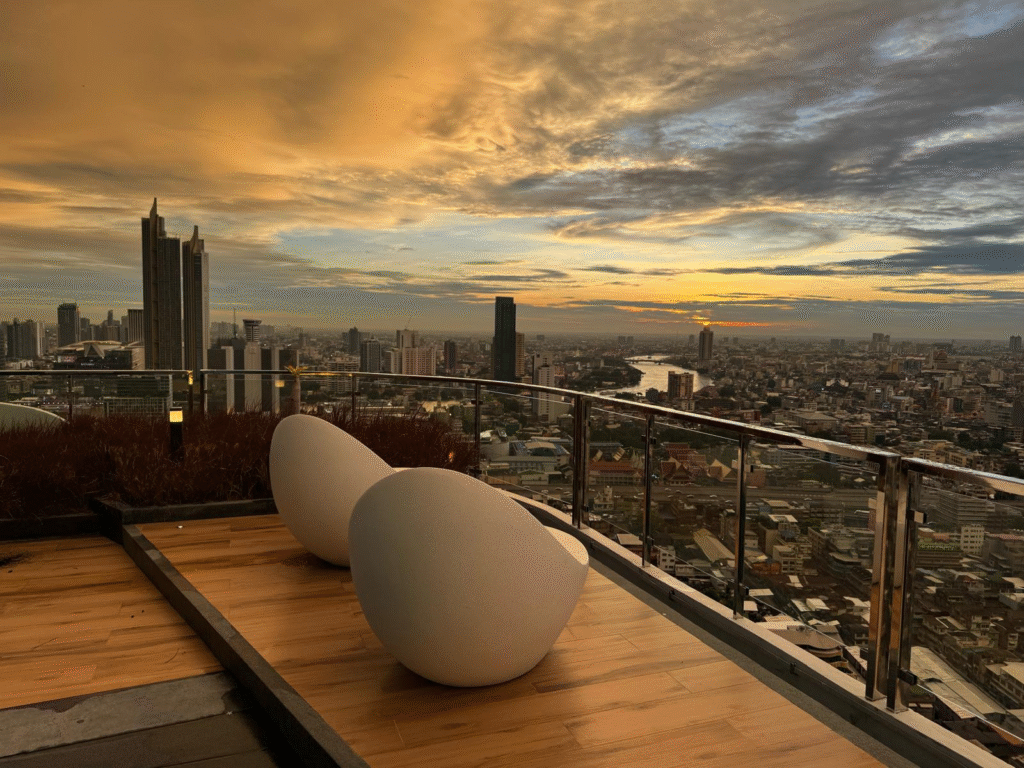
The view from my condo in the Bang Rak district of Bangkok.
Bangkok does lack in the way of green space; however, I would say you do have some of the best Parks in Southeast Asia, like Lumpini, Forest Park (where you can play racquetball for free), Rama 9, where you can walk, jog or bike and get away from the city (see below).
The images are of the two parks (left) Lumpini and (right) Forest Park in Bangkok.

What it lacks in natural green space, it makes up for in terms of convenience of international airports, transportation with the expanding lines and the whole delivery and 24/7 lifestyle. I would say it is probably best located for day trips, you can get to beaches like Bang Sean within just over an hour. You can reach the mountains in roughly the same time.
As well as being able to reach several islands relatively quickly, the North and South of the country are within 1-1.5 hours of flight. While ASEAN travel and the Southern part of East Asia (Taiwan, Okinawa) are all easy to get to from Bangkok with a several-hour flight.
Image of Bangkok Subway lines in 2025 showing ever-expanding lines. When I first moved in 2015, they only had a few lines. Now it has significantly more, and it continues to grow.

Chiang Mai, on the other hand, offers a slower pace of life. Nestled in the northern mountains, it’s popular with retirees, digital nomads, and anyone who wants a cooler climate, traditional culture, and a more relaxed vibe. But it does have a drawback: smoky season, when air pollution from agricultural burning can be severe for a few months each year.

Chiang Mai is a nature lover’s paradise and has long been a destination for Nomads. You get a lot more bang for your buck in Chiang Mai, and without looking at official figures, I would say it’s roughly 10%-20% cheaper than Bangkok. For those who enjoy living spaces to be larger and a garden while being next to nature, Chiang Mai is a better option than Bangkok. Chiang Mai offers houses/condos that are bigger and have more space than many of the condos that are offered in Bangkok.
You can be right next to nature while being close to malls and great restaurants, and cafes in Nimman, plus you still have great hospitals nearby. For many retirees and nomads, this can seem like paradise, which offers the best of both worlds between nature and infrastructure.
Key differences between living in Chiang Mai to Bangkok are that in Chiang Mai, you do need a car or bike to get around. And the fact that it does feel oddly like you are living in a small town without any borders rather than a huge city, which can feel strange (well, at least for me), but that adds to the charm of Chiang Mai.
I know of a few people who have loved Chiang Mai (mostly below 50) who have found it great to live in, yet after a year, they have reached a limit with the city as it is quite small. This is not the case in Bangkok. I would say Chiang Mai is more for retirees or those looking for a more laid-back lifestyle.

You may have read that one reason that Chiang Mai is not even more popular is the burning season (although it seems to be getting better this year in 2025), it’s still a big factor. Many expats choose to get away during these months and mainly go to Phuket, South Thailand or Bali for those months. So if you are looking to make Chiang Mai a base, carefully consider this.
What Does It Cost to Live Well?
Here’s an average cost comparison for a single retiree living comfortably in either city, with enough for some luxuries like travel, dining out, and help around the house.
| Monthly Expenses (USD) | Bangkok (Modest Life) | Bangkok (Good Life) | Chiang Mai (Modest Life) | Chiang Mai (Good Life) |
|---|---|---|---|---|
| Rent (1-bed condo in great area) | $1,000 | $1,500 | $600 | $1,000 |
| Utilities & Internet | $100 | $150 | $80 | $120 |
| Groceries & Home Food | $300 | $500 | $250 | $400 |
| Eating Out & Entertainment | $500 | $1,000 | $400 | $800 |
| Private Health Insurance | $200 | $400 | $200 | $400 |
| Transport (Grab, BTS, Taxis) | $150 | $300 | $100 | $200 |
| Domestic Help (Cleaning etc.) | $100 | $200 | $100 | $200 |
| Travel / Getaways | $300 | $500 | $300 | $500 |
| Miscellaneous & Extras | $250 | $450 | $200 | $400 |
| Monthly Total | $2,900 | $5,000 | $2,230 | $4,020 |
This shows you could easily live very comfortably on $3,000–$5,000 a month in either city. That leaves some buffer from your $50,000–$60,000 annual budget, or lets you spend extra on travel, hobbies, or family visits.
Why Retire in Bangkok? My opinion
What I like:
- Best medical care in Southeast Asia – world-class hospitals like Bumrungrad and BNH.
- Amazing shopping malls, fine dining, and rooftop bars.
- Modern infrastructure – BTS Skytrain, MRT subway, and global flights.
- Convenience – hire help for cleaning, errands, and deliveries.
- International community – plenty of expats, clubs, and social life.
My least favourite parts:
- Traffic – you’ll want to live close to transport or your favourite areas. Premium neighbourhoods like Bang Rak, Sathorn, and Silom are worth paying extra for comfort, walkability, and access.
- Hot & humid – but most buildings have excellent air conditioning, especially the malls and similar big buildings.
Why Retire in Chiang Mai?My opinion
What I like:
- Slower pace – perfect if you want peace, mountains, and temples.
- Very affordable – rents are cheaper, and day-to-day life is laid back.
- Good hospitals, cafés, and local markets.
- Big community of expats and digital nomads.
- Easy to hire help for chores and errands.
Least favourite parts:
- Smoky season – air pollution spikes from Feb–April due to crop burning. Many retirees choose to spend these months at the beach or abroad.
- Fewer big-city conveniences compared to Bangkok – but that’s part of the charm for many.
Visas for Retiring in Thailand
Thailand has several good options for retirees with $1 million or more:
- Long-Term Resident (LTR) Visa – Wealthy Pensioner: For those 50+ with at least $80,000 annual income.
- Thai Elite Visa: Pay a one-time membership fee ($20,000–$30,000+) for 5–20 years of hassle-free stays.
- Digital Nomad DTV Visa (new): For remote workers, less relevant if you’re fully retired, but handy if you do part-time consulting.
- O-A / O-X Retirement Visa: The classic – for retirees 50+ with minimum income and funds in a Thai bank account.
Having lived in Thailand and Asia for 10 years, I have used the Thai Elite visa and have written blogs on these visas, which you can find below:
- The Path to Permanent Residency in Thailand
- Thailand Residency – Full Guide for Expats 2024
- Thailand 2024 Tax Reforms Explained
How Does Thailand Compare to Other Southeast Asian Options?
In my opinion, only Penang and Kuala Lumpur (KL) in Malaysia come close in terms of healthcare, infrastructure, and cost of living. Penang is laid-back with a big expat community and great street food, but a bit quieter than Bangkok. KL is more urban, with great hospitals and shopping, but not quite the same energy or convenience for daily life as Bangkok’s transport system.
Final Thoughts
If you want big-city energy, world-class facilities, and endless things to do, Bangkok is hard to beat. Just pick your neighbourhood wisely and expect to pay a premium for a convenient location to avoid wasting hours in traffic.
If you’d rather wake up to mountain views, morning markets, and a slower pace, and you don’t mind spending the smoky season at the beach, Chiang Mai could be your perfect fit.
Either way, $1 million, carefully managed, can buy you a comfortable, secure, and enjoyable retirement in Thailand.
For more information on Thailand, with blogs I have written, these will help:
- Thailand 2024 Tax Reforms Explained
- 2025: Malaysia My Second Home (MM2H) Visa
- Thailand Visas in 2025: A Complete Guide for Digital Nomads, Retirees, and Long-Term Expats
Yes, for many expats $1 million can provide a comfortable retirement lifestyle in Thailand, especially given the lower cost of living compared to Western countries. However, lifestyle choices, healthcare needs, and inflation will all impact how far that money goes
Typical costs include housing, healthcare, food, transportation, and leisure activities. Private healthcare and international insurance can be significant expenses, so retirees should budget carefully to ensure long-term financial security
Strategies include investing in diversified portfolios, managing currency exchange risks, and choosing cost-effective locations within Thailand. Working with a financial adviser familiar with expat needs can also help optimise withdrawals and reduce tax liabilities.