For many expats living in Thailand, investing in the Thai stock market feels like a natural step. You live here, you see the economy around you, you recognise the brands, and it creates a sense of familiarity that can easily translate into investment decisions. However, when you step back and analyse the Thai stock market from a purely investment perspective, the case becomes far less compelling.
This is not about short-term volatility or market timing. It comes down to deeper, structural issues that have persisted for years and continue to affect returns, governance, and long-term growth potential.
If you have any questions about investing in the Thai stock market from an expat who has lived in Thailand for over 10 years and manages clients’ money, please contact me through my contact page.
Take a look at my services page if you want your investments managed by an advisor, Investment Management for Expats.

Investing in the Thai Stock Market
One of the most immediate concerns is regulation and market integrity. While the Stock Exchange of Thailand has made efforts to modernise and improve transparency, enforcement has not always kept pace with more developed markets. There have been several instances where stocks have experienced sharp declines following accounting concerns or governance issues, and questions around insider activity are not uncommon.
For foreign investors, this creates an uneven playing field. You are often reacting to information rather than acting on it, which fundamentally changes the risk profile of investing. The collapse of Stark Corporation in 2023 is one of the most notable, where an accounting scandal led to the company losing around 90–99% of its value and defaulting on billions of baht in liabilities. Similar issues have emerged with companies such as JKN Global Group and Thonburi Healthcare Group, where fraud allegations and questionable projects resulted in significant losses and eroded trust in the market.
One of the primary hurdles for investors in the Thai stock market is the high concentration of ownership. Many companies listed on the Stock Exchange of Thailand (SET) remain tightly controlled by their founding families, who often retain upwards of 80-85% of the total equity. Under SET regulations, while a company may technically be “public,” the actual free float, the portion of shares available for public trading, can be as low as 15%.
This creates a significant disparity in market valuation. While the SET Index was historically calculated based on total market capitalisation, it has shifted toward a Free-Float Adjusted methodology to better reflect the true investable value of the market. Essentially, although the “absolute value” of a company might appear massive, the “investable value” is often just a small fraction of that total. For expats, this limited liquidity means that even a moderate trade can move the price significantly, making it difficult to enter or exit positions without high “slippage” costs.
This dynamic means that, while companies are technically listed, they often operate more like private family businesses.
Decision-making can prioritise long-term family control or internal considerations rather than maximising shareholder value, which puts minority investors at a disadvantage. With around 51% of the Thai SET being family business, this is way over the average of 25%-30%.
This ties into a broader issue often referred to as the “three-generation problem.” Family businesses tend to evolve, with founders driving growth and expansion, the second generation maintaining stability, and the third generation often facing challenges in preserving the same level of performance and discipline. Thailand is now at a stage where many of its major listed companies fall into this latter phase. As a result, investors may see slower growth, less innovation, and in some cases, a gradual erosion of competitive advantage.
The structure of the market itself also limits opportunity. Thailand’s stock market is heavily concentrated in a small number of large companies and traditional sectors. The total market capitalisation of the Stock Exchange of Thailand is roughly in the region of USD 500–600 billion, and within that, a single company, Delta Electronics Thailand, has at times accounted for over 10–15% of the entire index weighting. This level of concentration is unusually high and creates distortion, where index performance can be driven by one stock rather than the broader economy.
Beyond this, the composition of the market is skewed towards traditional industries. Financials alone (primarily banks such as Bangkok Bank, Kasikornbank, and Siam Commercial Bank) make up a significant portion of the index, often in the range of 15–20%, while energy giants like PTT and PTT Exploration and Production add further weight to old-economy sectors. Property developers and conglomerates also represent a meaningful share of listings.
These industries are important domestically, but they are not where global growth is currently being driven. In contrast, markets like the United States, represented by indices such as the S&P 500, have a very different composition. Technology alone accounts for roughly 25–30% of the index, with additional exposure through communication services and consumer discretionary sectors, which include high-growth companies such as Apple, Microsoft, and NVIDIA. These businesses are global leaders in innovation, artificial intelligence, cloud computing, and digital infrastructure areas that have driven a significant portion of global economic expansion.
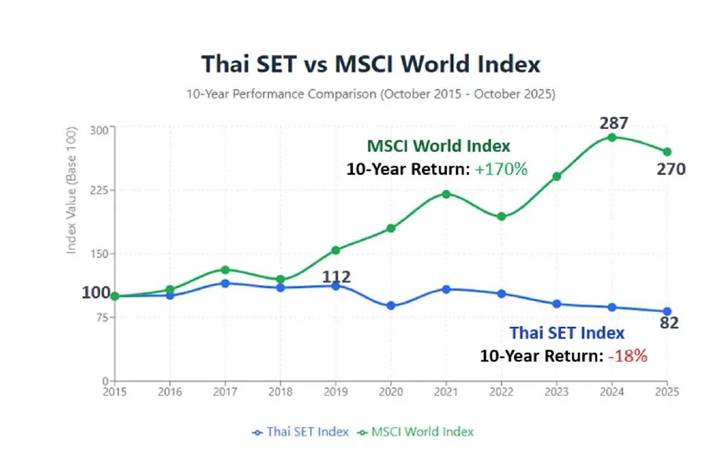
This difference in composition has translated directly into performance. Over the past five years, the S&P 500 has delivered returns of approximately 80–100% in total, depending on the exact timeframe and reinvestment assumptions. By contrast, the Thai market, as measured by the SET Index, has been broadly flat to slightly negative over the same period, with returns significantly lagging inflation in real terms.

The result is a widening gap between markets driven by innovation and those dominated by mature, slower-growth sectors. Thailand’s market structure simply does not provide meaningful exposure to the industries that have defined global equity returns over the past decade, and unless that changes, it is difficult to see how it can compete with markets like the US on a long-term basis.
Macroeconomic Challenges Facing Thailand
Macroeconomic factors also play a significant role, and this is where Thailand increasingly starts to resemble a developed market without the advantages of one. Over the past five years, Thailand’s GDP growth has averaged roughly 2–3% per year, held back by weak domestic demand, high household debt, and slow productivity growth. This is well below what you would typically expect from an emerging market. Looking forward, forecasts for 2026–2027 generally sit in the 2.5–3.5% range, again highlighting relatively modest expansion. In contrast, countries like India and Vietnam are growing at 5–7%+, driven by younger populations, manufacturing expansion, and increasing global investment flows.
Demographics further reinforce this trend. Thailand is one of the fastest-ageing societies in Asia, with a declining birth rate and a shrinking working-age population. This creates a structural drag on growth, consumption, and productivity over time. Unlike faster-growing emerging markets, Thailand lacks the demographic tailwind that typically supports long-term expansion.
At the same time, key industries are struggling to adapt to global changes. The automotive sector, historically a major pillar of the Thai economy, faces increasing pressure as the industry shifts towards electric vehicles. Thailand has long been a hub for traditional internal combustion engine manufacturing, but it risks losing competitiveness to China, where EV production is scaling rapidly and dominating global supply chains. This transition represents a structural threat rather than a short-term cycle.

Tourism, another cornerstone of the economy, also faces challenges. While it has recovered from the lows of COVID-19, growth has been uneven and increasingly competitive, with other regional destinations attracting a larger share of international visitors. Combined with shifting travel patterns and pricing pressures, this raises questions about how much tourism can drive future economic growth compared to the past.

Taken together, Thailand’s economic profile begins to look less like a high-growth emerging market and more like a slow-growing, structurally constrained economy, but without the innovation, productivity, or capital market depth typically associated with developed markets.
For foreign investors, there is an additional structural limitation that is often overlooked. Many participate in the market through non-voting depository receipts, which means they do not have voting rights in the companies they invest in. At the same time, boards are frequently dominated by founding families or long-standing insiders. This combination results in a situation where investors provide capital but have little to no influence over how that capital is deployed.
Regulatory and Governance Issues in the Thai Stock Market
Corporate governance standards further add to the complexity. While there are well-run companies in Thailand, consistency across the market is lacking. Issues such as related-party transactions, limited board independence, and transparency concerns can create risks that are difficult to identify and even harder to manage. These are not always visible in financial statements but can have a significant impact on long-term performance.
Overlaying all of this is the question of political stability, which has been a persistent issue in Thailand for decades. Since the end of the absolute monarchy in 1932, Thailand has experienced around 12 successful military coups, making it one of the most coup-prone countries in modern history. Even in more recent times, the political environment has remained volatile, with the 2006 and 2014 coups leading to prolonged periods of military-backed government and constitutional rewrites. Governments have changed frequently, and policy direction has often shifted as a result, creating an uncertain backdrop for long-term investment.
More recently, the 2023 general election highlighted ongoing structural tensions within the political system. The reformist Move Forward Party won the largest share of the vote, led by Pita Limjaroenrat, but was ultimately blocked from forming a government. Pita was suspended from parliament over a technical issue relating to shares in a media company that had effectively ceased operations many years prior, a case widely viewed by observers as politically motivated. The party itself has since faced further legal challenges, raising concerns about the durability of democratic outcomes.

For investors, this creates a deeper issue than just short-term uncertainty. It raises questions around the rule of law, institutional independence, and policy continuity. When governments can change direction abruptly, or when electoral outcomes are overridden or diluted, it becomes much harder to take a long-term view on economic policy, regulation, or reform.
Markets tend to reward stability, transparency, and predictability. In Thailand, the repeated cycles of political disruption, intervention, and legal challenges to elected parties introduce a level of uncertainty that is difficult to price, but very real in its impact on investor confidence and long-term capital allocation.
Taken together, these factors paint a clear picture. Thailand remains an attractive place to live, but from an investment perspective, it presents a number of structural challenges that are difficult to ignore. The combination of ownership concentration, governance concerns, limited growth sectors, weaker long-term returns, and macroeconomic headwinds makes it a less compelling destination for capital when compared to global alternatives.
For most foreign investors, a more effective strategy is to take advantage of global markets, where there is broader diversification, stronger regulatory frameworks, and greater exposure to high-growth industries. Thailand can still play a role in a broader portfolio, but it is unlikely to be the core driver of long-term wealth.
The key question, ultimately, is whether investment decisions are being driven by familiarity or by fundamentals. In the case of the Thai stock market, the two are often very different.
Summary
While the Thai stock market may feel familiar to expats living in Thailand, that comfort doesn’t necessarily translate into strong long‑term investment potential. Persistent structural issues, from weak governance and concentrated family ownership to limited free‑float and recurring corporate scandals, make it a challenging environment for outside investors. The market is also heavily weighted toward older, slower‑growth sectors, offering little exposure to the global industries driving returns elsewhere. When you add in Thailand’s sluggish economic growth, demographic pressures, and ongoing political uncertainty, the overall picture becomes even less compelling. For most expats, broader global markets with stronger regulation, better diversification, and more dynamic growth opportunities are likely to deliver far more reliable long‑term results.
- Banking Options for Expats in Thailand
- Living in Thailand as a UK Expat
- 3 Residency Programs – High Net Worths
For most expats, the Thai stock market is not the strongest long‑term investment option. Structural issues such as weak corporate governance, concentrated family ownership, and limited exposure to high‑growth global sectors make it less attractive compared to broader international markets.
Expats should be aware of governance concerns, political instability, low economic growth, and recurring corporate scandals. These factors can increase volatility and reduce long‑term returns, especially for foreign investors with limited influence over company decisions.
Yes. Most expats achieve stronger long‑term results by investing in globally diversified markets with higher growth potential, stronger regulation, and broader sector exposure. International index funds and global ETFs typically offer more stability and better performance over time.