
The Thai SET has been the worst-performing index in the world YTD, but is it worth investing in?
First of all, I want to give an overview of the political situation in Thailand as I believe it’s important to understand, and then go more into the macroeconomics and look at Thai SET as a part of EM exposure in an overall portfolio.
Having lived in Thailand for the last 10 years, I’ve been able to see and experience the changes which are happening, and I will share my experiences and opinions.
If you have any questions, please contact me through my contact page.
Blogs I have written on Thailand:
- Thailand 2024 Tax Reforms Explained
- Living in Thailand as a UK Expat
- Thailand’s LTR Visa Changes – October 2025
- British Inheritance Tax Planning for Expats in Thailand
Thailand’s Political Turmoil: A Leaked Call, Coalition Collapse, and What’s Next
Thailand’s political establishment has been thrown into disarray following the suspension of Prime Minister Paetongtarn Shinawatra on July 1, 2025, in the wake of a leaked phone call between her and former Cambodian Prime Minister Hun Sen. The call, leaked by Hun Sen himself, sparked outrage across Thailand’s political spectrum, with accusations of disloyalty and unethical conduct swirling around the Pheu Thai leader. The episode has not only intensified internal divisions but also exposed the growing fragility of Thailand’s current coalition government.
A Government Under Pressure
Paetongtarn Shinawatra’s path to power was controversial from the outset. In the 2023 general election, the Move Forward Party (MFP) won the most seats and the popular vote, campaigning on a bold platform of institutional reform and generational change. However, they were blocked from forming a government due to constitutional checks, most notably, the military-appointed Senate, which withheld its support.
The Pheu Thai Party (PTP), which came second, eventually formed a government by aligning with parties that had ties to Thailand’s military establishment, despite previously promising not to do so. This reversal prompted widespread criticism from both supporters and political observers, who accused the party of prioritising power over principle.
Further controversy surrounded the return of Thaksin Shinawatra, former prime minister and influential figure within Pheu Thai, who had lived abroad since 2008 to avoid corruption charges. Upon his return in 2023, Thaksin was briefly imprisoned but was quickly transferred to a hospital on medical grounds and subsequently released under a royal pardon. Around the same time, Pheu Thai installed Paetongtarn, Thaksin’s daughter, as prime minister, a move many saw as a consolidation of family political power rather than a reflection of grassroots support.
The Leaked Call and Political Fallout
The crisis reached a tipping point in mid-June 2025 when Hun Sen published audio of a phone conversation in which Paetongtarn referred to him as “uncle”, a sign of deference, and appeared to align herself with Cambodian interests amid ongoing tensions along the Thai-Cambodian border. In the call, she reportedly made dismissive remarks about a Thai military officer, which were widely interpreted as undermining Thailand’s security leadership.
The leak triggered a strong backlash. On June 18, the Bhumjaithai Party withdrew from the governing coalition, depriving the Pheu Thai-led bloc of a parliamentary majority. Protests began to build in Bangkok, with thousands gathering at Victory Monument on June 28 to demand Paetongtarn’s resignation.
The political pressure culminated in the Constitutional Court suspending her on July 1, pending an investigation into alleged ethics violations stemming from the call. In her absence, Deputy Prime Minister Suriya Juangroongruangkit has assumed interim duties.
A Fragile Economic Outlook
Paetongtarn’s government was already facing headwinds before the scandal. Her signature economic promise, a 10,000 baht digital wallet scheme intended to stimulate domestic consumption, has faced delays, legal scrutiny, and implementation challenges. Critics argue it lacks fiscal discipline and long-term impact, especially amid sluggish GDP growth and high household debt.
As a result, public confidence in the Pheu Thai Party has eroded. Polling data from late June placed its popularity at around 9%, a stark decline for a party that once commanded broad national support. Some observers believe that the Shinawatra family’s long absence from domestic politics, Thaksin lived abroad for nearly two decades, may have left them disconnected from the concerns of ordinary Thais, particularly the younger generation.
What’s Next for Thailand?
While Pheu Thai faces its worst legitimacy crisis in years, the reformist People Party remains popular, especially among urban and youth demographics. However, its leader, Pita Limjaroenrat, has been disqualified from politics over a now-defunct media shareholding, a charge many see as politically motivated.
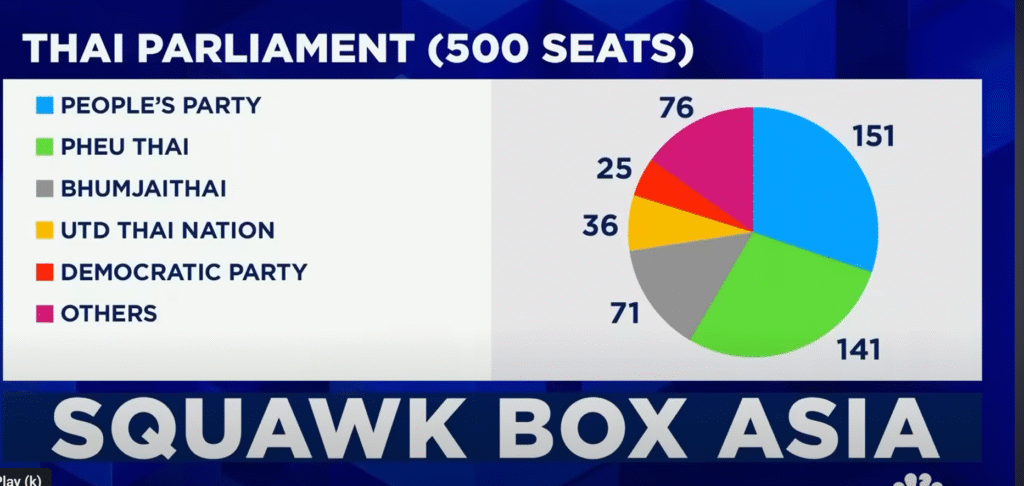
The broader implications are profound. Thailand is once again caught between forces pushing for systemic reform and a conservative establishment determined to preserve the status quo. The question is whether the country is heading toward a renewed democratic opening or yet another conservative retrenchment, possibly even a return to military-led governance, should the current turmoil spiral further.
Thailand’s Stock Market Hits 5-Year Low: Time to Buy?
Thailand’s SET Index has plunged to its lowest level in five years, a sharp reflection of deepening investor pessimism. With political upheaval, structural economic headwinds, and declining tourism all converging, marking a nearly 24% drop year-to-date. The big question now for investors: does this slump signal a buying opportunity, or is it a warning to stay away?
A Market Under Pressure
The recent crash in the Thai stock market didn’t happen in a vacuum. It’s the result of layered structural weaknesses and short-term shocks, beginning with the suspension of Prime Minister Paetongtarn Shinawatra over a controversial leaked phone call with former Cambodian leader Hun Sen. The fallout included a coalition breakdown, mass protests, and a potential leadership vacuum that has paralysed policymaking.
But this political drama is just one piece of the puzzle. Even before the recent crisis, Thailand’s economy was already losing momentum. In July, the World Bank slashed Thailand’s 2025 GDP forecast to just 1.8%, down from an already sluggish 2.9%. Behind that downgrade lies a cocktail of weak exports, declining consumption, and a troubled tourism sector that has yet to recover to pre-COVID highs.
The Collapse of Chinese Tourism
Thailand’s economic engine has long depended on tourism, and Chinese travellers historically made up the largest share of arrivals. But in 2025, that dynamic has shifted dramatically. For the first time in over a decade, Malaysia has overtaken China as Thailand’s largest source of visitors.
So far this year, Thailand has received only about 5 million Chinese tourists, less than half the 11 million in 2019. Overall, foreign arrivals are down 4.6% year-over-year as of June, and tour operators are calling the situation “hibernation mode.” In a country where high-spending tourists drive key service sectors, this prolonged tourism recession has had a chilling effect on earnings across hospitality, retail, and travel stocks.
A Market of Monopolies and Missed Innovation
Thailand’s corporate landscape has long been dominated by a handful of large conglomerates that control entire sectors, from telecoms and banking to energy and consumer goods. While this structure provides stability, it also stifles innovation and keeps competition low. Few Thai-listed companies are global leaders, and even fewer are meaningfully investing in AI, semiconductors, or high-growth technologies.
This lack of innovation is exacerbated by weak corporate governance, a common concern for institutional investors. Over the years, issues of transparency, political connections, and entrenchment have discouraged foreign capital, especially as other Asian markets modernise faster and offer better shareholder protections.
The Ageing Before It Gets Rich Problem
Demographics are another drag. Thailand is entering a phase of rapid population ageing, with fertility rates below replacement and a shrinking workforce. This transition is happening before the country has fully industrialised, which economists call “getting old before getting rich.”
Without aggressive reform in labour policy, pension systems, and productivity, this demographic shift could limit long-term economic potential. Unlike Vietnam or India, which boast young, tech-savvy populations, Thailand risks stagnation without bold policy action.
SET Valuations: Value Trap or Hidden Opportunity?
Despite the doom and gloom, Thai equities are now trading at multi-year low valuations, with P/E ratios near historic bottoms. On paper, that presents a compelling contrarian opportunity. For value investors, this could be a textbook case of buying fear.
However, the upside case hinges on reforms that remain elusive. A rebound in tourism, renewed infrastructure spending, and a return to political stability could all drive a recovery, but none of those is guaranteed in the short term.
Looking Beyond Thailand: Are There Better EM Bets?
For global investors with exposure to emerging markets, Thailand faces stiff competition. Countries like Vietnam and India are surging ahead, driven by favourable demographics, manufacturing shifts, and strong domestic demand. At the same time, Korea and Taiwan, though more developed, remain EM-classified and offer superior innovation engines in semiconductors, AI, and electronics.
In comparison, Thailand feels stuck, trading like an emerging market but operating like a legacy one.
Conclusion: Proceed With Caution
There’s no doubt that Thailand’s SET Index is cheap, but cheap for a reason. The combination of political fragility, demographic decline, monopolistic corporate structures, and weak innovation paints a sobering picture. While the long-term case for recovery exists, especially if a reformist government emerges or tourism bounces back, the near-term risk remains high.
For investors seeking exposure to Southeast Asia, Thailand may be best approached as a tactical, not strategic, allocation. Those looking for dynamic growth, innovation, and better governance may find more compelling opportunities in Vietnam, India, Taiwan, or South Korea.
In short, Thailand’s market is a contrarian play. But only those with patience, risk tolerance, and deep local insight should consider entering now.
- Britain’s New Political Chapter: Market Implications and the Primacy of Growth
- Offshore Bonds for UK Expats in Thailand: What They Actually Are (And How to Tell a Good One From a Bad One)
- 10 Money Mistakes That Catch Out British Expats in Thailand (And How to Avoid Them)
- How to retire in Thailand in 2026: A complete guide for expats
- Structured Notes Explained: Capital Protected Notes, Buffer Notes and Barrier Income Notes
The Thai SET Index hitting a 5-year low may present value opportunities, especially for long-term investors. However, expats should consider currency risk, political uncertainty, and sector-specific volatility before allocating capital. Diversification and selective exposure are key.
Key risks include political instability, currency fluctuations (THB vs GBP), and limited liquidity in certain sectors. Expats should also be cautious of overexposure to local banks or tourism-linked stocks, which may be sensitive to global economic shifts.
Expats can use regional ETFs, multi-asset funds, or global platforms that offer Thai exposure alongside broader ASEAN markets. This approach provides diversification, lower volatility, and easier portfolio management compared to direct SET investments.