
One topic I discuss proactively with potential clients is investment charges. It is important to understand what the charges are, how much they are likely to be, and what they relate to before you commit to a financial planner. That way, you avoid unpleasant surprises later on.
In a previous article, I looked at the different types of charges you may have come across, either in your own research or in conversations with advisers.
In this article, I am focusing on the charges associated with a product many expats come across: the offshore bond, also known as an insurance bond or portfolio bond.
If you have any questions, please contact me using the contact page. To understand more about how I help expats and clients with their investments, view my Manage Investments service page.
Fees of Offshore Bonds
Offshore bonds offer tax deferral, which can provide useful flexibility around when tax becomes payable if you redeem part or all of the bond. However, for expats living in places such as Thailand or elsewhere in South East Asia, the tax outcome depends on your current tax residence, future plans, and how withdrawals or remittances are treated where you actually live. In some cases, using a trust alongside the bond may also support estate planning objectives, depending on your circumstances.
However, the charging structures on many offshore bonds can be opaque or confusing. As a result, some investors only realise later that high commission, administration, or adviser costs have materially reduced the long-term value of their investment.
That does not mean offshore bonds are always a bad product. They can work well when they are used for the right reasons, structured properly, and not loaded with unnecessary commission or excessive ongoing charges.
To give some context on the sort of charges you may see, the table below compares pricing structures between UK-priced offshore bonds and bonds available in Hong Kong using the same provider. These figures are based on a £1 million investment. The figures were used historically and may no longer reflect current pricing.
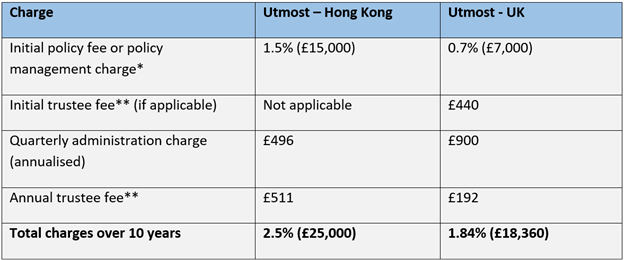
The Hong Kong policy charge is spread over five years and collected in quarterly instalments, which works out at 0.075% per quarter or 0.3% per annum. By contrast, the UK policy charge is typically taken up front.
Trustee fees are not compulsory, but I have included them here because a trust may be recommended to meet specific planning objectives.
The aim of the UK rules was to improve professionalism, increase transparency, and reduce obvious conflicts of interest. However, advisers and providers operating in overseas markets are not always subject to the same charging model, and commission-based structures still exist in parts of the expat market. That is particularly relevant for expats in Thailand and wider Asia, where disclosure standards, product design, and adviser remuneration can vary by jurisdiction. For that reason, I still receive regular emails from people being recommended offshore bonds with layers of charges they do not fully understand, so it remains worth addressing.
It is important to be cautious. If the costs quoted for an offshore bond include a high initial policy fee, an elevated ongoing policy management fee, or a long establishment period, that can be a sign that commission is built into the structure. In those situations, it is worth asking exactly who is being paid, how much they are being paid, what happens if you stop or reduce contributions, whether there are exit penalties, and whether the bond would still make sense if you move country again.
Summary
In my view, I would usually only look at an offshore bond if there is a clear planning reason for using one, such as estate planning needs, a future move to another jurisdiction, or a situation where the wrapper can be used efficiently based on the client’s tax residence and longer-term plans. Even then, the charges need to be sensible.
In broad terms, I would want to see a competitive structure, limited drag from administration costs, and no unnecessary lock-ins. For many investors, especially those who need flexibility, live in countries with changing tax rules, or may move again in future, a lower-cost platform can be the better option. I also continue to see offshore bonds recommended in situations where they are not appropriate, including within pension-related arrangements, where the additional layer of cost and complexity often makes little sense.
This is subjective, but I would not personally look at an offshore bond unless you are looking to move back to the U.K or Australia (or other location where it can be used tax effectively) used at the base cost. This is normally on a 10-year charging structure, 0.2% plus an admin fee of around 450 GBP (not going over 0.4% in TER), and you have over $250,000 that doesn’t need liquidity. These have been mis-sold to investors in pensions, where they make even less sense for most people and to people who do not need them.
If you have been proposed an offshore bond or an investment product would highly recommend you to read these articles:
Utmost International products (like the Evolution or Selection bonds) do not use a single, standardised public fee schedule. Instead, the total cost is a combination of multiple layers: policy administration fees, establishment charges (which fund the initial setup), underlying fund management fees (TERs), and any discretionary fund manager (DFM) or adviser fees. Because these costs are tailored based on your initial premium size and the specific assets chosen, investors can only see their exact “all-in” cost structure via a personalised financial illustration provided by a regulated adviser.
If your Utmost bond was structured with an Establishment Charge Period (typically lasting between 5 to 10 years), exiting the policy early will trigger a surrender charge. This penalty is essentially the insurance company clawing back the remaining initial setup fees that haven’t been amortised yet. For long-term wealth preservation, this structure works fine, but it makes the bond highly illiquid in the early years. Before committing capital, expats must ensure their investment horizon matches the establishment period to avoid heavy early-redemption penalties.
On paper, direct investment platforms or brokerage accounts usually have lower explicit administration fees than an offshore insurance wrapper like Utmost. However, for UK expats and high-rate taxpayers, the comparison isn’t just about the wrapper cost; it’s about the tax drag. Utmost bonds allow for gross roll-up (no tax on internal capital gains or income) and the ability to withdraw up to 5% of the initial investment per year tax-deferred. For larger portfolios, the long-term tax savings of the bond structure frequently outweigh the higher structural fees when compared to a standard taxable trading account.