
Vietnam, despite the U.S. efforts, remains one of a handful of communist countries. Like its (communist) neighbour to the north 20 years ago Vietnam is currently going through an economic boom. However, it is going somewhat unnoticed by a lot of the world. This article will look at whether investors should be keeping track of Vietnam right now and whether it is a good time to potentially invest in Vietnamese markets. I will also give a brief macro outlook and then look at the Vietnamese stock market.
History of Vietnam
An economic history of Vietnam might show a reason why most people are not taking note or rushing to invest in Vietnam. Its growth currently sits at 8% GDP annually through the 80s-90s after the U.S. war. While in the 2010s it fell below 7% annual growth.
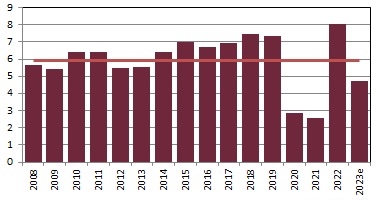
Source IMF: Vietnam GDP per capital growth 2007- 2022 (Q2).
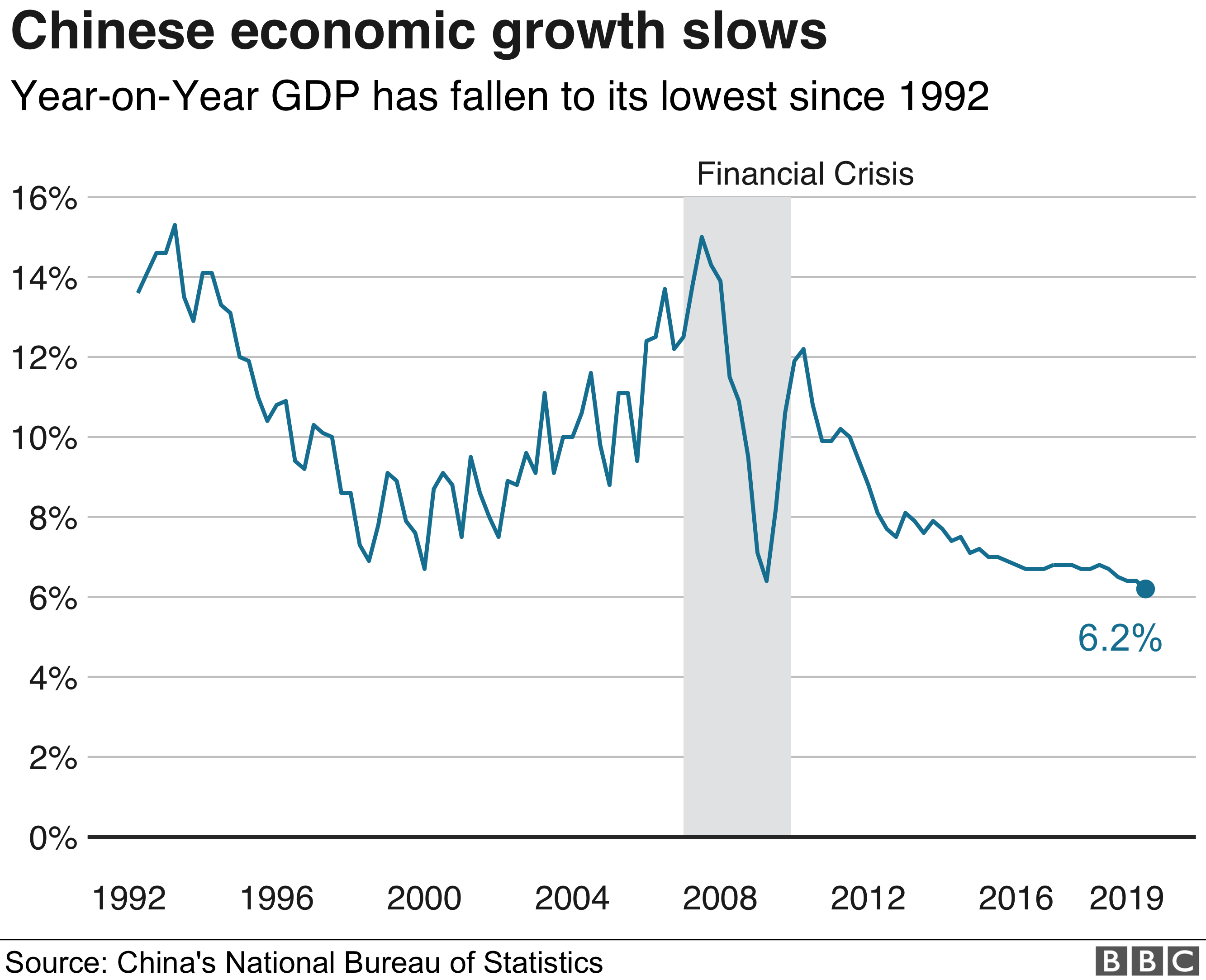
These are by no means a small amount of growth and has been consistently one of Asia’s fastest-growing economies throughout these time periods (the 90s-2020). Yet, this is well below the GDP growth that China saw in the 90s during its boom or even Japan in the 50s with its country’s economic boom.
Despite the growth, it is still a relatively small economy which compared to both China and Japan was growing to become the second largest economies in the world in their respective booms and remain the second and third largest economies today.
Source BBC shows Chinese economic growth 1992-2019
Vietnam has also failed to live up to its large economic expectations. For example, Goldman Sachs predicted in 2005 that Vietnam would become the world’s 35th largest economy by 2020 with a GDP per capita of $4,357.
This might have been on the optimistic side by Goldman and predicting decades ahead of growth in EM/Frontier markets is always a challenging task with numerous uncertainties and outcomes. But, it is still far off what Vietnam’s GDP is today of just under $3000 GDP per capita.
Source: Focus economics

Vietnam’s, economy is not all doom and gloom and the missed economic expectations should not be a reason to overlook its future for the reasons stated above.
The 7% annual growth GDP average over the last 20 years is nothing short of amazing. Vietnam is still one of ASEANS top performing economies which has doubled in size since 2012 and has skipped the 2020 (brief) recession. Vietnam has not had a recession in the last 30 years.
Likewise, companies have been flocking to Vietnam to take advantage of its low-wage labour to escape the U.S/China trade war (Vietnam being the prime beneficiary). Companies are seeing that Vietnam has skilled labour and this can be seen from companies such as Samsung moving to Vietnam and looking to produce advanced chips.
They are opting for Vietnam over more advanced ASEAN nations such as Thailand.
It does have economic obstacles to overcome. These are specifically the dominance of state-owned companies being mainly controlled by the government and are less efficient than the private sector.
This has been backed up by a 2015 paper on private vs government sector companies’ efficiency:
http://www.apjfs.org/resource/global/cafm/2015_3_1.pdfA
Although countries are investing more in FDI in Vietnam to reform the domestic market it aims for growth of 6-7% respectively over the next 5 years.
Vietnam Stock Market
From a stock market perspective, Vietnam has over 700 listed companies on Ho Chi Minh City Stock Exchange with a market cap of over $200 Billion.
The Vietnamese Hanoi and Saigon exchanges are down 28% and 52% respectively YTD
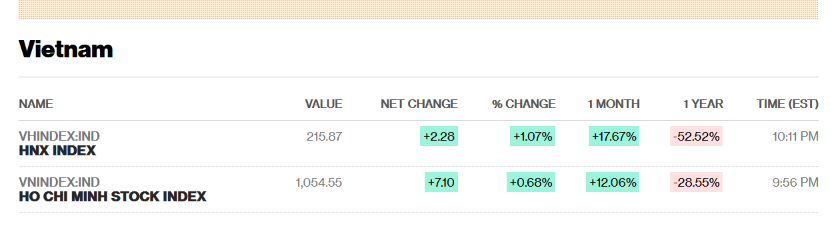
With the discrepancy between the economy and the exchanges, it does look like a promising opportunity to invest in a country with great potential.
For investors looking to invest, I would personally suggest ETF as frontier markets are difficult for stock pickers and specific funds can be expensive. Please note, this is not personal financial advice, if you need personal financial advice, please speak to a qualified and competent advisor.
VanEck Vietnam- With an expense ratio of 0.59%
The fund tracks the MVIS Vietnam Index, which reflects the performance of the largest and most liquid companies that operate in Vietnam. VNM is a multi-cap ETF that invests in equities of various market capitalisations.
Like its index, it includes companies that are both domiciled in Vietnam and elsewhere, but generate at least 50% of their revenue from Vietnam. More than 82% of the fund’s holdings are of companies domiciled in Vietnam.
| VanEck Vietnam ETF (VNM) Top 10 Holdings | ||
| Company Name (Ticker) | Percent of VNM Assets | Description of Company |
| Vinhomes JSC (VHM:STC) | 7.5% | Real estate developer |
| Vingroup Joint Stock Co. (VIC:STC) | 6.8% | Conglomerate with a focus on real estate development |
| Hoa Phat Group JSC (HPG:STC) | 6.7% | Steel products manufacturer |
| Masan Group Corp. (MSN:STC) | 6.5% | Food and beverage processor |
| No Va Land Investment Group Corp. (NVL:STC) | 6.2% | Real estate investment firm |
| Vietnam Dairy Products Corp. (VNM:STC) | 5.2% | Dairy product manufacturer and distributor |
| Saigon Thuong Tin Commercial Joint Stock Bank (STB:STC) | 4.2% | Individual and corporate commercial bank |
| Eclat Textile Co. Ltd. (1476:TAI) | 3.9% | Fabric and garment production |
| Feng Tay Enterprise Co. Ltd. (9910:TAI) | 3.9% | Manufacturer of athletic footwear |
| Joint Stock Commercial Bank for Foreign Trade of Vietnam (VCB:STC) | 3.6% | Commercial bank |
Conclusion
After reading this, if you still have questions about Vietnam, its stock market or its economic situation, please email me and I can arrange a time to speak to you,
You can email info@investmentsforexpats.com.
Vietnam has been growing steadily and shows promising signs of continuing to grow over the coming years. There is no certainty but for me, the signs are there to show that it has the potential to grow.
In the region, many companies are wanting to set up and move to Vietnam due to it’s labour market and current conditions which is why companies like Samsung are wanting to be in Vietnam.
Similar blogs to this one that you might find useful are: