
In this quick blog, I want to go over how 2023 has gone so far and where you might be able to find gains. Please note this is not personal financial advice, if you need personal advice, please speak to a qualified and competent advisor.
If you have any questions, please email me on info@investmentsforexpats.com
Large-cap global equity investors have had a positive start to 2023 as the S&P500 is up 4.98% so far, as of writing in January 2023 (source Yahoo Finance), and has gone past the psychological figure of 4000. While the tech-heavy NASDAQ is up 9.77% in Jan so far (Written on the 23rd Jan, Source Yahoo finance). This is optimism in the forward-looking market, due to factors such as not as cold winter in Europe with oil shortage, inflation data in the E.U., U.S, and the opening up of China.
All this has led to the markets being optimistic so far in 2023.
Although, this may be great for investors that have had heavy losses in their portfolios from 2022 if they were invested in large-cap equities, more so from the growth-driven ones.
Personally, I am looking at this with a bit of skepticism as I have a number of macroeconomic factors that could significantly affect the present equity rally in the short to mid-term. Despite what the market is pricing in I personally still have some harsh realities to deal with. Such as:
- Inflation is going to stay with us and for the ordinary individual, it’s much higher than CPI or RPI figures that have been suggested and this is going to give less consumer spending in the mid-term. Thus having a knock-on effect on leading economic indicators.
- The European conflict is still ongoing.
- Most countries still have large debt (and growing) that they will find harder to pay off in a higher interest rate environment.
Therefore, I see it more as a worrying time for investors when everything seems to be bullish in the markets but isn’t emulated in the real economy. Due to the fact that any one of the three major factors (and others) above could have a profound effect on large-cap developed market equities in the short term when the overall sentiment falls.
Investors looking to get in the market have always said if you are a long-term investor it’s better to be in the market than out of it and holding cash right now makes little sense. However, I would proceed with caution and use the old theory of dollar cost averaging to hedge risk. After all, depending on your situation, investing might need to come after creating an emergency fund first.
For the long term, investors may want to allocate a proportion of wealth to good quality growths stock in the U.S as I believe based on a number of metrics these still have some value due to the fact that certain technology companies have become an intrinsic part of our modern-day lives and have built a large moat around themselves that would be challenging (not impossible) for any companies to break in.
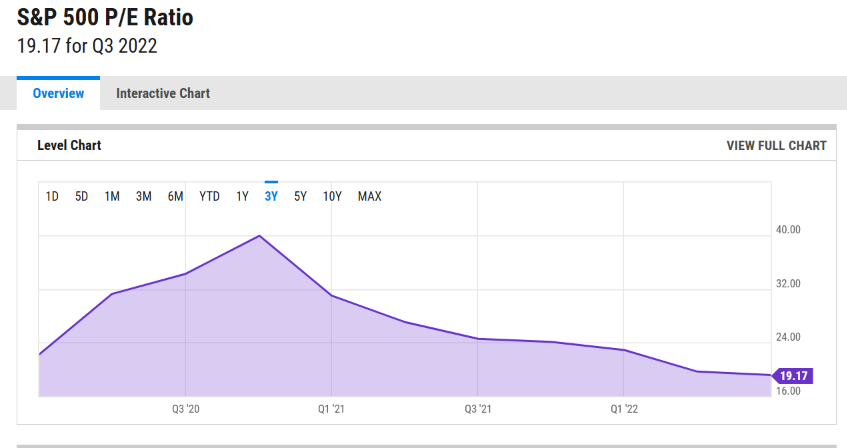
Examples of these are Apple, Google, and Microsoft and for value investors, some of these are actually trading on low P.E ratios.
Figure 1: Shows the P.E ratio of the S&P 500 showing 19.71 as of writing in Jan 23.
Although, for the pure value investor I do see more value in the mid-term in E.U. and defensive stocks, such as banks, and oil. I see investors that are pessimistic may want to take advantage of the high dividends as well as the present value that presents itself.
For example, have been looking at the Italian banking sector, where anyone who had read Ben Bernanke’s economic Nobel prize paper on the bank run suggests the catastrophic effect of letting banks fail would be difficult. Ironically 30 years or so after he co-authored the paper this was later implemented by him in 2008 as the chair of the fed.
Meanwhile, banks are not the most attractive business, but they do have a high moat due to the cost to get into the sector looking at the challenger banks and how much money needs to be pumped in just to get a small market share.
While from an economic point banks prosper in a rescission environment (usually and not guaranteed) due to higher interest rates means more savings and higher mortgages.
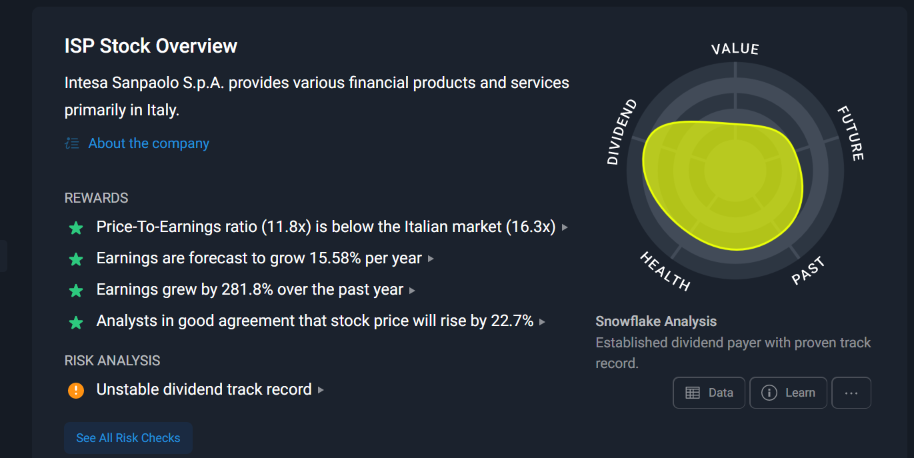
For example, ISP that has a high dividend also seems to be at a low P/E ratio with higher growth forecast (source simply wall street)
While looking at emerging market equities my perspective remains the same in China, Vietnam, and India as my top 3 areas (ETFs are fine) with looking at Indonesia as the next one. These all have various reasons that will not dwell on too much as have written a number of articles on the EM equity and economic long-term perspective of each of these countries looks positive for different reasons.
- Vietnam – An Emerging Market for 2023?
- New Portfolio Ideas – China Growth
- 2023 Portfolio Options for Expats
- The Economic Wolrd in 2023
Other Asset Classes
“Bonds are back” is a phrase that was coined by Blackrock CIO Wei Li in 2022. This has some merit as yields are higher than dividends in the S&P500 for the first time in a long time. While experts argue on what the FED Funds rate will eventually peak at. For bond fund investors in long duration, it is likely to see a negative effect on the price in the short term (due to the inverse relationship with interest rates) although mid-term if it peaks in 2024 do see this being reverted and a more a positive hold in investment grade long term bonds.
Also, those that are more adventurous do see some good deals in the EM markets such as Indonesia (just under 7%) on the run government bond.
Finally, Bonds!
HSBC Link: IDR-Long-Tenor-(FR)-(20191108).pdf (hsbc.co.id)
Although, it is an emerging market I have spoken to a few Indonesian fund managers and analysts and they are very positive about the economy so little chance of their option to default.
However, I would urge you to do some research yourself to make sure you are comfortable. However, please feel free to email me about this as do see it as an interesting option right now for some investors if they meet the right criteria.
Conclusion and Extra Resources
Here are some resources:
https://www.focus-economics.com/countries/indonesia
In short, investors could potentially benefit from:
- Long-term investors stick strong and do nothing (as in most cases) if investments have a sound theory and stick with it.
- Medium-term investors looking to make use of the current situation would be happy for the first time in a long time to go towards fixed income towards the end of the year. Meanwhile, in equities, I still see there is some good value in the U.S. large-cap and for anyone without risk tolerance would argue why would you go somewhere else in the midterm such as EM with potentially more volatility.
- Opportunistic emerging market equities, which I have written about Vietnam, but also still despite the markets maybe over positively reacting to China’s reopening and I see the long term in China’s consumer market and domestic market.
If you have any questions about the above, please email me at info@investmentsforexpats.com.
Some articles which are related and might also help are: