South Korea is a highly developed, technologically advanced economy with a dynamic stock market and a sophisticated banking system.
For expats living here, the opportunities to build and protect wealth are considerable, but so are the risks if you concentrate too heavily on the local market or overlook Korea’s tax rules, especially its strict inheritance tax regime. Successfully managing your finances in Korea means balancing local participation with global diversification, structuring your banking to suit both day-to-day living and long-term investment, and understanding the legal and tax framework that will ultimately shape your estate.
If you have any questions, or would like a second opinion, please contact me.
Table of contents
Banking and investing in Korea
For most expats, the first step is integrating into Korea’s banking system. Major domestic banks such as KB Kookmin, Shinhan, Woori and Hana all offer services to foreign residents, and many now have English-speaking staff or dedicated expat desks. Opening an account is straightforward if you have an Alien Registration Card or its new Resident Card equivalent, along with proof of identity and address. Local banking is efficient, digitally advanced, and fully integrated into the country’s payment systems, which makes it ideal for handling salary, rent, utilities and taxes. Funds in local banks are covered by Korea’s deposit protection scheme up to statutory limits, offering peace of mind for cash holdings.
The trade-off is that domestic accounts can be cumbersome for cross-border investing and foreign currency management. While Korean brokerage platforms provide access to the KOSPI and some overseas markets, the product range is narrower, and the fees are higher than those offered by many international platforms. This is why many expats also maintain offshore or international accounts, either with global banks such as HSBC or Standard Chartered, or through multi-currency digital platforms and international brokers. These accounts allow easier access to low-cost global ETFs, bonds, and alternative investments, and they provide currency diversification that’s valuable for long-term planning. Moving funds offshore, however, comes with compliance requirements under Korean foreign-exchange and tax-reporting laws, which vary depending on your residency status.
Figure: Showing the S&P 500 over 5 5-year period. August 2025.
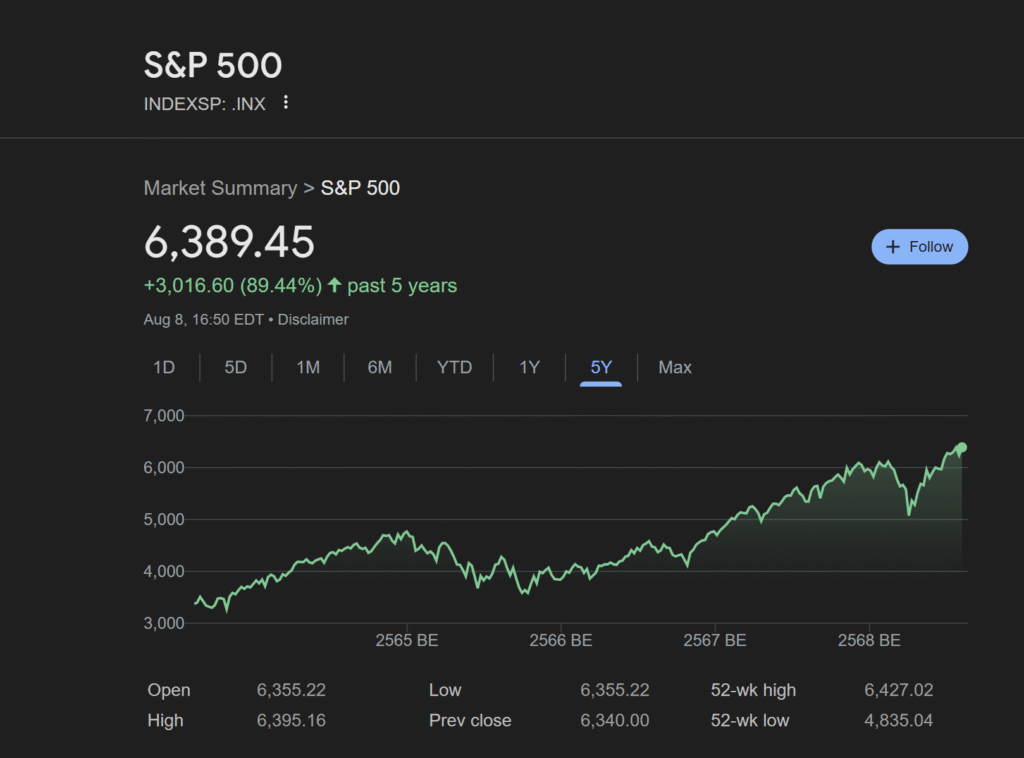
Figure: Kospi over the same 5-year period, August 2025
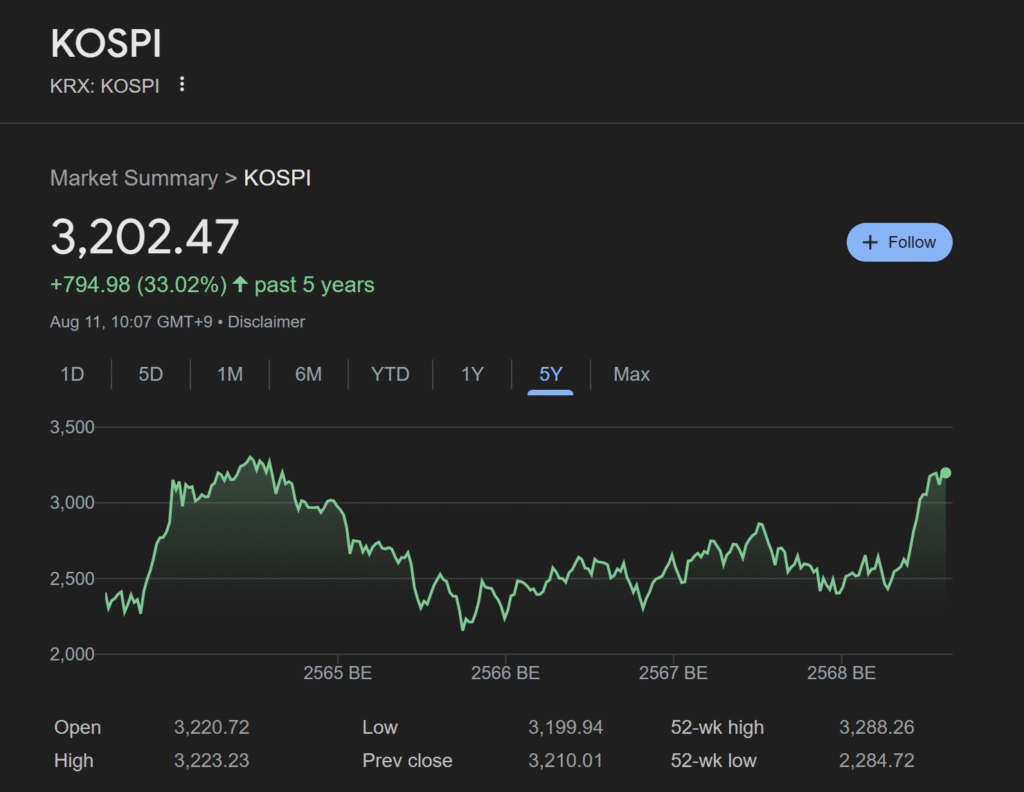
Once you have your banking structure in place, the question turns to where to invest. For many newcomers, the KOSPI is a natural starting point. It’s home to global champions in semiconductors, electronics, autos, and shipbuilding, and in boom years, it can deliver spectacular returns. Yet the KOSPI is also highly concentrated: a small number of chaebol conglomerates dominate the index, and the fortunes of the entire market often swing on the semiconductor cycle or a few major exporters. This makes it far riskier as a stand-alone investment compared with broader global indices.
The S&P 500, by contrast, is more diversified across sectors, technology, healthcare, consumer goods, financials, and energy, and includes multinational companies that earn revenue across the globe. Historically, it has often outperformed the KOSPI over extended periods, partly because its sector composition smooths out the volatility that comes from being tied to one national economy. For an expat whose income, housing, and daily expenses are already linked to Korea, concentrating investments in the same market adds another layer of single-country risk. That’s why many globally minded investors use a broad international index such as the S&P 500 or a world equity ETF as their portfolio core, adding Korean stocks as a smaller satellite allocation to capture local upside without taking on too much concentration risk.
The ideal balance between onshore and offshore investment varies from person to person. Keeping part of your portfolio in Korea offers direct access to domestic growth and familiar companies, and dividends from local stocks are automatically taxed at source. However, relying entirely on Korean markets limits your exposure to other geographies and sectors, and it subjects all your equity risk to the same economic and political environment you live in. Offshore investments, meanwhile, open up the full range of global ETFs, bonds, and alternative assets, as well as the potential to hold assets in different currencies and legal jurisdictions. The cost is the need to manage foreign account reporting and deal with different withholding tax regimes.
While investing decisions shape your returns during your lifetime, Korean inheritance and gift tax rules can have just as great an impact on what you leave behind. Korea’s inheritance tax is among the highest in the world, with marginal rates that historically ranged from 10% to 50% depending on the size of the estate after deductions. Although there has been political discussion of lowering the top rate and raising exemptions, the core structure remains in place, and until reforms are enacted, planning should assume the current framework applies.
Here’s the standard progressive table for Korean inheritance tax as it stands:
| Taxable base (KRW) — after deductions | Marginal rate | Progressive deduction (KRW) |
|---|---|---|
| Up to 100,000,000 | 10% | 0 |
| 100,000,000 – 500,000,000 | 20% | 10,000,000 |
| 500,000,000 – 1,000,000,000 | 30% | 60,000,000 |
| 1,000,000,000 – 3,000,000,000 | 40% | 160,000,000 |
| Over 3,000,000,000 | 50% | 460,000,000 |
If the deceased was a Korean tax resident, the tax can apply to worldwide assets. Non-residents are taxed on Korean-sited assets only, but even then, the scope can be wide. For expats married to Korean nationals, the rules still apply, though there are deductions and allowances for spouses with further reforms under discussion to make the system more generous. Gifts are also taxed, and in many cases, the gift tax is treated as an advance payment against eventual inheritance tax. That makes unplanned transfers during life just as important to manage as the estate itself.
For high-net-worth expats, this means estate planning should start early. A will that’s valid under Korean law, and possibly a separate will for assets in your home jurisdiction, is essential. You may want to explore the use of life insurance or other liquidity tools so that heirs can pay tax without having to sell illiquid assets. Trust structures and holding companies can also play a role, but Korea does not automatically treat foreign trusts the same way as domestic arrangements, so specialist legal advice is critical.
South Korea has one of the most demanding inheritance tax regimes in the world, and for those married to a Korean citizen or holding a Korean passport, these rules have significant implications for long-term wealth planning. Combined with global access to offshore investment platforms and the option to structure estates through trusts, understanding how to position assets has become a priority for many internationally minded families. The trend is clear: high-net-worth South Koreans are increasingly moving assets and in some cases themselves overseas, with Henley & Partners recently naming South Korea among the countries with the highest number of millionaire departures.
Example: How Korean Inheritance Tax Works
Let’s imagine a scenario:
- Total estate value: KRW 5 billion
- Spouse deduction: KRW 500 million
- Net taxable estate: KRW 4.5 billion
Tax calculation:
- For the first KRW 100 million → 10% = KRW 10 million
- Next KRW 400 million (100–500 million) → 20% = KRW 80 million
- Next KRW 500 million (500 million–1 billion) → 30% = KRW 150 million
- Next KRW 2 billion (1–3 billion) → 40% = KRW 800 million
- Remaining KRW 1.5 billion (over 3 billion) → 50% = KRW 750 million
Total tax = KRW 1.79 billion
This means over 35% of the estate value is lost to taxes, even after the spouse deduction.
How Life Insurance Can Help Reduce the Burden
One of the most common estate planning tools in Korea is life insurance. The reason is simple — life insurance proceeds can be structured to be tax-efficient and provide liquidity when it’s needed most.
Benefits of using life insurance in Korean estate planning:
Immediate liquidity: Inheritance tax must be paid within 6 months of death (or 9 months if overseas heirs are involved). Many heirs have to sell assets quickly, often at a discount, to cover the tax. Life insurance provides immediate cash to pay the bill without forcing asset sales.
Preferential tax treatment: Certain life insurance payouts can be exempt from inheritance tax if structured correctly, especially for smaller policies or those within the allowable exemption limits for heirs.
Wealth preservation: The payout ensures that real estate, family businesses, or investments can be passed on intact rather than being sold to cover taxes.
Offshore Investment Platforms: IBKR and Ardan
Global wealth mobility has given rise to two distinct categories of offshore platforms: those focused on active investing and those designed for longer-term estate structuring.
Interactive Brokers (IBKR) is one of the most widely used trading platforms for internationally active investors. It offers access to global equities, ETFs, bonds, and derivatives in multiple currencies from a single account. For residents of Korea, it provides a way to diversify beyond the KOSPI, gain exposure to US and European markets, and manage currency risk. The platform is highly cost-efficient for active traders and long-term investors alike, but it is geared toward self-directed investing rather than estate planning.
Ardan International sits at the other end of the spectrum. Based in the Isle of Man, Ardan is a custody and administration platform often used for holding investment portfolios in an estate-friendly structure. It can be linked to discretionary investment managers or advisory accounts, and its framework is designed to simplify the transfer of assets on death, potentially bypassing probate in some jurisdictions. While it is not in itself a tax shelter — Korean residents must still declare and pay applicable taxes — it can provide flexibility for multi-jurisdictional estate planning.
For Korean nationals and expats in Korea, combining a trading platform like IBKR for day-to-day investing with a custody platform like Ardan for longer-term estate structuring can strike a balance between market access and succession planning.
- Best Investment Platforms for Expats in 2025: Fees, Funds & Features Compared
- Ardan International Review
- Saxo Bank vs Other Platforms Review
Estate Planning with Trusts and the Outflow of Korean Wealth
Trusts are a powerful estate planning tool, especially for families with assets across multiple jurisdictions. In simple terms, a trust separates legal ownership of assets from the beneficial enjoyment of them. This allows for a smoother transfer of wealth to heirs, greater privacy, and in some cases, protection from forced-heirship rules or lengthy probate.
Korea does not automatically recognise all foreign trusts for tax purposes, and in some cases, the Korean tax authorities may treat the settlor or beneficiaries as owning the assets for inheritance and gift tax purposes. That said, when correctly structured and administered in a jurisdiction with a robust legal system, trusts can still play a significant role in protecting and transferring wealth for Korean families, particularly if some or all of the assets are offshore.
It is no coincidence that South Korea has seen a notable outflow of wealth in recent years. Henley & Partners identified the country as one of the top sources of millionaire migration globally, alongside nations such as China and India. The drivers are multiple high inheritance and gift taxes, the desire for greater investment flexibility, educational opportunities abroad, and political considerations, but tax policy is a consistent factor. With a top inheritance tax rate of 50%, Korea’s regime is one of the most onerous in the OECD, and while proposals for reform are being debated, many wealthy families are taking preemptive action.
This often involves moving both assets and residency offshore, acquiring second citizenship or residency in more tax-friendly jurisdictions, and restructuring portfolios to be held through platforms or entities outside of Korea’s immediate tax reach. For expats married to Koreans, this global perspective can open up additional options, especially if one spouse is already connected to another jurisdiction with lower inheritance tax.
Conclusion
Managing wealth as an expat in South Korea is ultimately about balance. The country offers efficient banking, advanced capital markets, and opportunities to invest in global leaders in technology and manufacturing. At the same time, it poses challenges in the form of market concentration, currency risk, and one of the world’s most demanding inheritance tax regimes. A sensible strategy for many expats is to keep local accounts for daily needs, use offshore accounts for global diversification, hold a core portfolio in broad international equities, and size Korean exposure to match your conviction without overloading your risk to one economy. Above all, build your tax and estate plan early, keep it updated as laws evolve, and work with advisers who understand both Korean and international rules. In a jurisdiction as complex as South Korea, the right structure is as valuable as the right investment.
My latest blogs:
- Statutory Residence Test Explained for UK Expats
- Interactive Brokers Review for Expats in 2026
- So You Won’t Make Those 10 Mistakes: Here’s What to Actually Do Instead
- Investors Trust Review 2026: Fees, Products, Complaints and My Honest Verdict
- Ardan International Review 2026
South Korea has one of the highest inheritance tax rates in the world, reaching up to 50% for high-net-worth estates. Expats considered “tax residents” are typically liable for tax on their global assets, while non-residents may only be taxed on Korean-sourced assets. Because tax must often be paid in cash within six months, many expats use offshore trusts or life insurance to provide the necessary liquidity for their heirs.
While local Korean brokerages offer access to the KOSPI, many expats prefer international platforms for better currency flexibility and wider asset choice. Interactive Brokers (IBKR) is a leading choice for self-directed traders due to its low fees, while Ardan International is often preferred for those seeking a custody-led platform that integrates more easily into long-term estate planning and trust structures.
In South Korea, life insurance is a primary tool for “tax-efficient liquidity.” Since Korean inheritance tax is aggressive and requires prompt payment, a correctly structured life insurance policy provides heirs with an immediate cash payout. This prevents the “fire sale” of property or stock market assets to cover tax bills. For expats, using an international provider can also offer protection against Korean Won (KRW) currency volatility.