
Iran, Tech, and the Fed Shape the Summer Rally
Source: Bloomberg: S&P and Nasdaq indexes Jan 23-June 2025
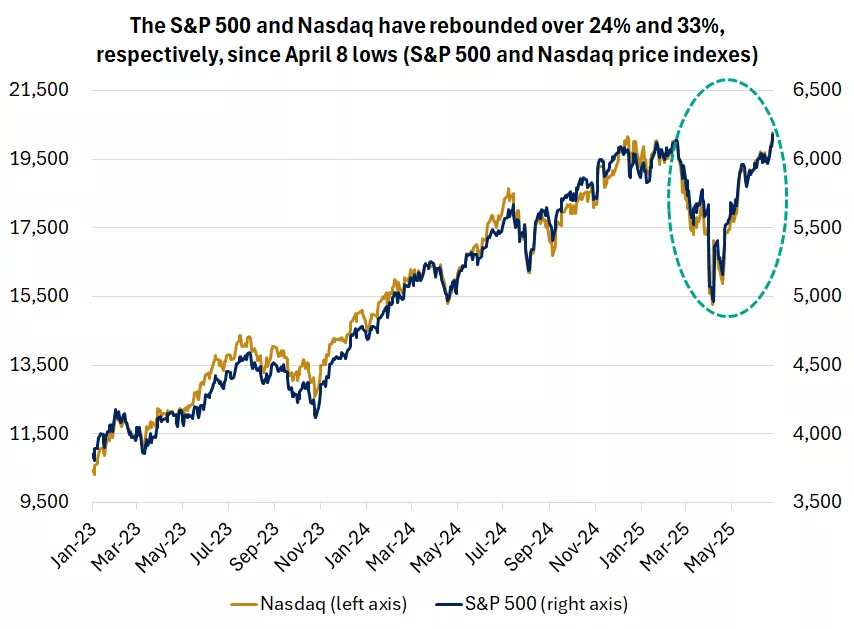
Last week, global markets surged in response to a confluence of powerful forces: geopolitical tensions in Iran that de-escalated almost as quickly as they erupted, a blockbuster earnings season for U.S. technology giants, and growing whispers that the Federal Reserve may pivot toward interest rate cuts before year-end. Together, these factors delivered a wave of optimism to investors and powered equities higher. But behind the buoyancy lies a more fragile reality, one where the catalysts for the rally may prove to be short-lived.
Iran’s Brush With Crisis: Contained… For Now
The week began with market nerves stretched tight. Reports of a targeted strike in Iran, allegedly disrupting a part of the country’s nuclear infrastructure, stoked fears of retaliation and a potential regional escalation. However, what followed was relatively restrained. Iran’s response was limited, oil prices cooled quickly, and global equities rebounded as traders interpreted the event as a “quick win” for Western deterrence.
Oil, which had briefly spiked, quickly settled near $83 per barrel. This rapid normalization soothed inflation worries and helped fuel risk-on sentiment. Yet experts remain cautious. The Strait of Hormuz, a critical chokepoint for global oil, remains a persistent geopolitical flashpoint. Any future disruption there could reignite market instability.“Markets are focused on whether oil prices will be sustainably disrupted. Right now, the answer appears to be no—but the situation remains fluid,” said Matt Orton, Chief Market Strategist at Raymond James.
Tech Titans Drive the Rally
Source Bloomberg: S&P 500 returns by sector from 4/8/2025-6/27/2025.
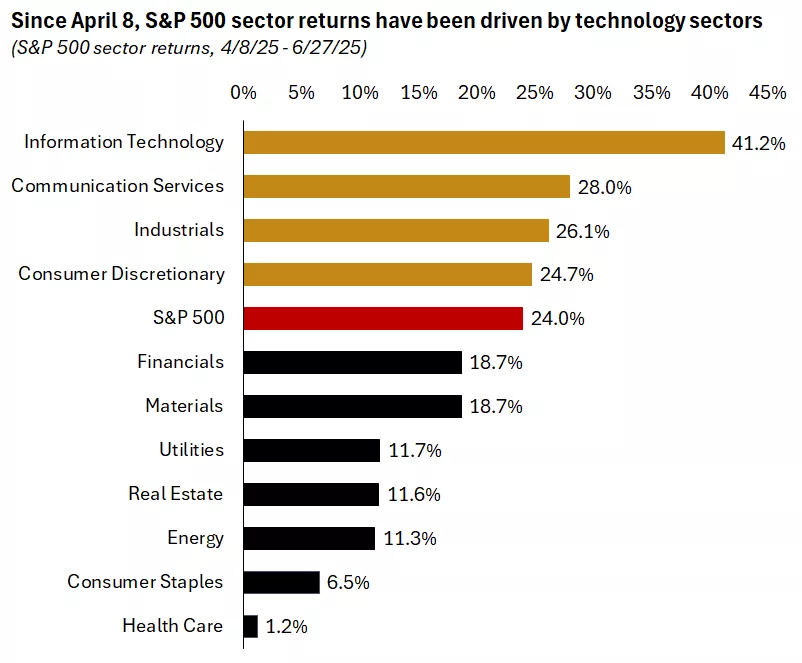
While geopolitics stole the headlines early in the week, it was U.S. technology earnings that gave the market its strongest push. The so-called “Magnificent Seven”, Apple, Amazon, Alphabet, Microsoft, Meta, Tesla, and Nvidia, have added an astounding $4.7 trillion in market capitalisation since April.
Nvidia, in particular, continued to ride the AI wave, posting earnings that beat even the most bullish expectations. Microsoft and Amazon followed suit, each reporting robust cloud growth and reaffirming confidence in enterprise spending.
Yet as impressive as these numbers are, some analysts question how long tech can remain the sole engine of market growth. As of last week, only about half of the S&P 500’s constituents were trading above their 200-day moving averages, suggesting that the broader market has yet to fully participate in the rally .“We’re seeing improving breadth, but it’s still uneven. If tech stumbles, the whole rally could falter,” Source Morgan Stanley.
The Fed’s Balancing Act
Perhaps the most consequential tailwind came from the Federal Reserve, or more precisely, from growing expectations that it may begin to ease monetary policy later this year. After months of caution, the market is now pricing in a near-50% chance of a rate cut in September, with a non-negligible chance of a July surprise.
This optimism is underpinned by signs that U.S. inflation is cooling and wage growth is stabilizing. The Fed’s preferred inflation gauge, the core PCE, came in below expectations last week, reinforcing hopes for a policy pivot.
Yet within the Fed, divisions are emerging. While Chair Jerome Powell continues to preach patience, some governors like Christopher Waller and Michelle Bowman have suggested that the central bank should be prepared to cut if inflation trends persist downward. “We’re still in a wait-and-see mode,” Powell said at a recent event. “But if the data continues to support it, rate cuts are certainly on the table this year.”
Adding to the intrigue is political pressure from the Trump campaign, which has openly floated replacing Powell, a move that could further politicise monetary policy during an already tense election cycle.
A Rally Built on Sand?
With oil prices stable, inflation cooling, and tech continues to deliver, the summer rally has all the hallmarks of a “Goldilocks” moment. Equities are climbing, credit spreads remain tight, and even previously risk-averse sectors, like industrials and small caps, are beginning to show life.
But can it last?
Several storm clouds are forming on the horizon. The Trump administration faces a July 9 deadline to either extend or let lapse a pause on new tariffs, a decision that could rattle trade-sensitive sectors. Meanwhile, upcoming inflation and payroll data will test the Fed’s resolve and could reset market expectations overnight.“We’re in a good place for now, but the next few data prints will be make-or-break,” warned Peter Cardillo, Chief Market Economist at Spartan Capital.
Then there’s geopolitics. The Iran episode may have passed without a broader conflict, but any misstep in the Middle East could trigger a rapid reversal, particularly if shipping through the Strait of Hormuz is impacted. Markets may be pricing in a calm, but history rarely moves in straight lines. And many reports have been leaked that Iran’s nuclear program may have only been back for a few months, so while it might seem like a quick win, I wouldn’t be so sure just yet.
Final Thoughts: Quick Win or Temporary Relief?
So, was last week’s rally a quick win for the West? In the short term, yes. A de-escalated geopolitical scare, strong tech earnings, and dovish central bank whispers created a sweet spot for risk assets. But beneath the surface, the rally rests on fragile foundations, confidence in future Fed cuts, political stability, and the continued outperformance of a handful of U.S. mega-caps.
Investors would do well to enjoy the upswing but prepare for volatility. Diversification, discipline, and attention to unfolding risks remain critical as the summer unfolds.
Read blogs I have written specifically for expats and their finances:
- Best Investment Platforms for Expats in 2025
- Vietnam’s Proposed 10-Year Golden Visa
- Estate Planning With Ardan Platform
In early 2026, Gold has surpassed $5,000 an ounce, driven by central bank diversification and geopolitical hedging. For expats, this “flight to safety” suggests that while equities are rising, the market is pricing in long-term currency debasement. We recommend reviewing your alternative asset allocation; holding 5-10% in physical gold or gold-backed ETFs can provide a crucial “safe haven” buffer if the US Dollar continues its recent softening against the Yen and Euro.
Yes. Throughout 2025, the market was heavily reliant on the “Magnificent Seven” tech stocks. However, in 2026, we are seeing a “Quick Win for the West” as capital rotates into small-caps, industrials, and healthcare. For expats, this means a globally diversified ETF strategy is finally outperforming concentrated tech bets. If your portfolio is still tech-heavy, now is the time to rebalance into these “real economy” sectors that are benefiting from stabilising interest rates.
The Japanese Yen has seen a dramatic recovery in early 2026, climbing as the US Dollar hits its lowest levels since 2022. For expats living in Asia or those with Yen-denominated liabilities, this reduces “carry trade” volatility. To manage this, ensure you are using a multi-currency investment platform like Swissquote. This allows you to hold balances in USD, GBP, and JPY simultaneously, letting you convert only when rates are favourable rather than being forced to exchange during sudden market swings.