
Stocks keep falling in October! Is now the time to start getting back into the equity market?
It’s evident that many portfolios are grappling with the uncertainty of these times. At first glance, the recent numbers can be quite disconcerting for the last few months performance:
- S&P 500: A 10% decline
- NASDAQ 100: A 10% dip
- Russell 2000: An 18% drop
- FTSE 100: A 9% decrease
- Hang Seng: A substantial 23% decrease
However, allow me to provide some perspective based on history and some latest economic factors in this month’s newsletter to aim to give some insights.
A Journey Down Memory Lane
Looking at a long-term prospective 2000 to 2020. During that period, the S&P 500 faced the challenges of the dot-com bubble, followed swiftly by the Global Financial Crisis. Yet, despite those trying times, we’ve witnessed some of the most impressive growth periods.
Figure: Source: Macrotrends S&P 500 2000-2020

An Encouraging Outlook
I encourage everyone to adopt a 10-year perspective. Over a decade, markets not only have the capacity to recover but also to prosper. While it’s natural to experience moments of anxiety, remember that with patience and a broader outlook, the potential for growth remains ever-present.
What happened in October with the economics and the markets? The economy continues to exhibit resilience
According to the initial government estimate, the U.S. economy experienced robust growth at a 4.9% annual rate during the third quarter, surpassing expectations and more than doubling the pace seen in the second quarter. This impressive expansion was primarily driven by consumer spending, which remains the backbone of the economy. Government expenditure contributed to growth for the fifth consecutive quarter, and the housing sector showed signs of recovery by recording its first quarterly increase in over two years.
Nonetheless, it’s improbable that this level of growth will persist. The increasing costs of borrowing are poised to affect consumers and might be a lagging effect, and the rate of spending is unlikely to outpace disposable income, especially considering that excess savings have largely been utilized. However, growth looks relatively stable. The labor market remains robust, and consumer finances are solid when compared to historical standards, which will continue to bolster consumer spending for the foreseeable future.
Inflation remains in a state of moderation
Despite robust economic growth and low unemployment rates, inflation is following a downward trajectory. The core personal consumption expenditures (PCE) price index, which the Federal Reserve favors as its inflation gauge, decreased slightly to 3.7% in September, down from 3.8% in the previous month. While this figure still exceeds the Fed’s target of 2%, it is notably lower than the peak of 5.6% observed last year. We anticipate that the slowdown in wage growth and reduced housing inflation will continue to contribute to further improvement in the coming quarters.
What is happening in the markets? Valuations have shown improvement
The recent dip in the stock market has resulted in the S&P 500’s price-to-earnings ratio dropping to 17.4 from 19.1. This again is mostly pushed up by a few stocks. For instance, the S&P 500 Equal Weighted Index is valued at 14 times earnings, and value-oriented investments, as represented by the Russell 1000 Value index, are valued at 13 times earnings, in contrast to the “Magnificent Seven” trading at 30 times earnings.
In the realm of fixed income, the historic decline in bonds has a silver lining in the form of attractive yields, which are likely to yield substantial returns. The increased income component can effectively counterbalance price declines, making a 1% drop in interest rates potentially translate into significantly higher price gains than the potential downside stemming from a corresponding 1% rise in rates.
Earnings are staging a recovery
Following a string of three consecutive quarters with negative results, corporate profits appear poised to resume growth in the third quarter, with expectations of continued improvement throughout 2024. A robust demand environment is fueling a resurgence in revenue growth, and the decrease in material and input costs is expected to contribute to a rebound in profitability. While analyst estimates projecting a 12% growth rate for next year may be somewhat optimistic, unlike the previous year when profits experienced a decline, the upswing in earnings is likely to underpin the rise in stock prices.
Is the long-term outlook more optimistic for the markets?
Anticipated deceleration in economic growth, gradual labor market cooling, and heightened geopolitical uncertainties are expected to sustain elevated levels of volatility for an extended duration. Given the Federal Reserve’s commitment to ensuring inflation returns to its target, it will maintain a restrained monetary policy for a considerable period, possibly leading to a less rapid market rebound.
Nevertheless, the advancements in tackling inflation and the reduction of headwinds indicate a shift away from the worst-case scenarios. The S&P 500 has experienced a 455-day period without achieving a new high, the lengthiest since the Global Financial Crisis, and stands approximately 14% below its January 2022 peak. This implies the potential for substantial gains, even if they materialize over a more extended period.
What would I do now for portfolios?
As shown above, from the lowering of P.E ratios in the S&P500, see it as a good time for those that have had significant gains in magnificent 7 tech stocks and then put in money markets to crystallise gains time to dollar cost average back in the broader large-cap equity markets. But, with more relevance toward defensive stocks or equal-weighted S&P 500. If history is anything to go by in the short term November and December have been historically stronger for the S&P 500 than September and October which have historically shown to be one of the worst months.
Written in the half-year review in June. Stated that saw markets in the Euro, and S&P 500 as then high and were negative to stagnant for the second half of 2023.
Figure: S&P 500 from April 2022 to October 2023 source Macro trends
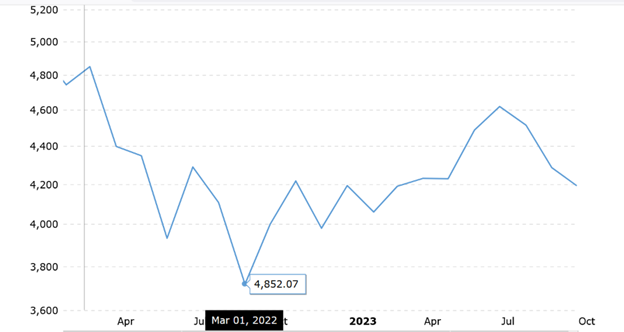
Now, my outlook has changed to slightly positive for the S&P500 for the first half of 2024, however, this will be very data-dependent on inflation, mainly due to the reasons stated above which are higher corporate profits and lower P.E ratios. This outlook is backed by many analysts (not they are often right) who see the S&P range of 4200-4600 presently at the lower end of most economic scenarios in the first quarter of 2024 and looking more towards 4400 at the end of Q1.
However, the geopolitical uncertainty and inflation data could be some of the disruptive trends to these predictions.
For investors looking to dip back into the S&P500 or to dollar cost average back into large-cap quality equities see as potentially a feasible time.
For other broader markets, I would look at Heng Sang as positive for 2024 and beyond due to different economic reasons.
Take it with a pinch of salt as these are all based on underlying factors and research which can change at any time. As if anything 2023 has shown how unstable Chinese/Hong Kong markets can be. Most analysts and I were expecting a great economic resurgent in consumer spending and GDP since the Chinese re-opening of the economy just over a year ago. What a humbling lesson it has been to see this not fully perspire. What I will say is that I was wrong about this with my 2023 outlook but I still believe it’s something to watch out for if you want growth in portfolios.
Investors on a 5-10 year time horizon I do see it hard to look past this index and the Chinese economy for a number of macroeconomic factors that I have written about throughout the year in much more detail. Some of these factors are that it’s becoming a more innovative economy and on-shoring more products. These and a number of other factors, if implemented well, are all long-term positive trends that should overcome the potential present negative economic impacts and headwinds such as export decreases from the U.S. and its allies due to political tensions and the internal property crisis.
As of typing at the end of October, the Hang Seng is around 17,100 and I would not be surprised if China can effectively deal with the economic problems it presently has in the property market and use sufficient monetary or fiscal policies to implement growth back into the country. It’s still at around 4.5% GDP growth for 2023. I would not be surprised if the Hang Seng goes back over 20,000 for the end of Q2 2024 on a positive outlook.
Figure: Source Google Finance Hang Seng index YTD 2023

Of course, this is speculative and could be very wrong as was last year if significant economic factors (and others) such as GDP growth, youth unemployment, and consumer spending remain stagnant at the 2023 level. I would urge investors like any EM market equities to take at least a 5-10 year outlook on this.
In tandem with China’s potential growth in 2024, investors looking for a stable developed market to get into as the ASX 200 (Australia index) which is heavily weighted towards mining and oil stocks that are heavily intertwined with the GDP of China.
This has been mostly negative for the ASX 200 in 2023. However, potential growth in 2024 could be positive for the index. For the ASX 200 I would reckon if economic data prevails with China the ASX to reach 7,300 (it’s not guaranteed). Additionally, the ASX has a good dividend yield due to the makeup of its companies being more stable and developed than growth-orientated. This is for an alternative developed market outside the U.S. which might not be a bad option for investors looking to diversify away from the U.S.
Figure: ASX 200 YTD Oct 2023. Source Google Finance

However, for those still looking to play it safe the good news from the turbulence in October’s economic data is that short-term money markets are still likely to yield a real return at least to the start of 2024. So, see no need to go longer in duration on fixed interest right now for investors not looking to take the additional risk of a potentially volatile equity market.
If you want to go over any aspects of your portfolio and/or look at the options for your investments please feel free to contact me at the bottom of the page.
Note this is not meant as financial advice as many times I could be wrong and any investment that is made without any advice is done so at your own risk.
Summary
There have been a few down months if you look at markets, however, if you manage to find stocks that have performed well over the past few months, you have picked good quality stocks. In my opinion, there is still an opportunity for growth in other emerging markets.
I have written articles on China, which hasn’t performed so well this year, but I still think that it will if the economic data, policies, and spending increase then it will be a market I become very interested in and watch closely.
If you have any questions, please contact me using the button below.
Some articles which I mention or allude to are:
- New Portfolio Ideas – China Growth
- September Market Update Plus What I Would Buy Now
- Vietnam – An Emerging Market for 2023?