Having lived in many places in Asia and being an avid property enthusiast, it seems a treat to be living in an era where I can see so much growth within the region. Many have invested in properties and done well from the rapid economic growth in the region.
Let’s take a look in 2020, where are the best places to invest in Asia and what does the future lie ahead?
Asia Property Market Overview
Asia, as a whole (with the exception of Japan), is going through somewhat of a boom right now and we can see the next few decades being Asia’s golden era.
Asian countries are seeing the biggest rises in GDP growth such as Vietnam, India, and even Cambodia. This makes investing in properties and potentially the currencies extremely lucrative as we have seen the example of China, which, over the last decade, made an average of 7%+ growth over the last 5 years (2014-1019) and before that the number was double figures (2005-2014).
Anyone that has invested in property back in the 1990s in cities such as Shanghai would have seen the values in their assets growing as much as 24% per year in some years (see table 1 below).
Table 1 Property prices over a 21 year period in China as a Whole.
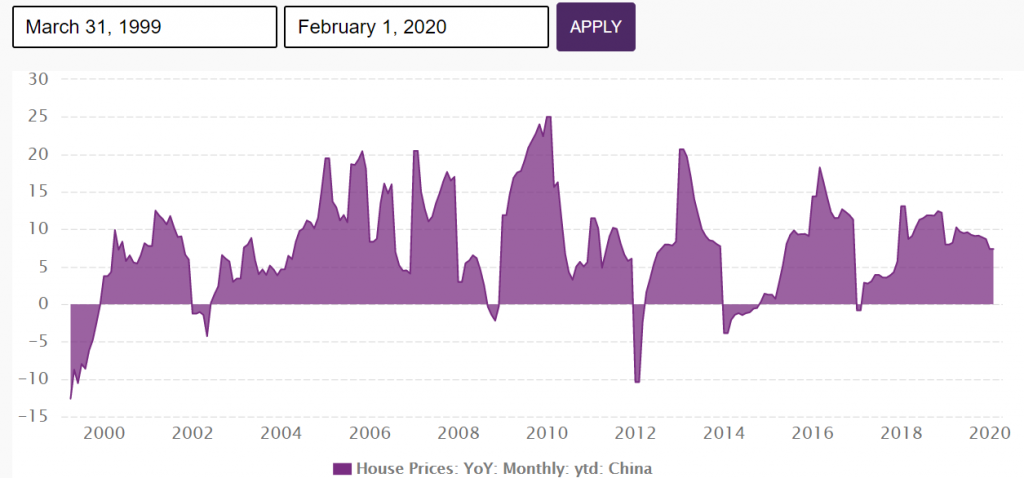
The growth in China has been exceptional and I don’t think it will ever be replicated again in such a short space of time. (See table 2 for the last 5 years growth).
Table 2 China Economy Data 2014 – 2018

Although we have seen the Asian boom and bust in the last 3 decades, I believe there is a lot of assets and potential in the next few years in Asia and I will go over a few of my personal favorites and not so favorite countries and cities within the continent.
How do you know properties are going to do well?
Well, in the west they have a concept that is made famous called the 18-year property cycle to predict it with interest rates, and how property prices and the economy falls into line with it over an 18 or near year period. I would highly recommend anyone that is not familiar with this concept to listen to the link (https://propertyhub.net/podcast/tpp069-18-year-property-cycle/) as it is a highly genius concept by Fred Harrison.
In emerging markets like the Asian segment, it would still be prevalent to some degree and it won’t be as relevant as it is to the west.
Personally, when looking at properties in Asian countries, I look for a few indicators economically before going into other details. The indicators I look into are the openness of the country, population growth, political environment, GDP outlook, foreign investment in the countries, and current prices per square meter (compared among similar locations or areas).
Vietnam
I have said this in many of my blogs and articles that this place is a gem. My personal favourite as of 2020 with Saigon being my top pick to live.
Since 2018, Vietnam’s economy has been prospering especially during China Trade War. Many countries have invested in many factories and manufacturing outlets in Vietnam due to the low wages and easy tariffs. The manufactures have moved from China to its southern neighbor for cheaper labour and lower tariffs.
Vietnam has a population of nearly 95 million looking to grow to 120 million, in the next 20 years. The Country growth is 6.5-7% a year, which is no real surprise why I have this as my top choice. It also has rapid urbanization that I have seen personally in Saigon.
Where to Buy
From a personal perspective, Saigon seems to be a perfect blend with the culture and development throughout the city.
My favorite area is D1, the central district of Saigon where you will find all Museums, Churches, and all the French influences. Although from a real estate perspective, it’s gaining price quickly as the city has become popular and people are gaining more interest in Vietnam as the next big economic miracle.
D2 is the area located over the river, where the roads are wider and it feels less hectic. It is an expat area, which suits the western lifestyle in Saigon with all the western living aspirations. So I would recommend these areas for buying properties for an investment.
While, in Hanoi, West lake district is a nice area. It is a blend of D1 and D2 of Saigon, holding its French past in the charming look of grace.
What to know
Do not get too excited by the figures and prospects of Vietnam too fast! Vietnam is not a completely open country. It does have its restrictions on buying property. In fact, until 2015, the government didn’t let any foreign ownership in the country.
Technically, if you have a resident visa you can invest in properties in Vietnam, but in reality, it is somewhat very difficult due to the laws.
The laws are that no matter who you are you can only lease the properties for 70 years (similar to China and Singapore). Although, it is possible to extend the lease technically (I have not known anyone doing this). They are also similar to Thailand. For foreign ownership in a condo development project, there is a set number of units that can be owned by foreigners.
30% is the normal allocation with an extra twist in the law in certain districts. There are restrictions on foreign ownership in properties in some particular district. For example, D10 in Saigon would only allow 250 condos to be owned by overseas buyers.
Although I am a big fan of the place, its openness to property investment for foreigners still lacks behind Thailand, Malaysia and even Cambodia. But is making slow steps forward and hopefully in the coming years you can see a shift towards openness for Vietnam.
Tax
Property tax is a plus for Vietnam. The Country has a high tax on sales within a set timeframe. It has VAT at a mere 5% and a small registration fee of 0.05%.
Conclusion
In short, I personally love this place and I would be keen to look for property investment, as it will have strong GDP growth. Saigon is my top pick. Although the laws are hard for foreigners to own properties but don’t let this denture you from getting into one of the best countries of the decade.
Table 3 – Vietnam Economy Data 2014 – 2018

Malaysia
If you are looking for livability and affordability, this is the place to buy. But too often, it gets overlooked by expats flocking to Singapore for expat jobs and to Thailand to retire.
The same can be said for property as well that it is very underrated. You can get a place in KLCC for under $4,000 USD. This is cheaper than Bangkok (in a similar location) and even Phnom Penh with its rapid urbanization.
But aside from all this, you can own land. Malaysia is only a hand full of Asian countries (along with Japan) that allows this while it is impossible to own land fully in Thailand if you are non-citizen. It’s a shame, as it’s the only asset that is worth buying in Thailand right now.
Although, you are not going to get the yield of 7% that I would get in the U.K. I am personally confident that when buying a place in KL (which I am looking to do later on this year), MR is undervalued. I have written in a few of my blogs that Malaysia is opening up. It plans to be fully developed by 2030.
Looking into the projects, it has on the go or planned ones with some of the world’s biggest sky scrappers. A number of these are in KL and there are some new cities in KL. The areas are River City and Bukit Bintang getting reformed.
Besides the biggest city in Malaysia, there is a Forest city & Iskandar, this is not one of the biggest projects in Malaysia but in the world right now.
Located next to Singapore in Johor, it is three times the size of Singapore and would stand up in any middle eastern extravagant oil wealth filled development project. It is for me, breathtaking for a place like Malaysia to undertake this. It looks to emulate the Shenzhen model of special economic zone rivaling Singapore. Regarding transportation, if not great already with low-cost flights, there will be a speed train from KL to Singapore to increase business activities that halted due to money.
Malaysia also has a rapid population growth of 30-40 million in the next 30 years and a rising middle class.
Table 4 – Minimum Amount Guideline that You Can Invest in Malaysia
| State | Without MM2H Visa | With MM2H Visa |
| Kuala Lumpur Federal Territory | RM 1 million | RM 1 million |
| Johor | RM 1 million | RM 1 million |
| Putrajaya | RM 1 million | RM 1 million |
| Terengganu | RM 1 million | RM 1 million |
| Pahang | RM 1 million | RM 1 million |
| Labuan | RM 1 million | RM 1 million |
| Negeri Sembilan | RM 1 million | RM 1 million |
| Perlis | RM 1 million | RM 500,000 |
| Sabah | RM 500,000 | RM 500,000 |
| Malacca | RM 500,000 | RM 500,000 |
| Kelantan | RM 500,000 | RM 500,000 |
| Sarawak | RM 400,000 | RM 300,000 |
| Perak | RM 1 million | RM 350,000 |
| Selangor | RM 2 million | RM 2 million |
| Penang Island (landed homes) | RM 3 million | RM 3 million |
| Mainland Penang (landed homes) | RM 1 million | RM 1 million |
| Penang Island (condos) | RM 1 million | RM 1 million |
| Mainland Penang (condos) | RM 1 million | RM 1 million |
How to buy properties in Malaysia
How do foreigners buy properties in Malaysia? Like I mentioned before you can buy land but it is not as simple as that, you do have to have at least $225,000 (USD) on average but this does vary on where you are looking to buy (see table above), if you have MH2 Visa. (A great residency program that I would recommend anyone to get a place to apply for it)
Taxes and costs
Malaysia has high taxes on properties with rental income of 20% on rental tax and 20% on capital gains on the property, if you sell it within a 5-year timeframe. This will halt many aspirations of flipping property for fast gains.
You have property tax as well, as this is depending on the size of your property. But it would be unusual for it to go over $20 USD. Condos like most in the region, do have a fee annually per square meter (or feet) for the facility and in one-bedroom would cost $20 a month. This varies on the condo.
Where to buy
Kuala Lumpur
My top pick in the KL is KLCC central and Bukit Bintang central. If you refer back to the projects in these areas (refer above) and the fact that you can still get some real estate for under $4000 (US) per square meter, then compare it to what Bangkok and Manila (BGC and Makati) are going for, you can see that it is still in good value.
Petaling Jaya is on the outskirts, and a big expat area with more space. Personally, I like this area and I can see that in the future it will have all the needs for an expat such as new malls and nice parks. And the places are a lot cheaper.
Penang
Penang, I first went here four years ago and I have been hooked on the place ever since.
Like much of Malaysia, this place seems to be overshadowed by its neighbor Phuket but it is just as nice (in my opinion) and more developed.
The Island itself has a fair bit to choose from and anything near Georgetown and the beach. It is quite expensive as it is near the malls and getting bought by a lot of Chinese pushing the price up. But, look at some surrounding areas, Banyan Bayu is a perfect spot to make use of Penang rapid urbanization at more affordable prices.
Conclusion
Buying properties in Malaysia is not going to be a turnaround investment for a quick profit. If you are looking for long-term assets, which currency and property price is going to grow, personally I would pick here.
Cambodia
Bangkok 30 years ago was a capital city in Thailand that looked very underdeveloped with low GDP. Now it is the world’s most visited city and it is more developed than somewhere in the west with new malls every 100 meters. Take note that Cambodia is Bangkok 30 years ago. Investors should look at this city very closely.
This is my top choice in Asia right now for rapid growth. I believe as of writing this (April 2020) that it has another year left to get in before the price gets too high because of Chinese investment. Although it is not as developed as KL and Bangkok but judging from the growth of the country, this is a hidden treat in the region and in the world. Personally, I believe it is Thailand 30 years ago.
I first went here 4 years ago and hated the place! I was looking at a condo opposite to the Aeon mall. It was still to be started. At the time Bangkok was a better option however, today Cambodia is getting a lot more attraction from expats moving from Thailand as Thailand becomes more expensive while Cambodia offers cheap living and easy visa controls.
In fact, Cambodia to my knowledge has had the cheapest residence in the world at $400 US a year. It has now gone up to $800 due to popular demand and need a work permit, but it still shows that the country is open. Additionally, many major international companies have seen their potential by opening offices in Cambodia.
Also, another pro and con, if you want to make use of currency about Cambodia, is that you can invest in USD and if you bank here you can get a 6% interest rate in USD in the bank. Not bad. On the growth side over the last 5 years, it has seen an 800% rise in overseas investment (mainly Chinese) but that speaks for itself.
Cambodia is a top performer in the region and in the world in growth right now with getting 7.5% a year. The construction data alone went up, 21% in 2019!
The capital Phnom Penh, although rapidly developing still has a shortage of housing, compare it to KL where it most have 1000s of condos and Bangkok 1000s of empty condos. I can still count the amount of Condos high rises on one hand. This is where demand is stripping supply, unlike the rest of the region such as Bangkok. This means good opportunity’s to buy renovate for the needs of a middle class.
Unlike, Vietnam that is still on the fence on whether they want foreign investment in properties. Cambodia shows quite clearly which side it is going. As a foreigner, you can openly buy a condo outright, but land is harder to come by where the majority of the land would have to be owned in Cambodian national’s name (like most in Asia)
You can get land through a land holding company, but this is a more complex way of doing it and I will stay clear of this. The property laws do get a little confusing when you go into title a hard and soft title, this is basically how they are registered.
Hard titles are registered through the national government’s land registry and give property owners an indisputable right. Soft titles are instead registered through the local government. Soft titles are, at least in theory, not as ironclad as hard titles. Note that foreigners cannot hold it in these titles directly and only in strata titles which is how foreigners buy then get a hard or a soft title to register.
If you are considering them, go for the soft ones as they are cheaper and quicker and about 90% of the people get a soft title.
Taxes
Taxes are the good part here as you pay 0.1% over $25,000 (U.S). While rental tax is 10% for resident and 14% for non-resident. Although, how many actually pay this tax with Cambodia is unknown.
Table 5 – Cambodia Economy Data 2014 – 2018

Places to buy
You could go for a lower-tier second city if you are looking for a bargain that is yet to be bombarded by Chinese investment. Or you could even go for Siam Reap or Sihanoukville, but there have always been firm believers who go where the growth is and the heart of the place this is, without a doubt, Phnom Penh.
The prices are getting higher in the center and can be $4000 (US) a square meter but if you do some researches you can find a lot of good options.
Daun Penh apartment by the river in the city center is for a good price. Chamkar mon, is my personal favorite and where I have looked at buying next to Aeon mall in 2016.
Thailand
Thailand, in recent years, has gone down in the property market, with a massive supply and not so big demand due to the strong Thai baht and condos in general just losing the attractiveness they once had due to the higher prices and stronger competition.
Thailand for properties, for me a great time to get in was 10-20 years ago, but for now, unless you are looking to live or really know what you are doing, I don’t reckon that it’s a great time.
Like I mentioned the Thai baht is strong in fact it has been against the pound as it has gone up 25% since 2017. This alone makes condos unattractive here. This is also replicated in AUD and USD.
I believe this is a low estimate as well and I think it would be closer to 1 million empty condos in Bangkok. The main driving force for this is the Chinese slow growth that has stunted middle class Chinese from buying combining with high prices in Bangkok and better alternatives in the region.
Moreover, Thailand has political uncertainty, the Government has also tried numerous failed attempts to weaken the strong Thai baht since the end of 2019 with monetary easing. These factors, as well as, tighter immigration laws have encouraged many expats to seek for other places in the region and deterred personal away from moving. I know personally quite a few people in real estate that they have halved their sales teams in the last two years and are outsourcing a lot of the sales.
I am not trying to say don’t buy properties here entirely as I have some (not for investment) and you can still generate an ok rental yield (better than the likes of KL) or more have turned to Airbnb condos. Being the worlds’ most visited city and with a 33% occupancy rate getting double of what they would in rent. It is easy to see why people have started this.
I will go over some of the positives of Thailand. Besides being the worlds’ most visited city, it is a great hub in the region and is very well developed. Although the Country has seen countless coups, it remains somewhat politically stable.
It is very open towards foreigners buying condos and actually encourages it with the main target buyers being Chinese. The country is opening up to do business ranking in the top 30 in the world among one of the top in the region. Moving forward, when the Chinese market starts to pick up, I believe that it will see an increase in sales. As well as when the Thai Baht does eventually weaken the condo prices will become more attractive so I will wait for that time.
The Laws
Well, you can’t buy land here. There are some technicalities where if you pay over 30 million THB and some US-Thai treaty arrangement. In my time in this country, I have never heard of any of these happen.
You need to be a part of the 49% foreign owners with 51% Thai owners in a condo project. So be sure to check if the quota in your interest project is not maxed out. Or you can get around it by setting up a complex company. I also know some people who get the properties in their spouse or child’s names (if they are Thai) but for the sake of simplicity, you can’t own a land (else it would make it a lot more attractive).
Buy before condo’s built
Buying a condo is the easiest way to invest in Thailand. Buying before the condo has been built seems to be a big trend with the Chinese buying intellectual property rights when the sales of the condo start years before it is built. Then they sell the right again to make a short-term profit.
I know plenty of people that have done okay from this but that was when everything was booming and there is a big demand to buy. Presently, buying the rights of expensive condos with a 5-10% down payment and not being able to sell the rights before the condos finish is not that attractive with low demand.
One thing that you should keep in mind when looking at condos in Thailand especially the showroom of the pre-built projects is that ‘don’t be fooled by the slick, sales office with a free latte and nice condo room that is all dolled up’. Your room won’t be like that if the project doesn’t include the interior decorations. It will be blank! The sales teams have put a lot of money in making the places look as nice as possible. Personally, I think that too much of the profits going to the sales team.
I believe you can still do well, with difficulty, in Thailand condos as a lot of people are just looking to offload condos at a loss due to the bad market conditions so you can pick up a bargain in the present market conditions.
Taxes and fees
Condos in Thailand have a fee calculated per square meter for the facility. I currently pay 425 Baht per year per square meter for the condo facility the average bill would be $500 US but this can rise for the size and condo facilities.
Stamp duty you pay 0.5% to the Government when you transfer ownership of the condo room. Also, if you sell the condo in a 5-year timeframe you have to pay a 3.3% tax fee.
Thailand does have a rental tax that depends on the deductions that your allowed normally around 3% per year but honestly, I have known a lot of people renting condos in Thailand that didn’t even know this. It seems that most don’t even bother to declare this. I am not saying you should do this at all. As the Thai government can be a force to be reckoned with if you get on the wrong side as a foreigner.
Where are the best places?
Well I live in Bangkok and like I mention at the top, I prefer to buy in the heart of economic areas. Within Bangkok unlike KL or Saigon, it doesn’t have a defended CBD and expat areas.
I could go most places in the city and see expats and office areas spread out between 4-5 different locations. With many places to choose from, I won’t go in too much details but run over a top few.
Central areas
Asoke: From Sukhumvit Soi 11-25, the Asoke area is in the mid-range housing prices (being topped by its Tonglor). Here you will find the adult entertainment areas and a lot of the offices, bars, parks. It is also centrally located being one of the few areas that combines both MRT and BTS lines so it is very well connected.
Silom/Lumpini: The second location, that has great connection and a lot of headquarters, next to the iconic Lumpini park. In the central.
Sathorn: Near Silom, this is also where a lot of business are based
Siam: Where Central world and a lot of malls are, it is probably the closest it has to a true CBD.
Down Town
Rama9: Deemed to be the new CBD, I go down the road and see 5 condos being built in 500 meters and 3 already built. This is one area that in 2016 was deemed one of the best places to buy in Asia, with new supertower, Unilever headquarters, and malls although it has short-lived up to expectation.
Chatuchak: World major oil companies and other have a major presence in down town
Outskirts
Nonthaburi: is out of the way but you do have bigger area and projects.
Anywhere on the ever-expanding MRT and BTS lines these I believe are the gems, if you look at a map of the BTS in 2030 and start to calculate the sprawling metropolis. You will find the best value.
Elsewhere I do see Chaing Mai is not bad, especially if it can implant high-speed rail to Bangkok and into southern China.
People rave over Pattaya and Phuket. It is ok if you want to live there but it is not the best for investment as it is overpriced as they popular tourist attractions. Hua Hin is my best pick if you want a beach house (or go for Cha-am if you want it cheaper) as it is close to Bangkok, very relaxed and not too touristy.
The Philippines
I have lived in Manila, personally not my cup of tea, however, I did see the potential here and why people would like this beautiful country, the people are friendly and happy.
From an investment point of view. The country is growing rapidly with a population of 107 million and growth of 6.7% GDP it is easy to see why it’s an attractive choice. And besides this, it has a growing population looking to grow to 125 million by 2030 you can see why people are flocking to buy here.
The island of Luzon is the most population heavy of the island chain nation of 63 million, this seems likely to grow to be the heart of the Philippines.
Manila, located here. Like many world cities, it is going to see more personal flock to it to come to absorb the economic opportunity that comes with living in a thriving economic center. But, Manila, is going to see this more than most cities within the near future (the next 20 years). The growth is looking to go from 14 million today to near 20 million in just 15 years’ time. This means that a lot more infrastructure Is needed. Manila is already a heavily congested crowded metropolis with by some metrics the world’s worst traffic. That is suffering from rapid growth. Just look at the slums that are located in Manila. The capital still has a high crime rate and corruption still plays a large part in the ineffectiveness of the country.
Looking at this from another economical aspect I see a lot of positives in the Philippines. A lot has to be said about the hard stance of the war on drugs.
If we get away from this we have a large English speaking population that is unrivaled in the region combined with low wages and high talent pool it is easy to see why many companies have set up their HQs here for outsourcing. I do not see this shorting as well as an ever-expanding demand on outsourcing work needing fluent English speakers at low wages will continue. Also, a lot of Filipino workers go overseas.
I was speaking to a taxi driver that had been working for 10 years in the middle east as a nurse. When I lived in Manila, I saw at least 5 recruitment centers looking for Filipinos to work overseas. These workers make a proportion of the population and are increasing year on year. And reported that by the year 2030 it expects this figure to grow from 10% of its GDP to 16% in a few short years.
The country is also open to foreign investment as well this being that if you want to come here getting visa and residency is easy in fact for $20,000 (U.S) in a local bank, you can get a residence here. Also, unlike Thailand and to some extent Vietnam, where immigration is actually a pain here they just let you go right through. I have said before in many of my blogs that a country looking to open up is a positive sign, and have seen it be positively impacted by the trade war with companies looking to shift manufacturing.
What can you buy
Like most of Asia, you can only get Condos, getting land is hard but possible (refer to Thailand to see how) and have actually looked at land in Palawan before it gets too popular with the Chinese. There are ways to do so but for the sake of simplicity. Land is unavailable, you can, however, buy the house on the land. And buying condos is straight forward and like most places actually put a foreign quota.
Tax
The annual tax is like Vietnam depends on the district but is 1% for Manila and no more than 2%. Also, rental tax is high so take this into consideration anyone getting more $10,000 (U.S) and a resident pays 32% tax. But you can use this against your income tax for residence for repairs.
While nonresidence pay a flat rate of 25% tax. Usually, a 3% tax is also done when selling (6% total tax is split between the buyer and the seller).
Where to buy
Personally, believe that you will make money in the long term in Manila, but places such as Makati, and BGC are considerably high and reflect the real estate price of that of Central Bangkok, and even outskirts of Singapore looking at times $5000 (U.S)/m2 now for the reason mentioned above I believe this could still be a good buy if your looking to hold but other areas in the region are better value.
BGC, I would also put in the same category, although both areas boosting the best development, and Makati is somewhat like a mini Singapore where the stock exchange is the best Ayala triangle, and green belt malls. BGC has also become an expat hub with its good infrastructure but when I can get a place in Katong Singapore or KLCC for the same price as a Cando I know which one I would buy. The market has already seen the growth and factored it into the price.
Malate by the bay is looking at undergoing a big revamp and has some projects that are a lot cheaper. With the U.S embassy Rizal park near by and a big shipping area this could have potential.
Quezon city to the north is also seeing large development and new head quarter and tech companies seem to be going here.
Cebu, normally, I am an avid believer in going for the heart of the country but for the case in the Philippines (and Indonesia).
I believe the government will want to divert the level of growth coming into the city to stop the congestion and already overused and deplete facilities of Manila as it just can’t cope with too much growth. The train lines are horrible and the traffic is a joint top with the worst I have experienced and the fact that the city is at risk of sinking.
In fact, traffic was so bad that I had to only have 1 meeting a day and be in the same areas as to get to any part of the city it would take over an hour. Having once made a trip to the airport on a Friday evening to my house it took 3 hours to do a 7km trip. Simply put it can’t cope with too much growth. The government will want to divert this away. Nowhere more prominent than this is Cebu, the second economic home of the Philippines in the south.
This being where a lot of manufacturing and electronics get produced, it could benefit from the trade war and big plans have been put by the government to get more GDP to Cebu.
Places such as Ayala, are seeing new malls and condos going up rapidly.
Indonesia
This somewhat of a hidden gem in Asia, just look at the size. It’s the 4 largest country in the world in terms of population with 264 million people and growing at a rate of 5.5% GDP per year as well as a 1.1% population rate.
This is more than Thailand. This seems to lack interest in personnel preferring Thailand and the newcomer Cambodia for property investment. While if they are looking the higher end stability go for Singapore. While this place gets overlooked.
Large scale companies are tripping over themselves to get her to have access to 260+ million and growing consumer market and ever-growing middle class. But trying to buy property here is a pain, I tried to talk to a few lawyers in Bali about this and got nowhere when trying to get some land on the official rules as no one seems to know.
The law states that you can’t hold freehold land in your name right now. Freehold titles in Indonesia, are called SMH (Sertifikat Hak Pakai) these essentially leaseholds that are open to foreigners to lease from 25- 70 years.
Taxes
One of the main reason personnel have been veered away from this south east Asian economic power house taxes are:
- The sellers are subject to a 2% tax and buyer 1%.
- Also, those sales that have “luxury condos” have a 20% tax sales tax.
- While renting is a flat rate, of 20% for non-residence and 10% for residence
Also, there is a small annual property tax and rates vary based on the government’s appraised value. These are 0.1% for properties worth between IDR200 million and IDR2 billion, 0.2% for any between IDR2 billion and IDR10 billion, and 0.3% for those over IDR10 billion.
Where to buy
Although, I do think there is still a lot of positives to buying in Jakarta, for the longer-term (in a similar way to Manila but more extreme) the government wants to shift its presence away from the sinking capital that is Jakarta with a population of 30 million and half the size of Bangkok (a city with 15 million) traffic here is terrible the worst in the world by almost all counts. Furthermore, the city is sinking so much so that they are moving the capital city starting in 2024 to the island.
That not saying to deter you from buying in Jakarta as you could still do well if you know the landscape and where to buy, but personally with the sale tax believe that would look elsewhere.
Bali
The digital nomad capital that is more popular than any other southeast Asian beach destination and that’s saying something as the place is made up of nice beaches.
Bali has a chilled vibe which due to its strong popularity, is kept somewhat cleaner than other places to keep attracting the tourist. The island south side where much of the tourist areas are such as Denpasar. While the north and even on the island of Lombok is becoming popular with buying of foreigners.
Like mentioned before you can get a 70 year lease, this is how many expats do it but the contracts are not legally binding.
Singapore
The island state nation with the worlds best everything. In 50 years this has gone from what was a little fishing village to be one of the worlds, freest easiest and safes places to do business with one of the highest GDP in the world today.
It really is amazing Lee Kuan Yew and his team have done with merging mixed races to a harmony to what is known as modern-day Singapore. The State, boasts the best Airline and airport, it is clean to the point of being annoying, and if super-efficient, everything just works.
It is regularly, stated as one of the top places to work due to these factors and high salaries for expats. It also has for one of the most densely populated countries in the world a lot of green space that it prides itself on.
Property in Singapore, this is where it gets high.
The real estate price especially those down Orchard road and central do reflect the cost of living in a utilitarian state and I have never seen one for less than 1 million US.
This with such high housing cost the Singaporean government has implemented private housing so that locals can afford the housing in the region. Probably a lot better than your countries public housing. This is why the rich Singaporeans or expats are the only real ones buying housing in Singapore.
This being said housing is in demand and costs a premium, but personally I am still bullish about the Singapore property market. I look at the financial effects of Singapore prospering more from Hong Kong in the future.
I see the fall of Hong Kong as a financial hub for several reasons and more so as China gets a bigger grip of the country before it passing in 2047.
I still believe, Hong Kong, for now, is a good place to open low tax business-friendly but question how long this will last for. I see more go to Singapore and why? Well, look at the other cities.
Tokyo, still hard to get into the culture and believe it’s not as near as open or as easy to do business for overseas companies due to language and cultural differences.
Shanghai, not open enough although merges as into China, restriction, and laws get stricture and less foreigner-friendly since the trade war. I see companies and banks still wanting the freedom and don’t see an infliction of business from Hong Kong to Shanghai
Taipei, just not viable to handle a mass infestation from Hong Kong, and is not a world power that the other cities are.
To see Singapore as the only viable option, this, in turn, will help it as finical hub and ease of doing business. This will drive demand for jobs and therefore houses. That’s why I am personally positive about real estate in Singapore.
As well as this look at the GDP figures for Singapore has a higher number than Banglidesh, at 8000 per square kilometer. This makes it the 3rd most cramped place on the planet.
Its GDP per capita is 65,953 this is much more than any place in the region with only a few city’s let alone countries having higher, they are Hong Kong and London. When you compare Singapore’s real estate it is half the value of Hong Kongs and London’s so believe there is still room to grow. Look at Monaco as an example.
Singapore has a strong financial centre English/Mandarin speaking language that has made it a prime buy for the rich forging investors. While all of Singapore’s condos are developed to high standards that is more than what can be said for other places in the region.
It does come at a cost for one, only a few can afford the high prices. Another, being that the rental yields are low, KL is bad with its 5% yields, look at Singapore with 3%. Foreign buyers may own condominium units in their own name and with a freehold title. As such, foreigners certainly enjoy equal rights compared to Singapore citizens when buying non-landed property.
Foreigners can own houses, bungalows, and other landed properties under six stories tall too. But you need government approval first.
Rental taxes are a flat rate of 20% for non-Singaporean or permanent resident holders and a note that taxes are more if you are non-resident and what rate you pay depends on if you are foreign and buying a residence or buying your second home.
Where to buy, well let’s face it’s pretty small and if you have the money go central if you are looking for cheaper real estate it can be cheaper north in woodland and Katong areas but for a real discount you will need to look over the border to JB.
Free tools for this topic
All free tools →Free, no sign-up, nothing stored.

Henry Temple-Baxter
Henry Temple-Baxter is the founder of Investments for Expats and is CISI Level 4 qualified. A long-term expat himself, he has lived and worked in Kuala Lumpur, Beijing, Bangkok, Hong Kong and Ho Chi Minh City. He set up the firm in 2018 to give UK expats fee-only, transparent advice on pensions, tax and investing abroad.
This guide is general information, not personal advice. Tax rules can change and their effect depends on your circumstances. Capital at risk.