Japanese inheritance tax matters if you own property or other assets in Japan, even as an expat. In fact, expats around the world often need to plan their estate. Generally, once you decide where to live long-term, you buy a home or other assets there. For example, I live in Thailand and have bought a place to live.
As a result, you may face inheritance tax not only in the UK but also in the country where the asset is. So this article focuses on Japan and what you need to know. If you want to know more about inheritance tax as an expat, here are some other blogs I have written.
- Expats Inheritance Tax
- Guide to Inheritance Tax for British Expats
- Mitigating Inheritance Tax: Strategies for British Expats
Any questions, please contact me through my contact page.
- Tax base: First, take the estate value and subtract deductions and allowances. Then split what’s left across the statutory heirs, and work out each person’s tax on a sliding scale.
- Top rate: 55%, but only on the highest slice.
- Key allowance: the basic exemption is ¥30,000,000 plus ¥6,000,000 for each statutory heir.
- Spousal credit: Your spouse pays no tax on what they inherit, up to their statutory share or ¥160,000,000, whichever is higher.
- Gift “lookback”: Also, the estate generally includes gifts made in the 7 years before death (with a ¥1,000,000 total deduction for gifts in years 4–7).
- Annual gift allowance: ¥1,100,000 per recipient per year.
- Life insurance allowance: In addition, ¥5,000,000 for each statutory heir can be free of inheritance tax.
- “Statutory heirs” usually means a spouse, children (or grandchildren), and parents if there are no children, under the Civil Code. Because Japan taxes each heir’s share separately, the top 55% rate often hits only a small part of the estate.
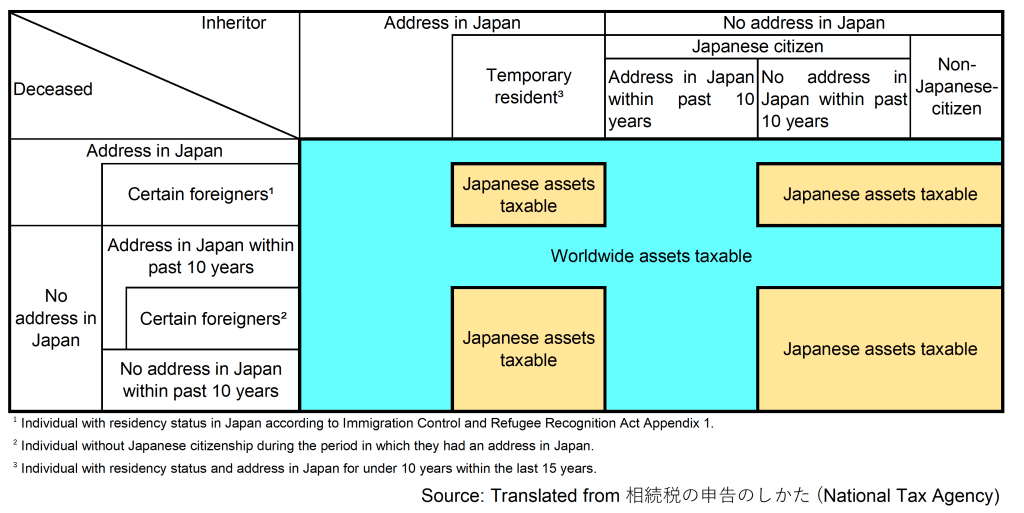
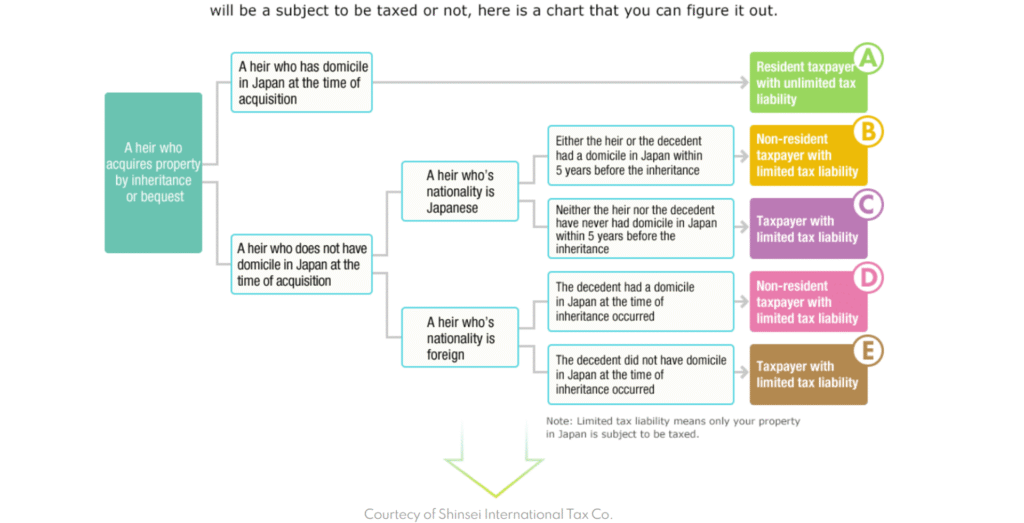
Who pays Japanese inheritance tax (and on what)?
Japan’s rules depend on residency, nationality and where the assets are. In broad terms:
- Japanese inheritance and gift tax generally applies to assets in Japan, wherever the people involved live.
- However, the tax can extend to worldwide assets, depending on where the deceased and heirs have lived and their status.
- Also, the NTA’s own valuation rules set the value of assets.
Deadline: the return is usually due within 10 months of death. Also, if you’re a U.S. person, the U.S.–Japan estate tax treaty helps avoid double taxation through credits and tie-breaker rules. However, rules can change, so it’s best to keep up to date.
The basic exemption from Japanese inheritance tax
In the UK, we have the nil rate band, which is an amount you don’t pay tax on. Similarly, Japan gives a large “off-the-top” deduction:
¥30,000,000 + ¥6,000,000 × number of statutory heirs. An example of this:
| Family configuration | Basic exemption |
|---|---|
| Spouse only (1 heir) | ¥36,000,000 |
| Spouse + 1 child (2 heirs) | ¥42,000,000 |
| Spouse + 2 children (3 heirs) | ¥48,000,000 |
| 3 children (no spouse) | ¥48,000,000 |
If the net estate (after debts, funeral costs and specific exemptions) is below this figure, there’s no Japanese inheritance tax to file or pay. In other words, it’s like the nil rate band, but it grows with the number of heirs.
By comparison, UK IHT is 40% above the nil rate band, which is why estate planning matters. Especially if you have assets in the UK and offshore, working out what you owe in the UK and where you live can become a logistical nightmare.
The spousal credit
The spouse’s inheritance bears no tax up to the greater of the spouse’s statutory share or ¥160,000,000.
Strictly, this is not an exemption from the estate. Instead, it’s a tax credit against the spouse’s tax, but the practical effect is the same: zero tax up to that cap.
Other key allowances/deductions
- Life insurance proceeds: ¥5,000,000 × statutory heirs is exempt for inheritance tax purposes (if the decedent paid the premiums).
- Retirement allowances paid within 3 years of death: same ¥5,000,000 × heirs’ exemption applies.
- Debts & funeral expenses: Deductible from the estate to reach the net estate.
Japanese inheritance tax bands (per heir)
First, Japan works out a “tentative total tax” on the whole taxable estate as if the statutory heirs had split it. Then it allocates and adjusts this tax. In practice, it’s easiest to think in per-heir brackets with deductions, as below.
| Taxable slice per heir | Rate | Deduction |
|---|---|---|
| Up to ¥10,000,000 | 10% | – |
| ¥10,000,000 – ¥30,000,000 | 15% | ¥500,000 |
| ¥30,000,000 – ¥50,000,000 | 20% | ¥2,000,000 |
| ¥50,000,000 – ¥100,000,000 | 30% | ¥7,000,000 |
| ¥100,000,000 – ¥200,000,000 | 40% | ¥17,000,000 |
| ¥200,000,000 – ¥300,000,000 | 45% | ¥27,000,000 |
| ¥300,000,000 – ¥600,000,000 | 50% | ¥42,000,000 |
| Over ¥600,000,000 | 55% | ¥72,000,000 |
These are the statutory rates and deductions in the National Tax Agency (NTA) method. You can check them on the NTA’s English tax pages.
How to work out Japanese inheritance tax (step by step)
Below are the steps in the order you work out the tax. I found this useful, so I wanted to share it with expats who live in Japan or own assets there.
- Value the estate at date of death (using NTA valuation rules).
- Subtract debts, funeral expenses, and specific exemptions (e.g., life insurance allowance).
- Compare to the basic exemption (¥30M + ¥6M × heirs). If below, stop, no tax.
- If above, compute the taxable estate and split it by statutory shares.
- Apply the progressive bands per heir to derive a tentative total tax, then allocate among actual heirs and apply credits (spousal, minors, disability) to get the final per-heir tax.
Worked example (numbers rounded)
Decedent leaves ¥150,000,000 net estate (after debts/funeral) and ¥10,000,000 of life insurance (premiums paid by decedent). Statutory heirs: spouse + two children (3 heirs).
Life insurance allowance: ¥5,000,000 × 3 = ¥15,000,000 → entire ¥10M policy is non-taxable.
So the net estate for the exemption test is ¥150M, because the ¥10M policy falls outside it.
Basic exemption: ¥30M + ¥6M × 3 = ¥48M → Taxable estate = ¥150M − ¥48M = ¥102M.
Split by statutory shares (spouse 1/2; two kids 1/4 each): Spouse: ¥51M; Child A: ¥25.5M; Child B: ¥25.5M.
Next, work out each heir’s tax from the bands. Then apply the spousal credit (up to the legal share or ¥160M). As a result, the spouse’s tax becomes zero, and only the children pay.
This is a simplified, hypothetical walk-through. Real returns include more steps, but it follows the same logic tax accountants use.
Gifts, the 7-year “clawback,” and planning
Japan has two parallel gift systems:
This is similar to the UK, where you can give certain amounts without IHT, and where the seven-year rule applies.
- Calendar-year gift tax: Everyone gets an annual ¥1.1M allowance per recipient. Above that, gift tax applies on a sliding scale, with lower rates for gifts from parents or grandparents to adult children or grandchildren.
- “Settlement at time of inheritance” system: For qualifying gifts from parents or grandparents (aged 60+) to adult children or grandchildren, you can choose a flat 20% gift tax after a lifetime ¥25M special deduction. Later, this gift tax counts as a prepayment of inheritance tax. So it fixes the gift’s value on the date you give it. However, you can’t reverse this choice.
Clawback rule (from 1 January 2024): gifts made within 7 years before death are generally added back to the estate at their value on the gift date. The extension from 3 to 7 years is being phased in, so the full 7 years only applies to deaths from 2031. For gifts made in years 4–7, there is a ¥1,000,000 total deduction from the added-back amount (a total cushion, not ¥1M per year). In addition, gift tax you have already paid is credited against the inheritance tax.
Japan’s approach to gifts is tiered, and so is the UK’s. You can read more about UK gifting on the gov.uk page Inheritance Tax: rules on giving gifts.
Personally, I like a tiered approach, because your heirs don’t pay the full amount if you pass away near the end of the period. Meanwhile, the UK has many rules on gifting. For example, you can give up to £3,000 a year without it counting in your estate, plus wedding gifts of up to £5,000 to a child.
Current gift tax bands (2025 snapshot)
For calendar-year gifts, the table below shows the NTA rates in practice. The “descendants” column is the lower schedule for gifts from parents or grandparents to adult children or grandchildren.
| Taxable gifts (¥) | Standard rate | Standard deduction | Lineal ascendant → descendant (18+) | Deduction |
|---|---|---|---|---|
| < 2,000,000 | 10% | – | 10% | – |
| 2,000,000–3,000,000 | 15% | ¥100,000 | 15% | ¥100,000 |
| 3,000,000–4,000,000 | 20% | ¥250,000 | 15% | ¥100,000 |
| 4,000,000–6,000,000 | 30% | ¥650,000 | 20% | ¥300,000 |
| 6,000,000–10,000,000 | 40% | ¥1,250,000 | 30% | ¥900,000 |
| 10,000,000–15,000,000 | 45% | ¥1,750,000 | 40% | ¥1,900,000 |
| 15,000,000–30,000,000 | 50% | ¥2,500,000 | 45% | ¥2,650,000 |
| 30,000,000–45,000,000 | 55% | ¥4,000,000 | 50% | ¥4,150,000 |
| ≥ 45,000,000 | 55% | ¥4,000,000 | 55% | ¥6,400,000 |
Tip: The settlement system (flat 20% after ¥25M lifetime deduction) can be attractive for large early transfers; it “freezes” values and converts the later inheritance tax to a reconciliation (crediting the 20% already paid). It’s an irrevocable election, so get bespoke advice before filing.
Legal ways to plan for Japanese inheritance tax
Below are mainstream, compliant planning approaches that families and advisers use. They rely on existing reliefs and valuation rules. To be clear, tax evasion is illegal, and I do not support it in any way. Planning within the rules is a different thing.
Exemptions, credits and insurance
Use the basic exemption efficiently: The exemption scales with the number of statutory heirs. Making sure your will aligns with the statutory share framework (or at least considers it) helps maximise relief.
Leverage the spousal credit: Structuring bequests so the spouse receives up to the statutory share (or ¥160M) can reduce immediate tax to zero for the spouse (with continued planning for second-death tax).
Position life insurance thoughtfully: Because ¥5M × heirs of death proceeds can be tax-free for inheritance tax (where the decedent paid premiums), policies can be calibrated to cover projected tax and reduce the taxable base. Coordinate policy owner/beneficiary/payer roles carefully.
Gifts and debts
Time and size lifetime gifts: Use the ¥1.1M annual exclusion per donee. For larger inter-generational transfers, consider the settlement system (¥25M lifetime deduction + 20% flat rate, valuation freeze) well in advance of the 7-year clawback window.
Debts and mortgages: Genuine debts and mortgages reduce the taxable estate. However, they must be real and properly documented, as artificial debt can be challenged.
Valuation, business and cross-border planning
Asset selection & valuation discipline: Japanese inheritance/gift tax requires valuations per NTA’s asset valuation Circular; understanding discounts and the correct approach to real estate, closely held shares, and certain rights is key. The tax authority can substitute fair value if the Circular is applied “materially inappropriately,” so professional appraisal discipline is critical.
Business succession regimes (for owners of unlisted SMEs): Japan provides special deferral/relief frameworks for qualifying business succession of non-listed shares (subject to stringent eligibility/filings that evolve in annual tax reforms). If you own a family company, this channel can be a transformative plan early.
Cross-border coordination: If you have assets or heirs in multiple countries, treaties (e.g., the U.S.–Japan treaty) and foreign tax credits can prevent double taxation—but the sequence of filings and elections matters. Align wills and beneficiary designations across jurisdictions.
Putting it all together
Your assets and your heirs
Inventory and valuation: First, build one list of all your assets, including those overseas. Get indicative NTA-style valuations for real estate and private shares. As an expat, your assets will usually be spread across countries, so a clear written tracker is important. Also, make sure your heirs know about your investment accounts and that the list stays up to date.
Heir map and will: Next, decide who gets what, and why, with an eye on statutory shares and the spousal credit. Making this clear also avoids a lot of disputes.
Do a dry run: Some people do this to see what their beneficiaries will pay, while others are more relaxed. Even so, it’s good practice to apply the basic exemption and then the per-heir bands to see a first estimate. You can then adjust bequests to reduce high-rate slices.
Insurance and gifting
Layer life insurance: Use the ¥5M × heirs life insurance allowance to cover expected tax and give heirs cash when they need it. Also, make sure the premiums fit your current budget.
Start gifting early: Use ¥1.1M annual gifts and, where suitable, the settlement system to move growing assets more than 7 years before death (noting the ¥1M cushion for years 4–7). Bear in mind that once you give assets away, they become part of the recipient’s estate. So there may be other ways to protect them.
Records and reviews
Debts and ownership: Make sure genuine debts are documented. Also review property ownership, beneficiary designations and international accounts. For example, you may have mortgages on properties in different countries, and your heirs need to know about them.
Document everything: As mentioned before, keep gift records, valuations and insurance contracts organised, as these are critical for the 7-year lookback. It sounds silly. However, when solicitors and lawyers ask for evidence of gifts, you will be glad you kept a receipt or a signed document. Bank statements can also provide a lot of evidence.
Review every year: Japan’s annual tax reforms often tweak the rules. So revisit your plan after any major life event or law change.
Quick reference tables
A table for inheritance tax bands (per heir)
| Slice per heir | Rate | Deduction |
|---|---|---|
| ≤ ¥10M | 10% | – |
| ¥10M–¥30M | 15% | ¥0.5M |
| ¥30M–¥50M | 20% | ¥2.0M |
| ¥50M–¥100M | 30% | ¥7.0M |
| ¥100M–¥200M | 40% | ¥17.0M |
| ¥200M–¥300M | 45% | ¥27.0M |
| ¥300M–¥600M | 50% | ¥42.0M |
| > ¥600M | 55% | ¥72.0M |
Table for core allowances & credits
| Item | Amount / rule |
|---|---|
| Basic exemption | ¥30M + ¥6M × statutory heirs |
| Spousal credit | No tax on spouse’s share up to statutory share or ¥160M (whichever larger) |
| Life insurance allowance | ¥5M × statutory heirs (inheritance tax) |
| Annual gift exclusion | ¥1.1M per recipient |
| 7-year gift lookback | Gifts in 3 years before death fully added back; gifts in years 4–7 added back minus ¥1M total cushion |
FAQs about Japanese inheritance tax
Not really. It applies only to the highest slices. With reliefs and splitting by statutory shares, effective rates are often far lower.
No, if the net estate after specific exemptions is below the basic exemption, there’s no filing. (Edge cases exist—always confirm.)
No. The clawback is about including gifts in the inheritance tax base; the settlement system just changes how gifts are taxed and credited. Planning early is still essential.
Generally, within 10 months of death.
Conclusion
Japanese inheritance tax looks fierce on paper, with rates up to 55%. However, the reliefs are generous: the basic exemption, the spousal credit and the life insurance allowance. Together with early, documented gifting, many families can plan for a much smaller bill, and some will pay none.
If your assets include real estate, private company shares or cross-border holdings, the details will drive the outcome. These include the valuation method, evidence of debts, lookback timing and treaty rules. That’s where a tailored plan and specialist tax advice really help. If you’d like to talk it through, book a free discovery call.
This article is general information, not tax or legal advice. Japanese and UK rules can change and depend on your circumstances, so take specialist advice in each country.
- Moving to Portugal from the UK: Tax, Pensions and Money
- Moving to Spain from the UK: A Financial Checklist
- Moving to Dubai from the UK: Money, Pensions and Tax
- P85 Form: How to Tell HMRC You Have Left the UK
- Statutory Residence Test Explained for UK Expats
Free tools for this topic
All free tools →Free, no sign-up, nothing stored.

Henry Temple-Baxter
Henry Temple-Baxter is the founder of Investments for Expats and is CISI Level 4 qualified. A long-term expat himself, he has lived and worked in Kuala Lumpur, Beijing, Bangkok, Hong Kong and Ho Chi Minh City. He set up the firm in 2018 to give UK expats fee-only, transparent advice on pensions, tax and investing abroad.
This guide is general information, not personal advice. Tax rules can change and their effect depends on your circumstances. Capital at risk.